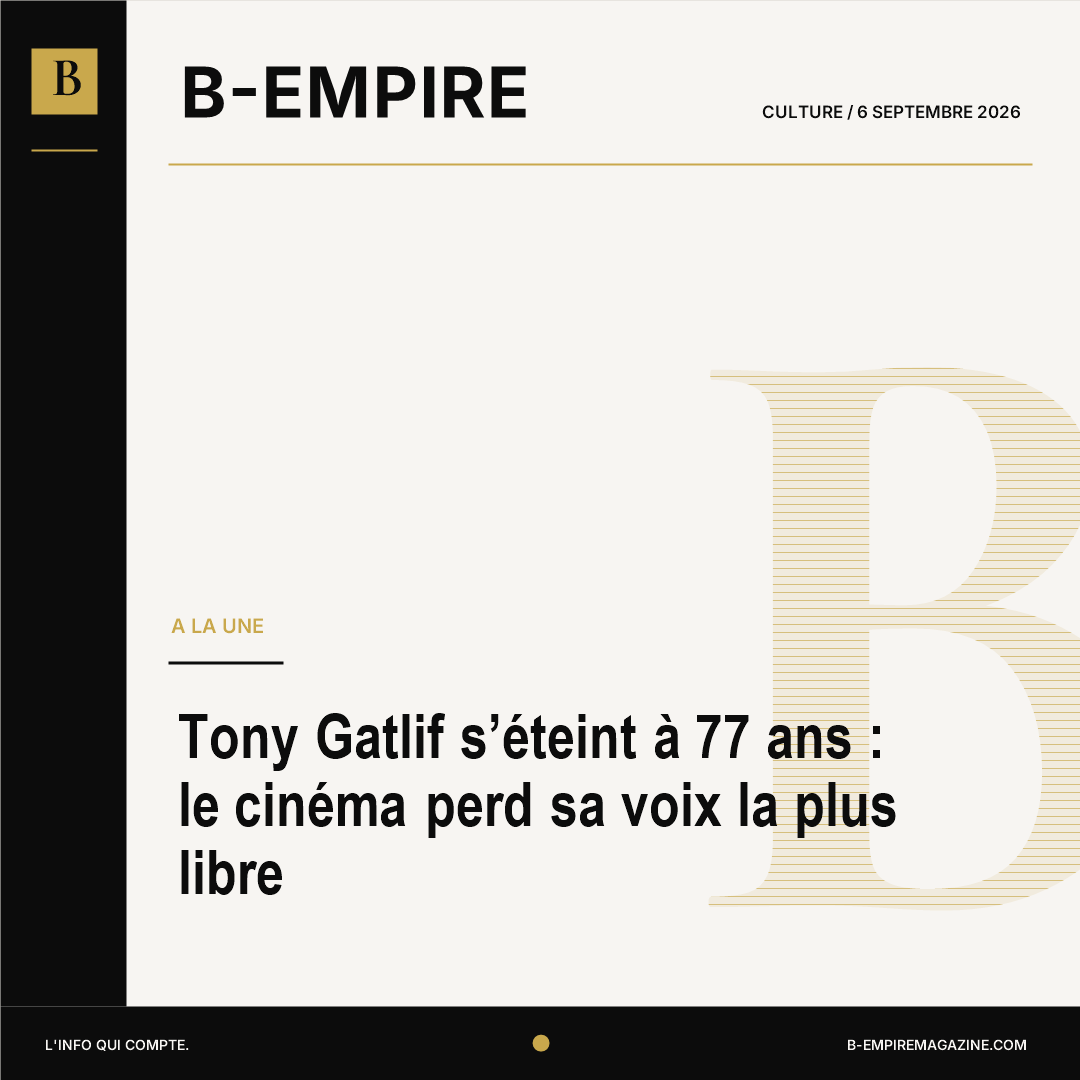
Cinema has lost a man who refused borders. Tony Gatlif, the French-Algerian director of Gadjo Dilo, Latcho Drom and Exils, has died aged 77 in Arles while still developing a historical film project. His family announced the news on September 4, paying tribute to his generosity, poetry and love of music. More than a filmmaker has disappeared: a singular chapter closes for an artist who placed Roma peoples, exile and marginalized lives at the center of the screen.
His work was neither a folklore museum nor a collection of picturesque postcards. It moved to the rhythm of trains, roads, celebrations and wounds. Gatlif filmed bodies before speeches and songs before explanations. That storytelling crossed France, Romania, Spain, Algeria and Greece, giving his cinema an immediately international reach.
A Final Journey Interrupted in Arles
According to AFP and several European outlets, Tony Gatlif died following a health issue in the Provençal city where he was preparing a historical film. The detail is poignant because it fits his entire trajectory: until the end, the director was searching for another story and another passage between memory and the present. Arles, the Camargue and the Roma world held an intimate place in his life far beyond their value as scenery.
Born Michel Dahmani in Algiers on September 10, 1948, to a Kabyle father and a mother of Roma origin, he experienced poverty, street life and exile to France at a young age. His adolescence was marked by institutions and instability. His discovery of theatre, followed by an encounter with actor Michel Simon, opened a way forward. This history explains why his films never look down on their characters: he knew the violence of labels and the vital need to be seen differently.
Gadjo Dilo Turned the Foreigner Into a Brother
For much of the public, Tony Gatlif’s name remains inseparable from Gadjo Dilo, released in 1997 with Romain Duris and Rona Hartner. The film follows a young Frenchman who travels to Romania looking for a singer heard on a cassette. His journey brings him into a Roma community whose language and codes he does not understand. Instead of explaining the encounter from a distance, Gatlif transforms it into an experience of desire, awkwardness, celebration and grief.
The film’s success showed that a story rooted in a culture often reduced to stereotypes could resonate far beyond its territory. The gaze changes sides: the outsider is no longer only the person branded as different by mainstream society. He is also the Western visitor, lost inside a world he assumed he could quickly understand. That reversal remains strikingly modern.
Music as a Universal Language
In Gatlif’s cinema, music does not merely accompany the image; it acts upon it. In Latcho Drom, it connects Roma communities from India to Spain and tells the story of migration without a heavy voice-over. In Vengo, flamenco becomes a dramatic force. In Djam, rebetiko carries the memory of displacement between Greece and Turkey. Songs and instruments preserve what official history forgets.
This intuition allowed his films to travel. Even when dialogue escaped the viewer, rhythm, gestures and glances remained legible. Gatlif understood that music can transport an identity without reducing it to a slogan. It made his characters present, complex and impossible to confine to the role of victims.
Exils, Cannes and International Recognition
In 2004, Exils won the directing prize at the Cannes Film Festival. The film follows two young French people traveling toward Algeria, retracing the family journey of exile in reverse. The award did not tame Gatlif. It confirmed that physical, musical and politically restless cinema could command attention on the world stage.
Across roughly twenty-five films, he continued to explore borders, expulsions, racism and freedom. Liberté, released in 2010, revisited the persecution of Roma people during the Second World War while echoing contemporary debates in France. Geronimo observed a youth worker trying to prevent conflict between two communities. His work rejected comfortable neutrality, but it also avoided lessons drained of human life.
Why His Death Reaches Beyond French Cinema
Tony Gatlif’s death comes at a time when identity, migration and belonging sit at the heart of European tensions. His films remind viewers that a culture cannot be reduced to an origin or a statistic. It lives in language, rhythm, family memory, a way of occupying space and a response to the gaze of others.
His legacy also matters to the global industry. Gatlif proved that an auteur could work with familiar performers such as Romain Duris or Céline Sallette without erasing lesser-known faces or turning a community into exotic decoration. For a new generation of filmmakers shaped by diasporas, that freedom remains a model: begin with the specific and reach the universal without asking permission to simplify identity.
The Signal His Work Leaves Behind
Tony Gatlif does not leave a perfectly tidy filmography. He leaves something better: a living, sometimes rough body of work propelled by movement. His films ask viewers to listen before judging and to see those whom dominant narratives push outside the frame. At a time when content is calibrated to be understood in seconds, that demand is precious.
His family wished him “Latcho Drom,” meaning a safe or good journey. The phrase gave its title to one of his best-known films and now summarizes his legacy. Tony Gatlif’s road ends in Arles, but the music, faces and anger he filmed continue to circulate. Cinema loses a free voice; the people he made visible retain a witness the screen will not allow to disappear.