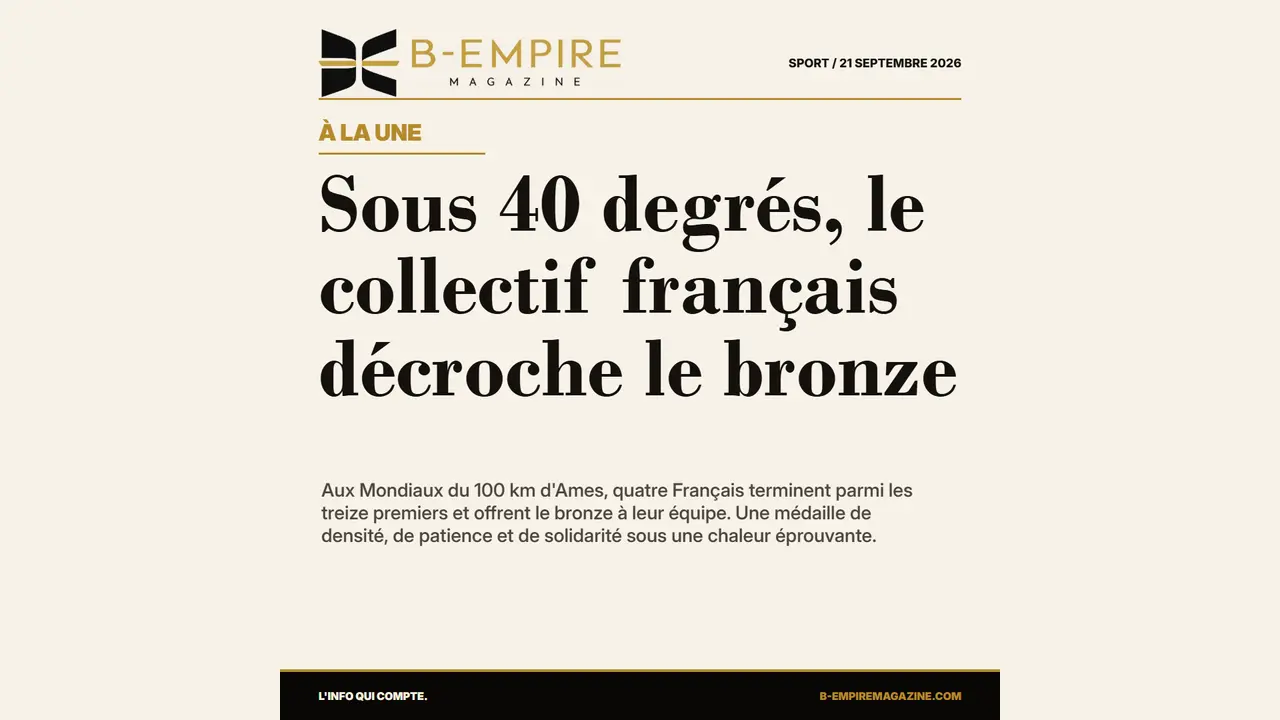
Over 100 kilometres, a medal can be won without placing an athlete on the individual podium. In Ames, Galicia, the French men’s team proved it through remarkable depth. Jason Pointeau finished fifth in 6:24:34, Steven Galibert sixth in 6:25:30 and Justin Dourlens eleventh in 6:32:48. Their three combined times earned France the world team bronze medal behind the United States and Great Britain.
Jan Gutermann, thirteenth in 6:34:16, completed France’s presence near the front. Four runners separated by less than ten minutes after more than six and a half hours of effort tell the story better than any isolated breakthrough. The result reveals a team capable of occupying the race for its full duration, limiting major collapses and converting consistency into an international medal.
A Medal Calculated by Time and Built Over Distance
The team ranking adds the times of each nation’s first three finishers. In that arithmetic, every minute lost by one athlete immediately affects the collective total. France finished in 19:22:48 according to the results published by the French Athletics Federation, roughly five minutes behind the Americans and British. The gap is narrow enough to underline the quality of the French performance, yet clear enough to show the demands of this discipline.
Charlie Lawrence, the individual world champion in 6:09:25, drove the American victory. Great Britain relied on Alex Milne’s third place. France needed no individual medallist: it put two men in the top six and a third just outside the top ten. This is another way to control competitive space, less spectacular at first glance but especially resilient in a championship where depth matters as much as the leading edge.
Running Together Without Running the Same Race
The French federation reported that runners who entered with similar personal bests stayed together and supported one another through part of the event. Over such a long distance, that choice does not mean surrendering individual ambition. It can provide a shared pace, reduce mental strain and offer reliable reference points when the perception of effort begins to become less dependable.
The group then works like a moving infrastructure. One athlete protects the tempo, another signals the next feeding point, and a third holds the rhythm when the others cross a difficult patch. Each remains responsible for his own body and race, yet nobody is entirely alone against the distance. The closeness of Pointeau’s and Galibert’s times illustrates that logic: they finished less than a minute apart, immediately behind the expanded podium positions.
Heat Changes the Meaning of Performance
The Ames 100km was not simply a contest against the clock. The French federation said the apparent temperature reached 40 degrees Celsius during the afternoon. Under those conditions, the best strategy is no longer merely the one that maximises speed. It must protect the athlete’s ability to cool the body, absorb carbohydrates, drink according to an individual plan and retain enough clarity to adjust the effort.
World Athletics guidance stresses heat acclimatisation, pre-race cooling and hydration plans rehearsed in training. It also warns against overhydration, which can cause a dangerous reduction in blood sodium. The objective is therefore not to drink as much as possible, but to adapt intake to fluid loss, duration and personal tolerance. Over 100 kilometres, that precision becomes a sporting skill in its own right.
The French race also showed the cost of those conditions. Benjamin Polin withdrew at kilometre 76 after enduring digestive pain for much of the event. In the women’s race, Camille Chaigneau stopped at kilometre 60 following heat illness, according to the federation. These withdrawals are not an inconvenient counter-story to erase behind the medal. They remind us that finishing is never guaranteed and that safety must remain more important than any demand for a result.
Two French Women in the Top Ten
The women’s performance deserves attention as well. Malory Leroy finished eighth in 7:24:07 and Selina Leroy ninth in 7:26:29. Placing two French athletes inside the top ten of a world championship is a strong result even without a team medal. Their presence confirms that French ultradistance running does not depend on a single generation or one type of athlete.
It also clarifies the nature of the national ranking: it rewards the balance between individual excellence, depth and the ability to bring enough athletes to the finish. A team can produce two major performances and still miss the podium without a third finishing time. That rule turns an apparently solitary race into a collective problem of preparation, selection and risk management.
French Ultrarunning Gains Visibility
The 100km remains less visible than the marathon or trail running even though it combines highly legible qualities: endurance speed, nutritional discipline, mental resilience and team tactics. The times recorded in Ames provide a concrete measure of that intensity. Covering 100 kilometres in 6:24 means maintaining an average pace close to 3:51 per kilometre, repeated one hundred times in difficult conditions.
For France, the bronze medal can become a foundation. It recognises athletes who often compete far from the largest commercial circuits and makes the work of coaches, support crews and medical teams visible. It also carries a lesson that transfers across elite sport: when the format combines performances, cohesion is not a moral extra. It becomes a measurable strategy.
The Power of a Result Without a Single Hero
The Ames medal has a distinctive narrative value. It does not depend on a spectacular reversal in the final metres or on an established star. It emerged from a compact group, decisions repeated over several hours and the ability to remain connected without preventing each athlete from producing his own race.
Pointeau, Galibert, Dourlens and Gutermann gave the French bronze a coherent shape: a nation present throughout the upper reaches of the standings. In heat that made every decision more expensive, they showed that ultrarunning performance is not only the art of travelling far. It is also the art of preserving enough strength, method and solidarity for several individual journeys to become one shared result.