
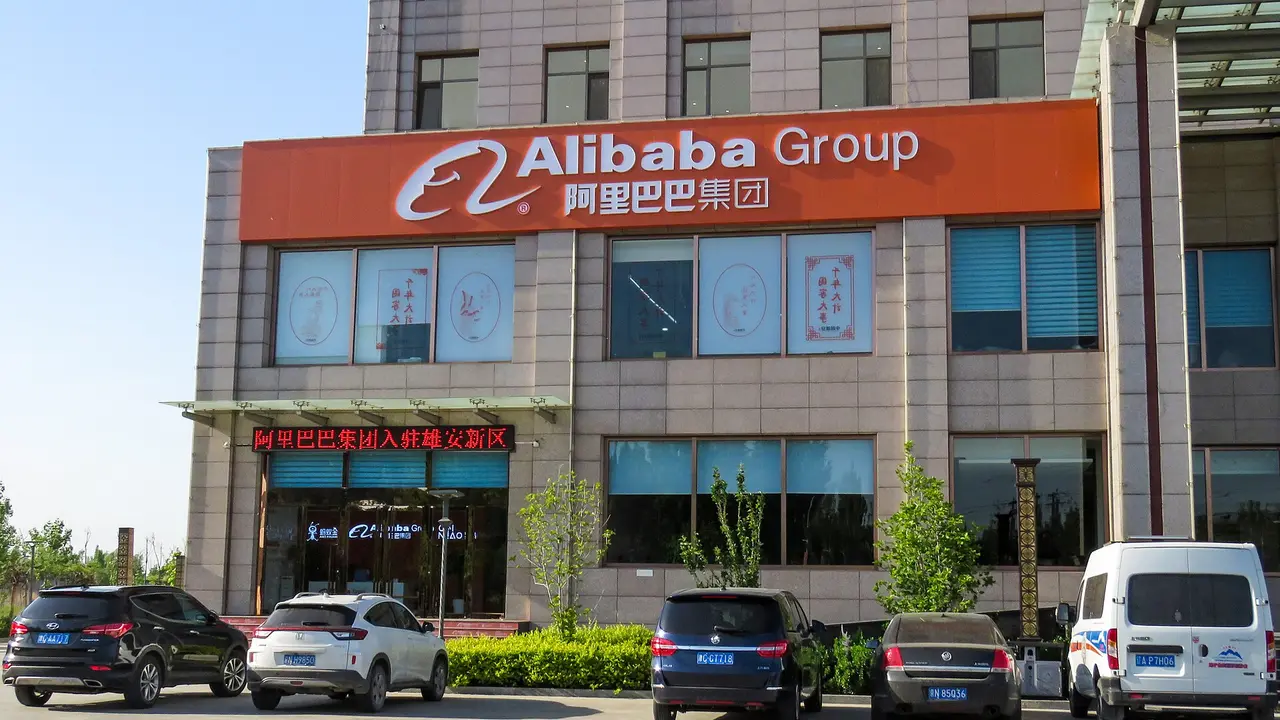
Ten billion dollars to ensure the digital future is not written without it. Alibaba announced on Sunday, August 23, 2026, its intention to place new shares in Hong Kong for a total amount of HK$80 billion, approximately US$10.2 billion. The Chinese group claims it intends to dedicate 100% of the net proceeds from the operation to its artificial intelligence capabilities, particularly the expansion of its infrastructure. This is not merely a fundraising effort: it is a declaration of power in a global race that now mobilizes staggering sums.
The operation remains subject to market conditions, but its scale is already sufficient to send a message to investors, competitors, and governments. Alibaba aims to consolidate its position in cloud computing, AI models, and computing power at a time when demand is exploding and access to advanced chips is becoming strategic. China does not merely want to use artificial intelligence: it wants to have the infrastructure capable of producing it on a large scale.
HK$80 billion for a single priority
In its official statement, Alibaba specifies that the placement targets non-American investors as part of operations conducted outside the United States. The group has not yet detailed the exact allocation between data centers, semiconductors, foundational models, or cloud services. However, it sets an unambiguous destination: all net funds must support its so-called “full stack” AI capabilities, from infrastructure to applications.
According to Bloomberg, this issuance could become the largest stock sale conducted in Hong Kong since 2021. Reuters notes that it would rank among the largest primary follow-on offerings of the year globally. The choice of equity rather than additional debt shows that Alibaba is willing to share the immediate cost of its offensive with its shareholders. It also involves a risk of dilution, a classic trade-off of capital financing.
Why Alibaba is accelerating now
The timing is no coincidence. Three days before the announcement, Alibaba released quarterly results that perfectly illustrated the tension of its new model. Its revenue for the April-June period grew by 9%, reaching nearly 269 billion yuan. The revenues from its cloud and AI-related computing activities reached approximately 48.4 billion yuan, or US$7.2 billion, with a growth rate of 45%.
However, this acceleration comes at a high cost. Investment expenditures for the quarter surged by 75%, to 67.7 billion yuan, nearly US$10 billion. At the same time, quarterly profit plummeted by 75%, to 10.5 billion yuan. The contrast is stark: AI brings growth, but it requires machines, energy, networks, and buildings before generating sustainable margins.
The battle is no longer just about models
The general public primarily sees conversational assistants and image generators. Industrial players, however, look at the hidden layer: chips, servers, cooling, electricity, fiber optics, and management software. Owning a high-performing model is no longer sufficient. It is essential to be able to train it, deploy it for millions of users, and guarantee businesses a secure, available, and affordable capacity.
Alibaba has a significant advantage in China thanks to Alibaba Cloud and its family of Qwen models. The group can connect research, infrastructure, e-commerce, and professional uses. Its challenge lies in transforming this integration into regular revenues while supporting massive investments. The US$10.2 billion sought is precisely aimed at shortening the gap between technological ambition and industrial capacity.
A new front in the US-China rivalry
This offensive must also be viewed in a geopolitical context. Microsoft, Amazon, Alphabet, and Meta are collectively planning hundreds of billions of dollars in investment spending in 2026, largely directed towards data centers and AI. In the face of this American financial power, Chinese groups must secure capital, develop their own technological chains, and navigate export controls on certain advanced components.
Alibaba does not claim to catch up with the entire American ecosystem alone. However, it demonstrates that China still has companies capable of raising amounts comparable to the annual cost of a vast national program. Hong Kong regains a central role in this strategy: the financial hub allows for mobilizing international investors while remaining connected to the Chinese market.
What the operation could change for Asia
If the placement succeeds, the impact will extend beyond Alibaba. Increased cloud capacity in Asia can reduce access times to AI services, support regional startups, and accelerate the digitization of sectors such as logistics, finance, commerce, and industry. Developers using Qwen could also benefit from a broader ecosystem around the group’s open models.
However, this expansion could also increase pressure on energy and electrical networks. Data centers have become critical infrastructures but also major consumers of electricity and water. Therefore, Alibaba’s success will be measured as much by the performance of its models as by its ability to build reliable, cost-effective computing power that is compatible with local environmental constraints.
The bet carries an immediate risk for shareholders
The issuance of new shares mechanically dilutes the holdings of current shareholders if their economic rights do not progress at the same pace. The market will need to assess the placement price, the final number of shares, and the speed at which investments will generate revenues. The group already has significant liquidity, making its choice even more revealing: Alibaba seems to want to preserve its financial flexibility as the cost of AI continues to rise.
The strategic risk is equally real. The industry is evolving rapidly, computing prices may decline, and no player yet knows which business models will dominate. Investing too little exposes one to obsolescence; investing too early or without discipline can destroy value. Alibaba is thus asking investors to believe that its lead in the Chinese cloud and the dissemination of Qwen justify a long-term bet.
Why Europe and France need to pay close attention
For France and Europe, this announcement highlights the scale gap that separates political ambitions from industrial means. The continent has researchers, electricity suppliers, data center operators, and several leading young companies. However, it still needs to convert these strengths into financing and deployment capabilities comparable to those of American and Asian giants.
European companies will also face an increasingly complex choice between American clouds, Chinese offerings, and sovereign solutions. Price criteria alone will not suffice. Data localization, cybersecurity, regulatory compliance, and technological dependence will weigh heavily in every decision. Alibaba’s expansion could stimulate competition, but it will also make the issue of digital sovereignty even more urgent.
The figure that reveals a changing era
A few years ago, a raise of US$10 billion could have financed acquisitions, commercial expansion, or share buybacks. In 2026, Alibaba wants to dedicate this amount solely to building its future in artificial intelligence. This concentration says it all: computing power is becoming a strategic asset on par with transportation networks or energy resources.
The placement is not yet complete, and its final conditions will need to be monitored. But the signal is already global. Alibaba believes that inaction would cost more than dilution and that the next technological hierarchy will be decided now. In the AI battle, the size of models matters. Now, the size of the balance sheet matters just as much.
Sources
- Alibaba Group, official announcement of the share placement, August 23, 2026
- Reuters, proposed placement of HK$80 billion, August 23, 2026
- Bloomberg, scope and financial context of the operation, August 23, 2026
- Associated Press, quarterly results and AI spending of Alibaba, August 20, 2026
- Alibaba Group, annual report and Qwen/cloud strategy, May 2026