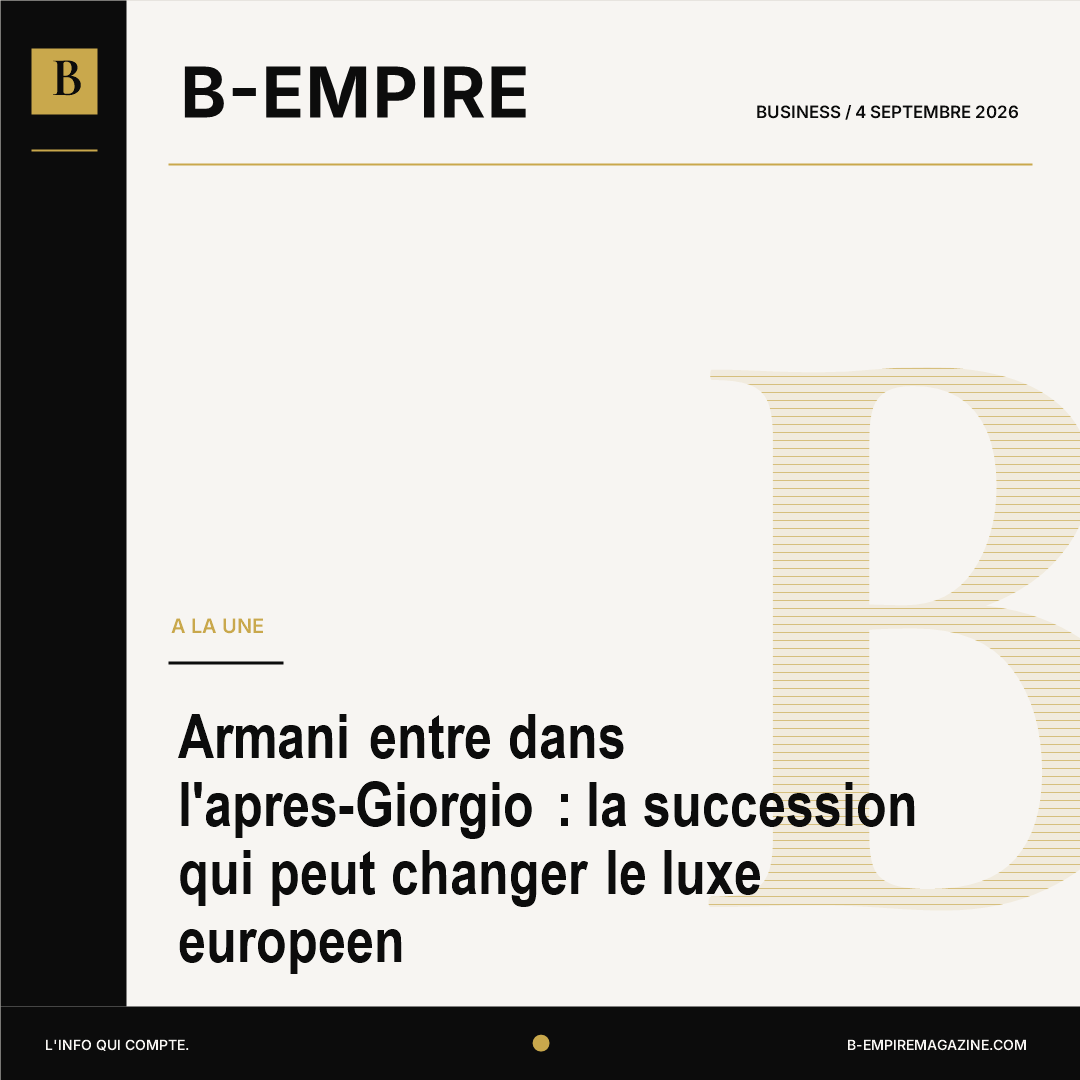
One year after Giorgio Armani’s death, the house he built is entering a delicate zone: the point at which heritage must learn to operate without its creator. According to Reuters, published on September 4, 2026, the Italian group is approaching the countdown for an initial stake sale set out in the founder’s will. The scenario mentioned is about 15% of the company between twelve and eighteen months after his death, followed by a larger disposal or a stock-market listing. For Armani, this is not just a financial operation. It is a civilizational test for a brand that long fused style, control and independence with rare elegance.
In a luxury industry under pressure, the case carries special resonance. The potential buyers named in the will, LVMH, L’Oreal, EssilorLuxottica or another group of comparable standing, are not looking at Armani as a simple label. They are looking at a rare architecture: a global fashion house, still highly identifiable, connected to beauty, eyewear, hospitality, accessories and an Italian imagination that is almost institutional. A minority stake could therefore become the beginning of a new balance of power between the Armani family, historic licensing partners and Europe’s major luxury empires.
A House Built on Control
Armani’s uniqueness begins with discipline. Giorgio Armani imposed a recognizable silhouette: clean, fluid, urban, less theatrical than many of his Italian competitors. But he also imposed a method. For decades, he kept the house outside the major takeovers that restructured the sector. While other brands moved under conglomerate ownership, Armani remained associated with personal authority, almost artisanal in its decision-making logic.
That model created coherence. It also created an unavoidable question: what happens to a company so closely tied to one eye when that eye is no longer there? The first year was devoted to governance. Reuters reports that Giuseppe Marsocci, a group veteran who became chief executive, is preparing a new business plan. Former Gucci chief executive Marco Bizzarri is among the new board directors. The signals are cautious, but they already say one thing: the house knows that immobility cannot be a strategy.
The Sale as a Transition Tool
The sale of around 15% of the capital, if confirmed, will carry symbolic as well as economic weight. It will not be enough to transfer control. It will, however, be enough to choose a partner, frame the future and set a public valuation for the legacy. According to Reuters, bankers and advisers value the group at between 5 and 7 billion euros, while the company held around 500 million euros in net cash at the end of 2025. This is not the case of a house in distress. It is the case of a house that must organize its strength before the market imposes its own tempo.
The timetable is not mechanical. Reuters had already reported in August, in an article carried by Euronext, that the sale could be delayed if market conditions did not support a sufficiently favorable transaction. That flexibility matters. Luxury has faced several quarters of softer demand, notably because of cautious Chinese consumers and a tense geopolitical environment. Selling quickly would signal respect for the will. Selling too quickly could reduce the prestige premium of a house that does not need to rush.
Three Suitors, Three Logics
LVMH, L’Oreal and EssilorLuxottica embody three different readings of Armani. LVMH has scale, fashion experience, distribution, retail real estate, investment capacity and a portfolio culture. For the French giant, Armani would be a highly strategic prize, but also a sensitive one: the house was built on an independence that full control could weaken in the public imagination.
L’Oreal reads Armani differently. The beauty group protects a long and profitable relationship around fragrances and cosmetics. Reuters reports that the beauty licence runs until 2050 and that L’Oreal says it is ready to study the opportunity whenever Armani representatives open the discussion. For L’Oreal, a stake would not need to turn the group into an integrated fashion house. It could mainly secure an asset of desire, a brand language and a revenue source regarded as solid.
EssilorLuxottica, for its part, sees Armani through eyewear, one of the most powerful entry points in contemporary luxury. Eyewear combines relative accessibility, margin, repeated purchase and immediate visibility. At a moment when consumers are making sharper spending choices, these entry categories become essential. A small holding could consolidate the licence without forcing the group to carry the full complexity of a fashion house.
The Risk of Inertia
The real danger for Armani is not betraying its DNA. It is excessive respect. A heritage house can protect itself so strongly that it slows down its own desirability. The Armani style remains readable, but the market has changed. Young customers discover brands through TikTok, red carpets, collaborations, revived archives, bags, eyewear and fragrance before they ever engage with ready-to-wear. The house must therefore speak to a generation that knows Giorgio Armani as myth, not as daily presence.
This is where succession becomes cultural. The aim is not to turn Armani into a noisy brand. That would probably be a mistake. The aim is to make its minimalism active again: less as nostalgia for discretion, more as a response to the visual overload of the age. Quiet luxury has proved that it can become powerful again. Armani has immense legitimacy in that grammar. But it must be interpreted, not merely preserved.
Hospitality as a Signal
Giuseppe Marsocci cited, according to Reuters, a joint venture to develop Armani Hotels and Resorts as an example of future strategy. That detail matters. Hospitality is not a decorative extension for a brand like Armani. It allows style to be embodied in space, service, light, food, silence, rooms and ritual. When fashion becomes more volatile, hospitality gives luxury a physical duration.
This route fits a broader trend: houses no longer want only to sell products, they want to organize worlds. But hospitality requires capital, partners, operational rigor and a property vision. A minority investor could help finance such expansion, provided it does not dilute the precision of the brand. The challenge is always the same: grow without losing the tone.
Why Europe Is Watching
Armani is a European asset in the fullest sense. If a stake went to LVMH, the center of gravity of continental luxury would concentrate even more around Paris. If L’Oreal or EssilorLuxottica emerged as minority partners, the case would confirm the power of licences and accessible categories in the economy of desire. If Armani ultimately chose the stock market, the house would send another message: one of independence organized through public markets, with all the risks of quarterly transparency that implies.
Each option tells a philosophy. The conglomerate promises scale. The licence partner promises commercial continuity. The IPO promises institutional autonomy, but exposes the house more directly to investor sentiment. The Armani family and foundation will have to choose not only a price, but a form of future.
Luxury After Founders
The question reaches beyond Armani. Many luxury houses live with the tension between memory and renewal. Founders give a voice, but companies must then turn that voice into a system. Chanel, Saint Laurent, Dior, Gucci and Valentino have each experienced, in their own way, the passage from incarnation to institution. Armani arrives there with an added difficulty: its creator was not only the face, but also the ultimate guardian of measure.
The house therefore needs a precise evolution, almost musical in character. Too little, and it risks becoming a respected monument that is less desired. Too fast, and it risks losing the sobriety that makes it different. The next partner, if there is one, will need to understand that fine line. Buying a stake in Armani is not buying a simple growth opportunity. It is entering a grammar.
A Test for the Value of Desire
The market will soon put a number on Armani. But that number will not say everything. The real value of the house lies in a form of trust: the trust of customers who associate the name with lasting elegance, the trust of partners exploiting licences, the trust of teams that must keep the brand alive without its founder, and the trust of heirs who must respect the will without becoming prisoners of the timetable.
Armani is therefore entering its most modern moment. Not because it must break with Giorgio Armani, but because it must prove that its style can survive Giorgio Armani’s absence. In luxury, immortality is never granted by the archive. It is earned every season, every store, every fragrance, every image. The coming stake sale will say who enters the capital. The real verdict will say whether one of Europe’s last great independent houses knows how to become a living institution.
Sources
- Reuters via Investing.com, September 4, 2026, on Armani succession, the stake sale and potential buyers.
- Reuters via MarketScreener, September 4, 2026, on governance, valuation and the L’Oreal and EssilorLuxottica licences.
- Reuters via Euronext, August 11, 2026, on the possibility of delaying the sale if market conditions remain difficult.
- Sowetan Live carrying Reuters, September 4, 2026, on the timetable, the 5 to 7 billion euro valuation and possible partners.