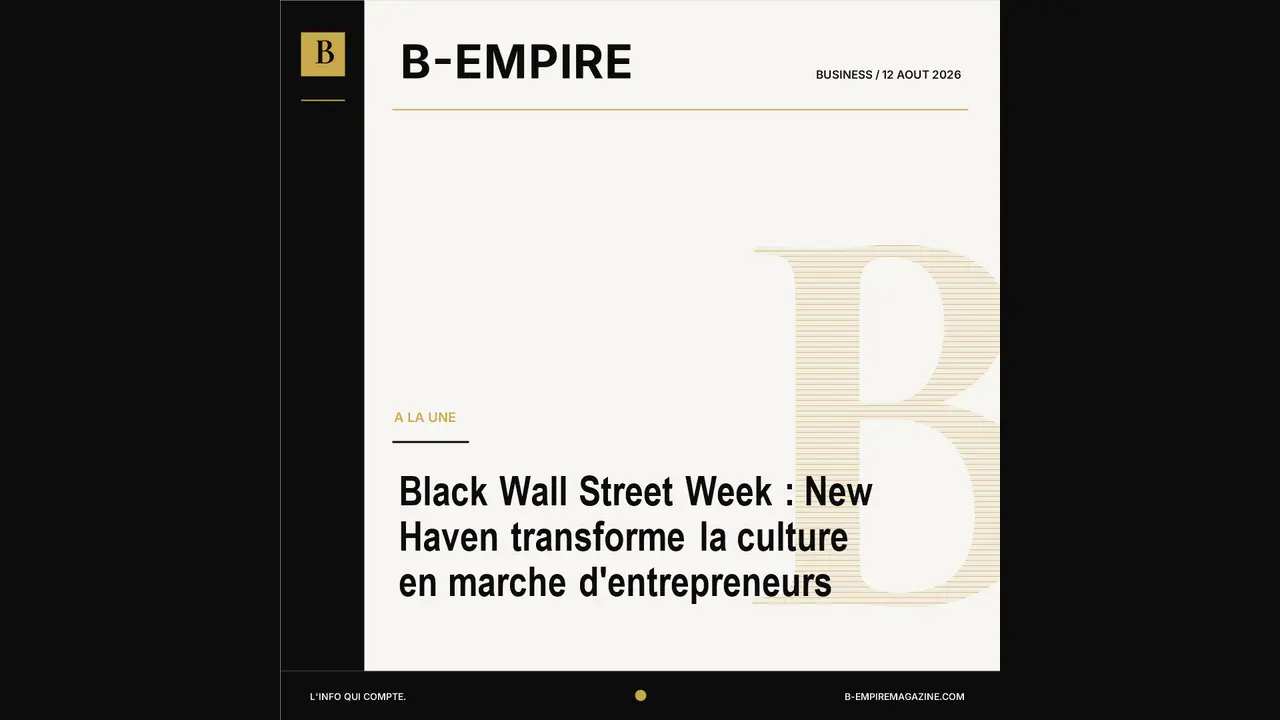
Black Wall Street Week 2026 began in New Haven on August 9 and runs through August 16, with its central moment announced for August 15 on the New Haven Green. For B-EMPIRE, this is not merely a cultural calendar item in Connecticut. It is a business signal: community festivals are becoming platforms for distribution, legitimacy and social capital for Black and Brown entrepreneurs who build an audience before chasing scale.
According to CT Insider, this fifth edition brings together a week of events around creativity, food, fashion, networking, music and economic mobilization. The official BWS Fest website presents the festival as a strategy to spotlight Black and Brown business owners and creatives while strengthening local economic wealth. The formula is simple, but powerful: take a public place, turn it into a cultural marketplace, then let attention, purchases and relationships circulate through it.
When a festival becomes commercial infrastructure
The heart of the event is the Black Wall Street Fest on Saturday, August 15, announced from noon to 8 p.m. on the New Haven Green. CT Insider reports more than 400 vendors, including more than 300 Connecticut-based businesses. That number changes the nature of the gathering. This is no longer a simple festive stage where a few stands decorate the experience. It is a large-scale market operation, where music, food, clothing, services, art and political conversations share the same space.
For a small brand, that density is almost a media campaign. The customer sees the product, meets the founder, feels the atmosphere, posts online and returns with friends. The festival creates a form of trust that digital advertising buys with difficulty. In an economy where acquisition costs are rising and platforms change their rules without warning, a well-organized physical space becomes a kind of commercial sovereignty.
The power of the dollar as programming
The official program is not limited to the large Saturday gathering. The attendance page mentions a restaurant week, a film screening, an opening reception, an economic summit with a pitch competition, a fashion show, an entrepreneur party and a closing brunch. The message is clear: consumption is only part of the story. The festival also wants to produce training, visibility, connections and a culture of local investment.
That is the difference between celebrating a community and building an ecosystem. A fashion creator can meet a photographer. A restaurant owner can win customers for after the weekend. A nonprofit can attract volunteers. A sponsor can measure its alignment with a real audience. An entrepreneur can hear a question that forces the offer to improve. In this kind of event, value is not limited to the day’s revenue: it continues through contacts and reputation.
New Haven is writing its own creative grammar
New Haven does not need to copy Brooklyn, Atlanta or Los Angeles in order to exist in America’s Black cultural economy. Its strength can come from another scale: a university city, a port city, a dense city capable of bringing institutions, neighborhood businesses, young creators and families together around a symbolic center. The Green becomes more than scenery here. It becomes a meeting point between memory, commerce and ambition.
The name Black Wall Street carries obvious historical weight. It evokes Tulsa, Black entrepreneurship, racial violence and the question of economic reconstruction. But the interest of the 2026 edition is that it avoids pure symbolism. Organizers speak about vendors, sponsors, volunteers, hotel partners, tickets, logistics, schedules and VIP spaces. That is the less romantic but essential part: a durable cultural economy needs methods, not only slogans.
Fashion, music, food: commerce through identity
The presence of a fashion show and a major vendor market reminds us that fashion is often an entry point into creative business. A T-shirt, a dress, a jewel, a hair oil or a signature plate can tell an identity faster than a manifesto. At a festival like this, products are not bought only for their utility. They are bought because they express belonging, style, memory and economic support.
This dimension explains why Black and diasporic festivals are becoming strategic objects for cities. They draw traffic, but they also produce an image: a city that makes room for its creators, makes minority businesses visible and turns diversity into a concrete economic experience. For local brands, it is a stage. For the city, it is proof of vitality.
The risk: a weekend economy
The challenge begins after the festival. An event can create an explosion of attention, but businesses need repetition: regular customers, access to funding, solid accounting, logistics, e-commerce, insurance, mentors, contracts and affordable premises. Black Wall Street Week will be truly powerful if it serves as an entry point into year-round infrastructure, not only as a summer peak.
This is where sponsors, institutions, local banks and public partners are judged. Support for Black and Brown entrepreneurship cannot be limited to placing a logo on a poster. It has to help founders turn a strong sales day into a stable company. Festivals reveal talent; ecosystems retain it.
Why this story matters
Black Wall Street Week 2026 matters because it shows a cultural economy organizing from the ground up, with its own places, codes and networks of trust. In New Haven, the festival is not only selling a day of music and food. It proposes a larger idea: community as a distribution channel, culture as market proof and local purchasing as a political gesture.
For B-EMPIRE, the signal is clear. Cities that understand the next phase of the creative economy will not look only at major concerts, museums and tech investments. They will also look at community marketplaces capable of making brands exist before platforms, before stores, sometimes before banks. Power often begins there: a table, a crowd, a story, and a customer who decides that their dollar has a direction.