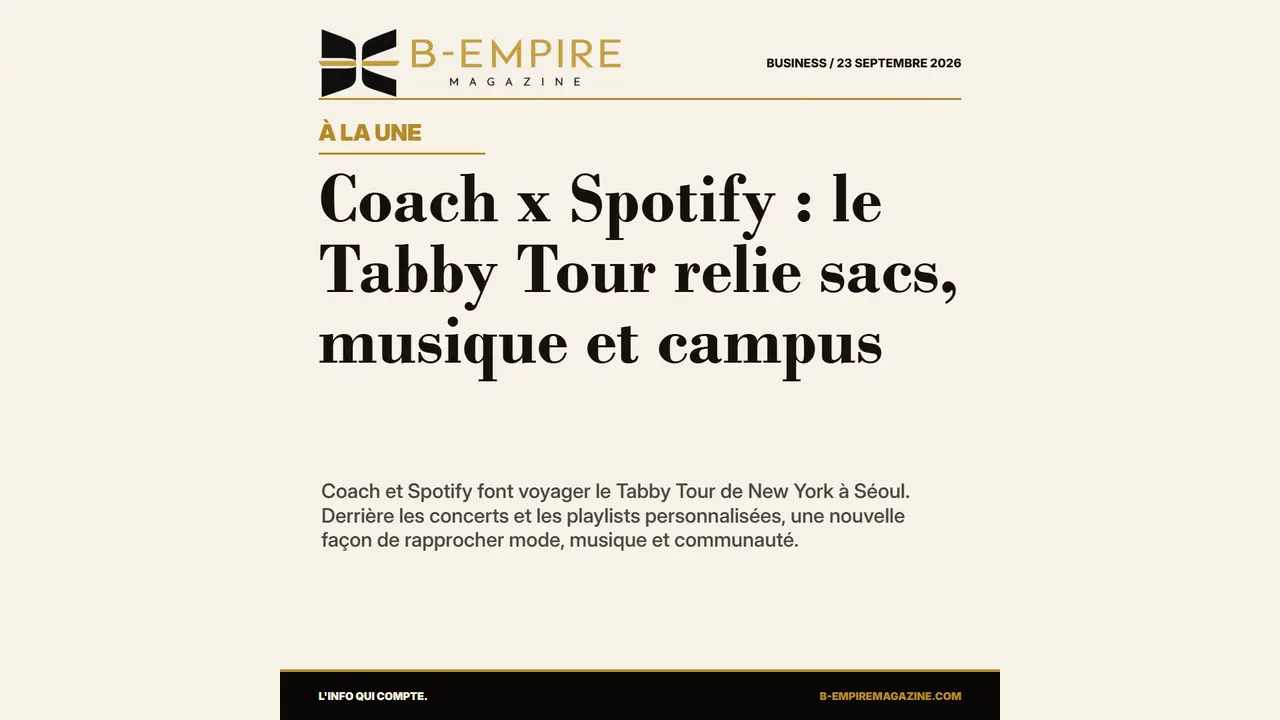
A bag, a song and a concert memory: Coach and Spotify want to bring all three into the same story. Their Tabby Tour, launched in New York on September 16, 2026, stops at American campuses before heading to the United Kingdom, Japan and South Korea. The tour accompanies Coach’s fall 2026 Live Your Story campaign. This is more than an exercise in visibility. It shows how a fashion brand is trying to build a lasting relationship with an audience that moves constantly between its phone and the physical world.
A tour, not just a display
Spotify says the tour bus contains spaces dedicated to music discovery and creativity. At each stop, artists discuss their journeys and then perform live. Visitors can explore special-edition Tabby bags, customize accessories and take away an item linked to a playlist through a Spotify code. A photo booth and a message board extend the experience. The setup offers several reasons to attend, including for people who had no intention of buying a bag.
The announced route includes New York on September 16, Boston on the 22nd and Washington on the 24th. Other American stops are scheduled for October and November, followed by Manchester, London, Tokyo, Osaka and Seoul. Organizers describe the program as evolving: featured artists and some local details are unveiled along the way. That flexibility lets one campaign take on a different character in each city instead of reproducing the same setting everywhere.
Music as a shared language
The digital part goes beyond posting pictures from the tour. In the Courage Frequency experience, Spotify uses participants’ listening habits to assign one of six profiles and then offer a personalized playlist. Another tool tracks the bus and upcoming stops. Coach also highlights six branded playlists and emerging artists. The journey therefore runs from a concert to an app and back to a physical object: a bag, an accessory or a personalized keepsake.
On its own site, Coach frames the campaign around style, soundtrack and personal story. It features Tabby designs inspired by personalities involved in the campaign and charms resembling concert tickets. The product remains central, but appears in a social and musical setting. A playlist can recall a moment shared with friends; an accessory can become a material reminder of it. The collaboration is designed around this movement between memory and merchandise.
Why campuses matter
The early campus stops are deliberate. They place the campaign where music, clothes and belonging to a group help shape identity in everyday life. Coach and Spotify say Gen Z does not sharply separate what it wears, what it listens to and the communities it joins. That is the partners’ view, not a universal rule about every young person. Their commercial response is to create opportunities to meet rather than an advertisement viewed only on a screen.
The approach has limits, too. A free, photogenic event can draw a crowd without turning interest into loyalty. Personalized playlists can entertain without saying much about anyone’s real attachment to a brand. The tour’s success should therefore not be measured only by the number of social posts. The quality of the concerts, the relevance of local artists and Coach’s credibility after the event ends will matter as well.
Two companies, complementary goals
For Coach, music gives the Tabby a place in lived moments rather than simply in a shop window. For Spotify, the tour demonstrates that its service can be a creative partner for brands, beyond selling advertising space. The project was developed with AUX, Spotify’s team for experiences and commercial collaborations. The platform brings personalization tools and a daily connection with listeners; the fashion house brings a recognizable object and a physical presence.
Traveling across the Americas, Europe and Asia also gives the story a global scale. Yet the real test will be local. A successful stop in London does not guarantee the same reception in Tokyo or Seoul. Musical tastes, campus customs and attitudes to accessible luxury differ. By making room for the artists and programming of each city, the partners at least acknowledge that the experience cannot simply be exported unchanged.
The Tabby Tour captures a shift in cultural marketing: sell less directly, let people experience something, then connect that experience to a product and a digital identity. Whether the concerts and conversations create memories worth more than their staging remains to be seen. That is the difference between a tour whose song stays in your head and a campaign forgotten as soon as you leave the bus.
There is also a question of who gets included in the story. A campus tour naturally favors people who can reach a selected city at a selected time, while the digital experiences can travel much further. Spotify’s playlists and tour tracker partly close that gap, but they cannot reproduce the shared atmosphere of a live performance. The balance between access and exclusivity will shape how people understand the partnership: as a community event, a product launch, or both at once.
Sources
- Spotify, Tabby Tour announcement, September 16, 2026: program, features and itinerary.
- Coach, Live Your Story campaign, fall 2026: collection, personalization and stops.