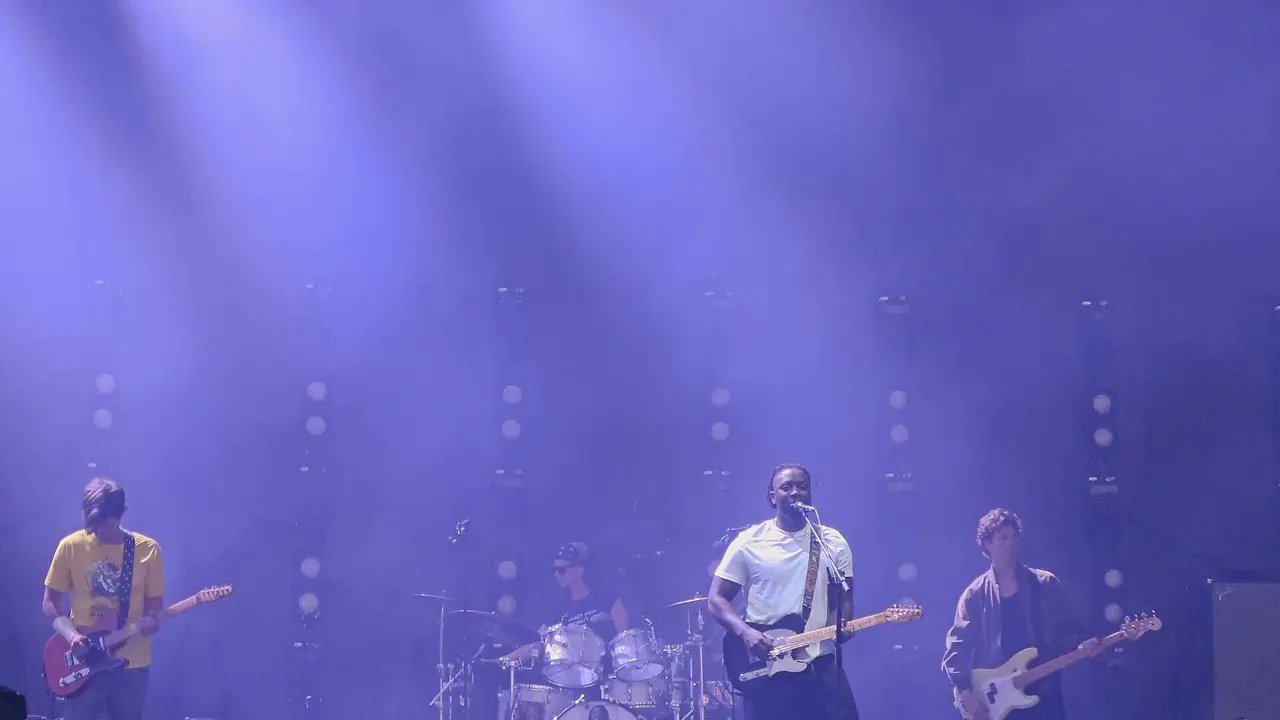
The clipped guitar riffs, restless drums and unmistakable voice of Kele Okereke defined a generation. More than twenty years after Silent Alarm, Bloc Party is refusing the comfortable role of a rock museum piece. The British band is preparing Anatomy of a Brief Romance, its seventh album, scheduled for September 11, 2026. The proposition is immediately intriguing: heartbreak, dance-floor momentum and the presence of Trevor Horn, a producer associated with some of modern pop’s most spectacular sonic architecture.
The Associated Press included the record among the week’s notable cultural releases. Bloc Party’s official website has opened pre-orders, while Apple Music lists the release date and makes several tracks available ahead of the full project. This comeback is therefore about more than nostalgia. It shows how a defining 2000s band can attempt to become an event again in a market ruled by playlists, short-form video and catalogue revivals.
An Album Turning a Breakup Into Movement
The title Anatomy of a Brief Romance promises an emotional dissection. Bloc Party has often been at its best when intimacy collides with velocity: desire, jealousy, urban loneliness and bodies in motion. This time the band is presenting a world Okereke has described in the press as “disco heartbreak.” The phrase works because it combines opposing forces, placing the pain of an ending against the physical impulse of the dance floor.
That contrast sits at the center of enduring pop music. Sad songs people can dance to have survived every cycle from new wave to contemporary electronic production. It is also natural ground for Bloc Party. Even in its most angular work, rhythm has always been central. The guitar was not merely abrasive; it was percussive. The drums did not decorate the songs; they propelled them.
Trevor Horn Changes the Scale
Trevor Horn’s participation gives the project unusual weight. The British producer is connected to a maximalist idea of sound built around precision, space and melodic power. In an NME interview around the 2025 Ivor Novello Awards, Bloc Party discussed working with Horn on the new album while emphasizing that the group’s identity would remain at the center of the record.
That is exactly what makes the partnership compelling. Bloc Party owns an instantly recognizable signature, but a signature can become a cage when it is repeated without risk. Horn can add depth, clarity and pop drama without removing the tensions that animate the band. The objective is not to turn Bloc Party into an artifact of the 1980s. It is to expand the band’s language so it still works in headphones, on festival stages and inside the playlists of 2026.
The Enormous Weight of Silent Alarm
Every new Bloc Party album inevitably enters a conversation with Silent Alarm. Released in 2005, the debut became a landmark of British indie rock. It captured a period when blogs, Myspace, clubs and festivals could push a group into the spotlight almost simultaneously. That memory now provides a powerful commercial advantage, feeding reissues, anniversary tours, archive footage and discovery by younger listeners.
Legacy can also consume the present. A band celebrated for its first album risks having every new idea reduced to a comparison. Bloc Party appears to have accepted that tension. Okereke has spoken about being at peace with the lasting importance of Silent Alarm. That position opens a more ambitious possibility than a simple revival: using the trust created by the catalogue to lead listeners toward a new sonic color.
Why This Comeback Arrives at the Right Time
Popular culture is moving through a broad reactivation of the 2000s. Fashion silhouettes, compact digital cameras, guitars, physical formats and the sounds of the decade are circulating again among Gen Z audiences. Established artists benefit from that curiosity only when they offer more than a souvenir photograph. Listeners want to recognize an emotion while discovering a reason to stay.
Bloc Party has a rare advantage here. Its original aesthetic was never purely retro; it mixed post-punk, electronics, rock and pop sensitivity. That hybrid approach fits today’s market, where genre boundaries matter less than a song’s ability to create a moment. One track can travel from a gym playlist to a social video, a television series and a festival stage without asking permission from a single music community.
A Battle for Attention, Not Just Sales
An album launch in 2026 is no longer a single date. Vinyl pre-orders, signed editions, staggered singles and touring create a chain of appointments. Bloc Party’s official site highlights multiple physical formats and a promotion involving signed test pressings. Such devices turn the musical object into proof of belonging for committed fans.
At the same time, Apple Music presents the album as a pre-release and allows listeners to add it in advance. The two strategies are complementary. Streaming supplies global reach and repetition. Vinyl, merchandise and limited editions supply margin, collectability and emotional connection. For established bands, that combination has become essential: the catalogue attracts, the new release reactivates and the physical object builds loyalty.
A Signal That Indie Refuses to Disappear
Bloc Party’s return matters beyond its own fan base. It demonstrates how a group tied to a very specific era can still negotiate a place in the present. Replaying the anthems is no longer enough. A band needs a clear narrative, an honest relationship with its history and a contrast strong enough to produce curiosity. “Disco heartbreak” already performs that role: two words are enough to suggest an atmosphere, a tension and a live spectacle.
The songs will deliver the final verdict when Anatomy of a Brief Romance becomes available. Yet the strategic movement is already visible. Bloc Party is not denying the guitars that made it famous, and it is not simply placing them behind glass. The band is repositioning them inside an architecture that sounds brighter, more sensual and potentially more pop. In a year crowded with comebacks, that is the only strategy that can truly matter: return with a reason to move forward.