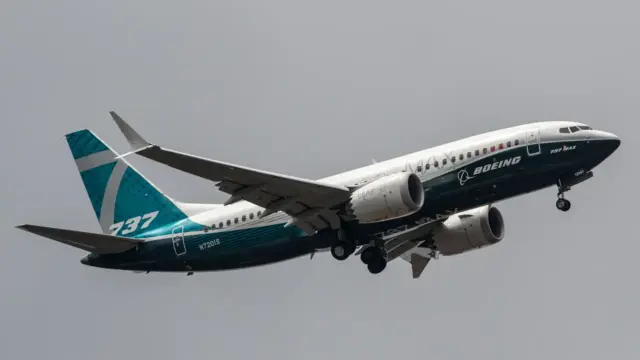
After years of delays, technical modifications, and increased scrutiny, the smallest aircraft in the 737 MAX family finally receives its passport to the American skies. The Federal Aviation Administration (FAA) certified the Boeing 737 MAX 7 for commercial service on Monday, August 3, 2026. This decision concludes a wait that began well before its first flight in 2018, but it primarily opens a new challenge: convincing airlines, international regulators, and the public that Boeing can turn regulatory approval into reliable and safe deliveries.
The green light is significant for Boeing, whose single-aisle 737 remains the commercial backbone. It comes after a thorough review of the design and safety systems, in a context still marked by the accidents of the MAX 8 from Lion Air and Ethiopian Airlines, which killed 346 people in 2018 and 2019. The certification of the MAX 7 does not rewrite this history. Instead, it illustrates how much the rules of the game have changed around the American manufacturer.
A Green Light Long Awaited
The 737 MAX 7 is the most compact version of the MAX family. Designed for short to medium-haul routes, it aims to offer airlines a more contained capacity while maintaining the efficiency and operational commonality of the range. Boeing unveiled it nearly ten years before the FAA’s decision. Its first flight took place in March 2018, but the timeline was subsequently disrupted by the global grounding of the MAX, the pandemic, production difficulties, and much stricter certification requirements.
According to Boeing, the 737-7 program has accumulated 686 hours of flight testing over 441 flights, along with an additional 349 hours of ground testing. By mid-July, the manufacturer estimated that 95% of the certification deliverables were completed and that flight testing was finished. These figures do not erase the delays, but they indicate the extent of the technical and documentation work required before final approval.
Safety Changes Required Before Authorization
The FAA stated that it required several modifications before signing the certificate. These include changes to the flight control software, alerts displayed to pilots, and the engine anti-ice system. The latter could, under rare conditions, cause overheating without crew intervention or design changes. Boeing has therefore developed a solution intended to be integrated into new models and adapted for MAX aircraft already in service.
The manufacturer is also working on an improved angle of attack measurement system. The goal is to reduce erroneous or confusing indications in the cockpit. The angle of attack played a central role in the analysis of the MAX 8 accidents, particularly due to how the MCAS system reacted to incorrect data. However, caution dictates distinguishing between the aircraft and their configurations: the MAX 7 is a new model certified after a specific series of tests and changes.
Certification Does Not Mean the End of Scrutiny
The FAA’s decision does not equate to a return to pre-crisis normalcy. The American agency indicates that its inspectors will remain present at Boeing’s facilities to observe manufacturing, the safety management system, and the internal culture of the group. In other words, the model’s authorization and the oversight of each produced aircraft are two distinct levels.
This point is crucial. A few weeks before the MAX 7 certification, the FAA had authorized Boeing to resume issuing airworthiness certificates for new 737 MAX and 787 aircraft, after eight months of comparing quality results. The agency had removed this responsibility from the manufacturer for the MAX in 2019. It assures that it will continue its inspections, audits, and monitoring of critical assembly stages. The trust granted remains therefore framed and reversible.
Southwest and Airlines Now Await Deliveries
For airlines, certification has economic value only if the aircraft arrive on time and with the expected quality. Southwest Airlines is among the customers still holding orders for the MAX 7. The aircraft’s format particularly fits its network of domestic and regional routes. However, delays have forced carriers to revise their fleet plans, retain some aircraft longer, or seek other capacities.
Boeing indicated in the spring that it aimed for initial deliveries in 2027. The timeline now depends on the certification standardization of already produced aircraft, ramp-up, and operational readiness of customers. Each delay can affect costs, route openings, and seat availability. Conversely, each successful delivery can gradually strengthen the industrial credibility of the program.
A Global Challenge Against Airbus
The MAX 7 is not just fighting a battle in the United States. The global single-aisle market is dominated by Boeing and Airbus, with order books filled for several years. Airlines want more fuel-efficient aircraft capable of serving more routes with controlled costs. In this competition, the time lost in certification turns into a commercial advantage for the European rival.
The larger MAX 10 is also at the heart of Boeing’s strategy. Its program has progressed in testing, but it still needs to pass its own regulatory milestones. The success of the MAX 7 can serve as a demonstration: the manufacturer is capable of closing a file under the new oversight regime. However, it does not guarantee automatic approval for the MAX 10 or the 777-9, two programs assessed according to their own risks and requirements.
What France and Europe Need to Watch
For European travelers, the FAA’s announcement is an American milestone, not an immediate universal authorization. Authorities in other regions maintain their procedures and may require their own validations before commercial operation. Europe, which hosts Airbus and a vast network of aerospace suppliers, will observe both the technical decision and Boeing’s ability to maintain production quality over time.
The stakes go beyond industrial rivalry. French and European airlines depend on a global supply chain of parts, maintenance, training, and financing. A program that regains stability helps streamline the supply of aircraft. However, competition is only healthy if safety remains the primary constraint. Delays are costly; a rushed certification would cost infinitely more.
Boeing Wins a Step, Not Yet the Trust Battle
The certified Boeing 737 MAX 7 represents a tangible victory for engineers and testing teams. It also gives the group an additional product to meet global demand for single-aisle aircraft. Yet, the true verdict will not be rendered by a press release. It will come from operational performance, the consistency of deliveries, audits, and transparency regarding potential issues.
After the crises that shook Boeing, trust can no longer be demanded: it must be demonstrated aircraft by aircraft. The FAA has opened the door to the MAX 7 while promising to remain in the factory. This image summarizes the new phase of the program. The manufacturer is moving forward again, but under scrutiny that no one wishes to see loosened.
Key Takeaways
- The FAA certified the Boeing 737 MAX 7 on August 3, 2026, after years of delays.
- The agency mentions changes to flight software, cockpit alerts, and engine anti-ice systems.
- American inspectors will continue to monitor Boeing’s production and safety culture.
- Southwest Airlines is among the airlines with pending orders.
- Initial deliveries are expected starting in 2027, subject to industrial readiness.
Sources
- Associated Press, certification of the 737 MAX 7 and changes required by the FAA, August 3, 2026.
- Boeing, status of testing and certification files for the 737-7, 737-10, and 777-9, July 16, 2026.
- Federal Aviation Administration, oversight mechanism and resumption of airworthiness certificates, July 17, 2026.
- Boeing Investor Relations, first quarter results and indicative delivery schedule, May 13, 2026.
- Le Monde, international coverage of the certification of the 737 MAX 7, August 4, 2026.