
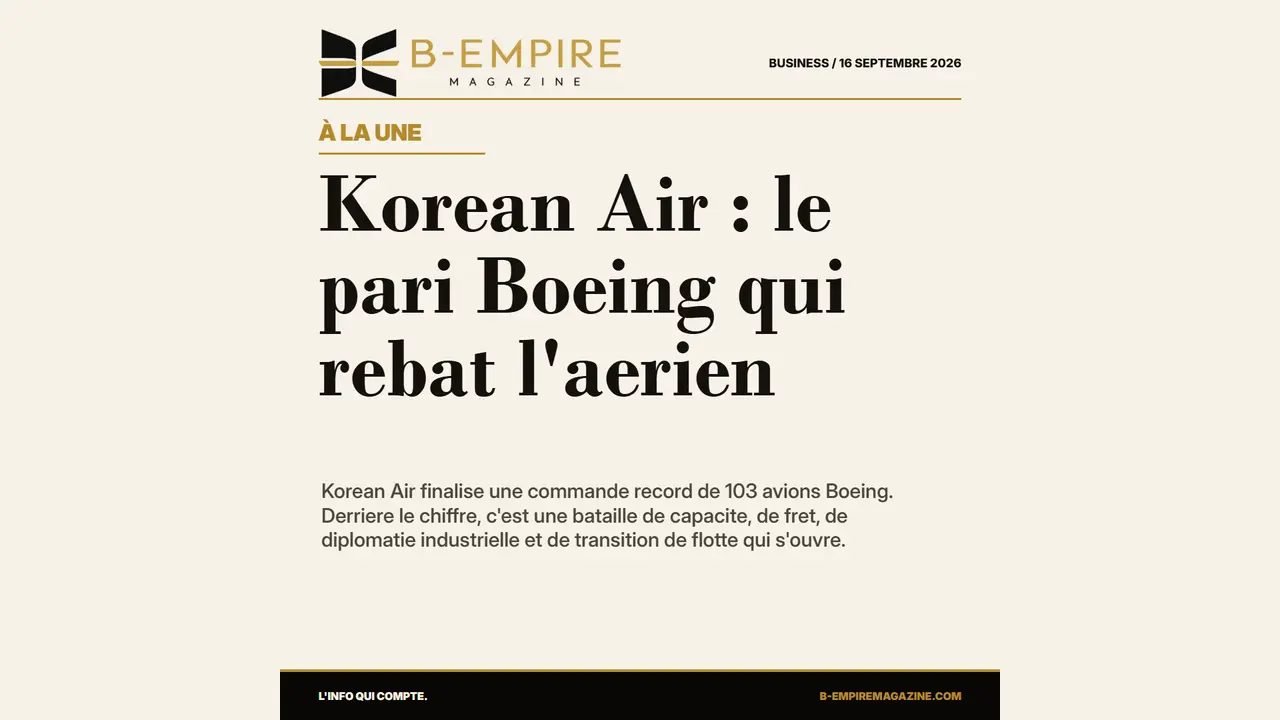
Korean Air is not merely signing an aircraft order. The South Korean carrier has locked in an industrial plan that says a great deal about air transport in the late 2020s: the scarcity of available aircraft, the return of widebody jets as strategic assets, the role of cargo in airline balance sheets and the weight of diplomacy in manufacturers’ order books.
On September 16, 2026, Boeing and Korean Air announced the finalization of an order for 103 aircraft. The package includes 20 777-9s, 25 787-10s, 50 737-10s and eight 777-8 Freighters. According to Boeing, the order fulfills a procurement commitment made in August 2025 and fits into the industrial relationship between the United States and South Korea. Yonhap describes a broader package worth about $44.8 billion, including $36.2 billion for the aircraft and $8.6 billion for spare engines, GE Aerospace and CFM International equipment, and fifteen years of maintenance services.
For Korean Air, timing matters as much as volume. The airline is preparing its integration with Asiana Airlines, a move that changes the scale of its network, commercial power and operational responsibility. Ordering 103 aircraft is therefore not a spectacular purchase designed only to inflate a fleet on paper. It is a way to reserve positions in a global supply chain where delivery slots have become a competitive advantage. Airlines that wait too long pay more, receive aircraft later and sometimes lose the best windows for growth.
The model mix also reveals the strategy. The 787-10 strengthens high-density long-haul routes with the promise of fuel efficiency and modern comfort. The 777-9, still highly anticipated by the market, embodies a premium widebody vision: more capacity, more range and more margin on routes where business and leisure demand can coexist. The 737-10 covers regional and medium-haul flying. The eight 777-8 Freighters, meanwhile, are a reminder that cargo has not returned to being a secondary business after the pandemic. Belly capacity and dedicated freighters have become instruments of resilience.
The order also lands at a delicate moment for Boeing. The manufacturer needs strong signals, solid customers and visible orders to support its industrial recovery. Korean Air provides all three. Yet the deal also exposes a less romantic reality: not every aircraft in the package sits at the same level of certification and commercial maturity. Reuters, carried by CNA and Boursorama, notes that the 787 is currently the only aircraft in the list already certified for commercial service, while Boeing continues to develop the 777-8 Freighter. Korean Air’s bet therefore rests on future delivery as much as present trust.
There are two readings here. From the airline’s side, Korean Air is buying time, capacity and a modernization narrative. It can speak about a more efficient fleet, lower emissions per seat, expansion toward new destinations and a better customer experience. From the industry’s side, Boeing converts a political and commercial commitment into a firm order book, with a customer that matters in Asia-Pacific. From the states’ perspective, Washington and Seoul can present the agreement as proof of economic proximity in a region where aviation, defense, semiconductors and energy increasingly overlap.
The real test will be execution. An order for 103 aircraft creates value only if deliveries arrive, crew training keeps pace, engines are available on time and the network can absorb the new capacity. The risk is not only industrial. It is commercial. Too many aircraft on poorly calibrated routes can weaken margins; too few aircraft at the wrong moment can leave growth to more agile competitors. Korean Air is playing a chess match in which every delivery becomes an advanced square on the board.
For travelers, the effect will not be immediate, but it could be deep. A renewed fleet changes the perception of an airline: more modern cabins, more stable connectivity, lower consumption, the possibility of new routes and cargo that is better integrated into revenue. In contemporary aviation luxury, the product is no longer just the seat. It is the whole system: punctuality, network, baggage, data, maintenance, lounges, sustainability and the ability to absorb shocks.
The Korean Air-Boeing order is therefore a broader marker than the headline number suggests. It says that major airlines do not believe in smaller aviation. They believe in more selective aviation, denser aviation, aviation watched more closely through costs and increasingly dependent on technology. The winner will not simply be the company with the most aircraft. It will be the company able to place them in the right market, at the right time, with the right level of service and financial discipline. That is where fleet strategy becomes brand strategy.