
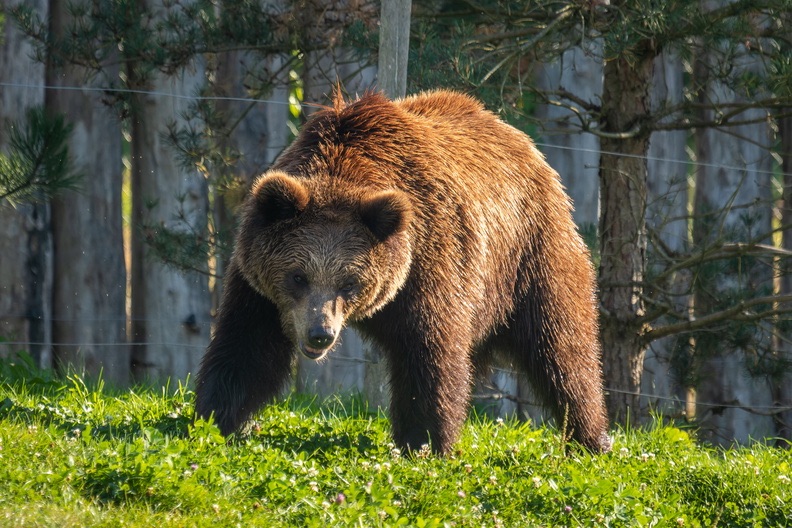
In the mountains of northern Spain, some bears seem to have found a spectacular method to avoid confrontation: making others believe they are larger than they actually are. A study published in July 2026 in the Journal of Mammalogy describes seven males that climbed trunks or used natural platforms to leave their marks higher than their size would normally allow.
The behavior is rare, and researchers remain cautious: it does not prove that all bears ‘lie’ consciously as a human would. However, it shows that these animals can modify a signal previously considered difficult to falsify. Behind this viral discovery lies a major scientific question: how far can mammals manipulate the image they project to their rivals?
117,552 Hours of Footage to Identify Seven Strategists
The international team monitored 14 marking sites in the Cantabrian mountain range between 2021 and 2024. In total, the camera traps accumulated 117,552 hours of recording and allowed the identification of 164 brown bears. Among them, seven males, or 4.3% of the sample, exhibited potentially exaggerated markings.
These animals did not merely stand on their hind legs. They climbed or leaned on elevated elements before scratching, rubbing, or depositing their scent on a tree. The resulting mark was thus above the height corresponding to their actual size. Four of the seven individuals were adults, and three were subadults.
The researchers notably observed a mark located nearly three meters off the ground, while a standing bear typically marks around two meters. A broken branch beneath this trace suggested that the animal had climbed the support. Elevated markings were observed at 14.3% of the studied sites, primarily during the day.
A False Business Card for Rivals
For a bear, a mark on a tree is not just a scratch. It conveys visual and chemical information: presence, identity, sex, reproductive status, and likely size. A rival discovering a very high mark may deduce that a formidable individual frequents the area and decide to stay away.
Height thus functions as a business card. Until now, this type of signal was considered relatively honest, as it seemed limited by anatomy. A bear cannot normally leave a mark higher than it can reach. However, by using a slanted trunk, a branch, or a platform, it circumvents this physical constraint.
For a young male or a non-dominant individual, the potential advantage is clear. Appearing larger can deter a competitor, reduce the risk of injury, and preserve access to territory or mates. Bluffing costs much less than a confrontation between two animals capable of inflicting serious injuries.
Can We Really Say That Bears Lie?
The word ‘lie’ grabs attention, but it must be used with caution. The study refers to exaggerated signaling and possible manipulation of a ‘cue signal,’ meaning a signal normally reliably linked to a physical characteristic. The images show the behavior; they do not provide access to the animal’s mental intent.
It remains to be demonstrated that bears deliberately choose to climb to deceive a rival, that other individuals indeed interpret height as a sign of large size, and that this strategy provides a measurable advantage. The authors thus call for further observations and complementary experiments.
The low frequency is also significant. Seven males out of 164 do not allow for the portrayal of the brown bear as a systematically deceptive species. This rarity may even be essential for the functioning of the bluff: if all marks were false, rivals would quickly stop trusting them.
A Discovery That Changes Our View on Animal Intelligence
Animal communication is filled with signals of strength. Antlers, calls, colors, scents, or postures often help avoid combat. These systems work because they generally provide credible information. However, evolution also creates space for cheaters, provided they remain rare enough for the signal to retain its value.
In several species, behaviors of concealment, imitation, or exaggeration have already been documented. The Cantabrian case is remarkable because the manipulation concerns two dimensions simultaneously: the visible trace and the scent deposited on the support. The animal not only produces an impressive silhouette; it modifies a lasting territorial message that other bears will discover later.
This discovery also reminds us that intelligence is not solely measured by tool use or puzzle-solving. Knowing how to manage social risk, anticipate a competitor’s reaction, and exploit the environment to modify a signal can represent a sophisticated form of adaptation.
The Cantabrian Mountain Range, a Laboratory of Fragile Renaissance
The setting of the study is as important as the observed behavior. Brown bears in Spain nearly faced extinction during the 1970s and 1980s. Populations in the Cantabrian mountain range and the Pyrenees now exceed 400 individuals thanks to conservation efforts, according to data cited by Euronews, but the species remains threatened.
As the population rebuilds, encounters between bears become more frequent. Local density can intensify the use of marking sites and make territorial communication even more crucial. A study by CSIC published in May 2026 had already shown that communication activity increases when more individuals frequent the same areas.
Understanding these signals can help better protect the species. Marking trees are information crossroads. Their disruption by human activities, especially during the breeding season, could alter movements or increase risky encounters. Researchers thus suggest the need for temporary restrictions in certain sensitive areas.
A European Issue That Also Concerns France
France shares with Spain the responsibility for the Pyrenean population. Although the study focuses on Cantabrian bears, its lessons extend beyond this region. Methods of monitoring through camera traps, analyzing marking sites, and managing human visitation can inform conservation programs in the Pyrenees and elsewhere in Europe.
The topic remains politically sensitive in France, where the presence of bears often pits biodiversity advocates against farmers facing predation. A better understanding of behavior does not resolve this conflict, but it prevents the management of the species from being based on simplistic images. The bear is neither an unpredictable brute nor a fairy tale character: it is a socially aware animal, capable of adjusting its signals to a complex environment.
The Most Astonishing Bluff in Nature
These seven bears may not have invented lying, but they have just shattered a certainty. A mark that was supposed to honestly reveal its author’s size can be moved, amplified, and transformed into a tool of intimidation. The forest thus becomes a network of messages where each reads the traces of others without ever being certain of seeing the whole truth.
The most fascinating conclusion is not that 4.3% of the observed bears would be ‘cheaters.’ It is that the communication of a large solitary mammal likely possesses more nuances, strategies, and uncertainties than we imagined. In the heart of the Spanish mountains, a few males have shown that, in nature too, appearing larger can sometimes be enough to win without fighting.
Sources
- Journal of Mammalogy â âExaggerated signaling in a solitary mammal: evidence from brown bearsâ, July 7, 2026.
- Euronews â 5% of Cantabrian brown bears may cheat about their size, July 26, 2026, updated July 27.
- National Museum of Natural Sciences / CSIC â communication and density in Cantabrian bears, May 6, 2026.
- Scientific Reports â visits of brown bears in inhabited areas and coexistence, reference version July 16, 2026.