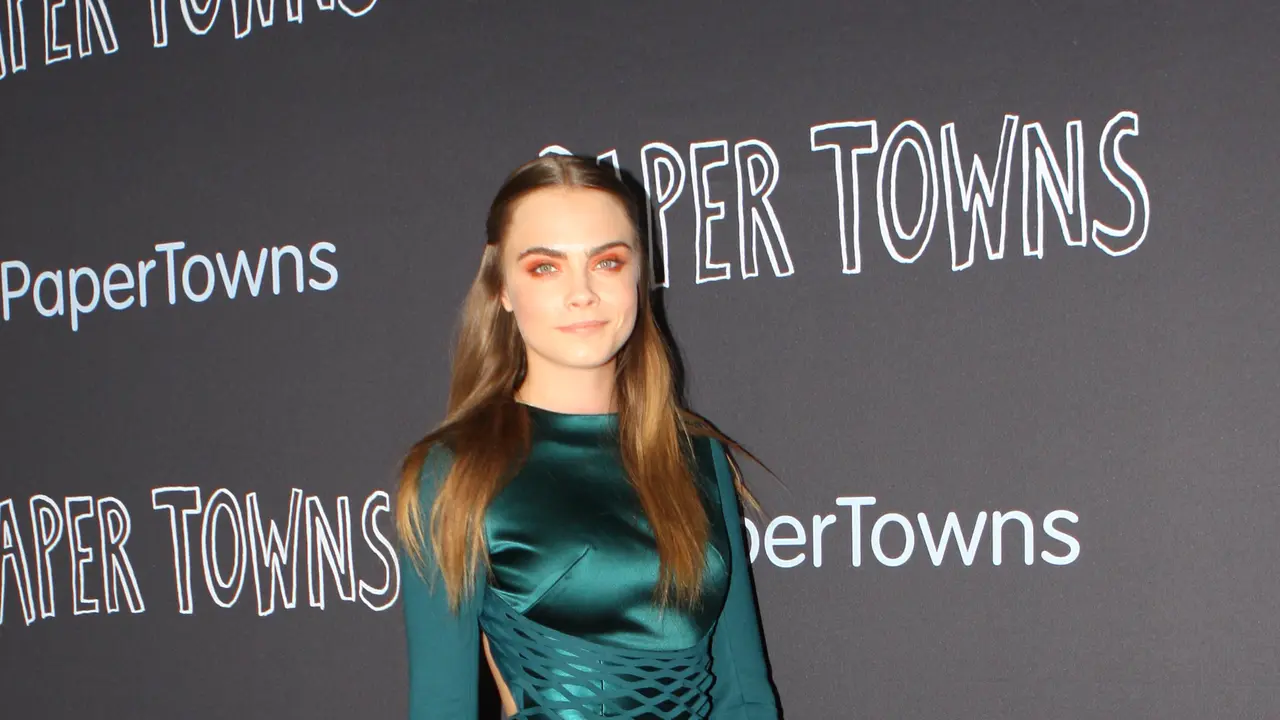
The iconic face of Topshop is no longer content to simply wear the brand: she now wants to write its next chapter. Cara Delevingne unveiled her first collection designed for the British label on Monday, August 24, 2026. This capsule of 16 pieces, conceived beyond her own wardrobe, transforms nostalgic reunions into a very current commercial bet. More than a decade after being the first model to solely embody a Topshop campaign, the star returns as creative director. The symbolism is powerful: a global icon from London is called upon to help a former high street glory regain its desirability.
A Announcement That Completes Twelve Years of History
In 2014, Cara Delevingne became the first solo ambassador for Topshop. She had already walked the runway for the Unique line and participated in the brand’s universe at a time when it represented a certain idea of British fashion: fast, accessible, cheeky, and capable of bridging the street with the catwalks. Her return in 2026 is therefore not just another celebrity collaboration. It brings together two trajectories that have experienced glory, rupture, and reconstruction.
British Vogue reveals that the collection consists of 16 pieces. Among them are wide denim culottes, off-the-shoulder mini dresses, short trench coats, a white tank top, striped sets, and fitted jeans. Delevingne explains that she wanted to step out of her comfort zone and design a wardrobe that is coherent for very different people, rather than simply reproducing her personal style.
The Signal That Topshop Cannot Afford to Miss
For Topshop, this capsule arrives at the heart of a reclamation effort. Following the closure of its famous Oxford Street store and the disappearance of its former physical empire, the brand was taken over by ASOS. Since then, it has relaunched its own website, returned to the catwalks, and multiplied initiatives aimed at rekindling the attachment of a generation that associated its Joni and Jamie jeans with the 2000s and 2010s.
The official announcement published by ASOS had already set the stage by presenting Cara Delevingne as the face of a new era and confirming the development of a capsule for the 2026-2027 season. The promise was already based on three strategic words: sustainability, inclusion, and quality. The revelation of the collection now gives concrete content to this discourse and allows Topshop to transition from nostalgia to an identifiable product.
Why Cara Delevingne Refuses to Do Simple Merchandising
The most interesting choice may be the decision not to turn the capsule into a star uniform. Delevingne claims to have thought of every man, woman, or gender non-conforming person. She does not even appear in the campaign accompanying the collection, allowing the clothes to be represented by other profiles. This decision distances the project from the classic model where a famous name sells a few pieces replicating their wardrobe.
The occasional designer acknowledges that some garments, like a long denim wrap skirt, are pieces she would more easily admire on someone else. This distance serves as a credibility argument: her role is not just to select what she would wear, but to build a usable, combinable proposal that is broad enough to live beyond her image.
London as a Global Language
However, the collection remains deeply tied to her identity. Cara Delevingne describes a vision of the world filtered through London. The asymmetrical cuts evoke, according to her, the architecture of the capital, while the mix of eras and the association of vintage with new reflect that British freedom which has long been the strength of Topshop.
Denim plays a central role because it ages, wears, and escapes the disposable nature often attributed to accessible fashion. This emphasis on longevity is important in a market where customers simultaneously demand affordable prices, novelty, and greater responsibility. Topshop thus attempts to maintain the energy of the high street without giving the impression of merely recycling past formulas.
The Immense Shadow of Kate Moss
Any collaboration between a British model and Topshop inevitably conjures memories of Kate Moss. Her numerous collections caused queues, stock shortages, and worldwide media coverage. Delevingne does not shy away from the comparison, but she shifts it. While Moss’s capsules largely reflected her personal wardrobe, the new creative director aims to avoid becoming the only possible model.
This difference speaks volumes about the evolution of fashion. The power of a celebrity remains essential to attract attention, but a contemporary campaign must also show that the public can appropriate the pieces. Inclusion is no longer just a moral statement: it becomes a condition of commercial relevance, particularly for a brand that wants to regain a global clientele on social media and e-commerce.
A Real-World Test for the New Topshop
The success of the capsule will not be measured solely by the buzz generated by the announcement. It will be necessary to observe international availability, pricing, perceived quality, offered sizes, and the brand’s ability to convert interest into repeat purchases. A collection of 16 pieces can create an event; it is not enough to rebuild a lasting relationship with consumers on its own.
Nevertheless, Topshop has a valuable advantage: its name still provokes an emotional reaction. For former customers, Cara Delevingne reactivates an era when the brand seemed at the center of cultural conversation. For a younger audience, she brings a well-known personality from film, fashion, and social media, but also a narrative of personal transformation compatible with the brand’s desire for renewal.
Why This Capsule Exceeds British Fashion
The stakes are global because the battle for the mid-range is now fought between digital platforms, ultra-fast fashion giants, heritage brands, and viral collaborations. A historic brand can no longer rely solely on its network of stores or the authority of its logo. It must produce cultural moments, tell an immediately understandable story, and offer pieces capable of circulating from TikTok to the streets of Paris, London, Dubai, or New York.
With Cara Delevingne, Topshop brings together these ingredients: a global face, a collective memory, a short capsule, and a discourse of inclusion. The gamble remains risky, as the public quickly distinguishes a genuine creative direction from a mere marketing stunt. However, the launch gives the brand a rare chance to align its heritage with the expectations of 2026.
The Comeback That All Retail Will Observe
Cara Delevingne is not trying to become the new Kate Moss, and Topshop cannot become exactly the brand it once was. This is precisely what makes this collection interesting. It offers a passing of the torch rather than a reproduction: from model to creative role, from cult store to global platform, from nostalgia to a more open fashion.
If the garments deliver on their promise of quality, versatility, and longevity, this capsule could become much more than a celebrity launch. It could provide Topshop with the clear image it has been missing for its comeback. The fashion world is now watching to see if sixteen pieces and a London icon can reignite one of the most famous brands on the high street.