
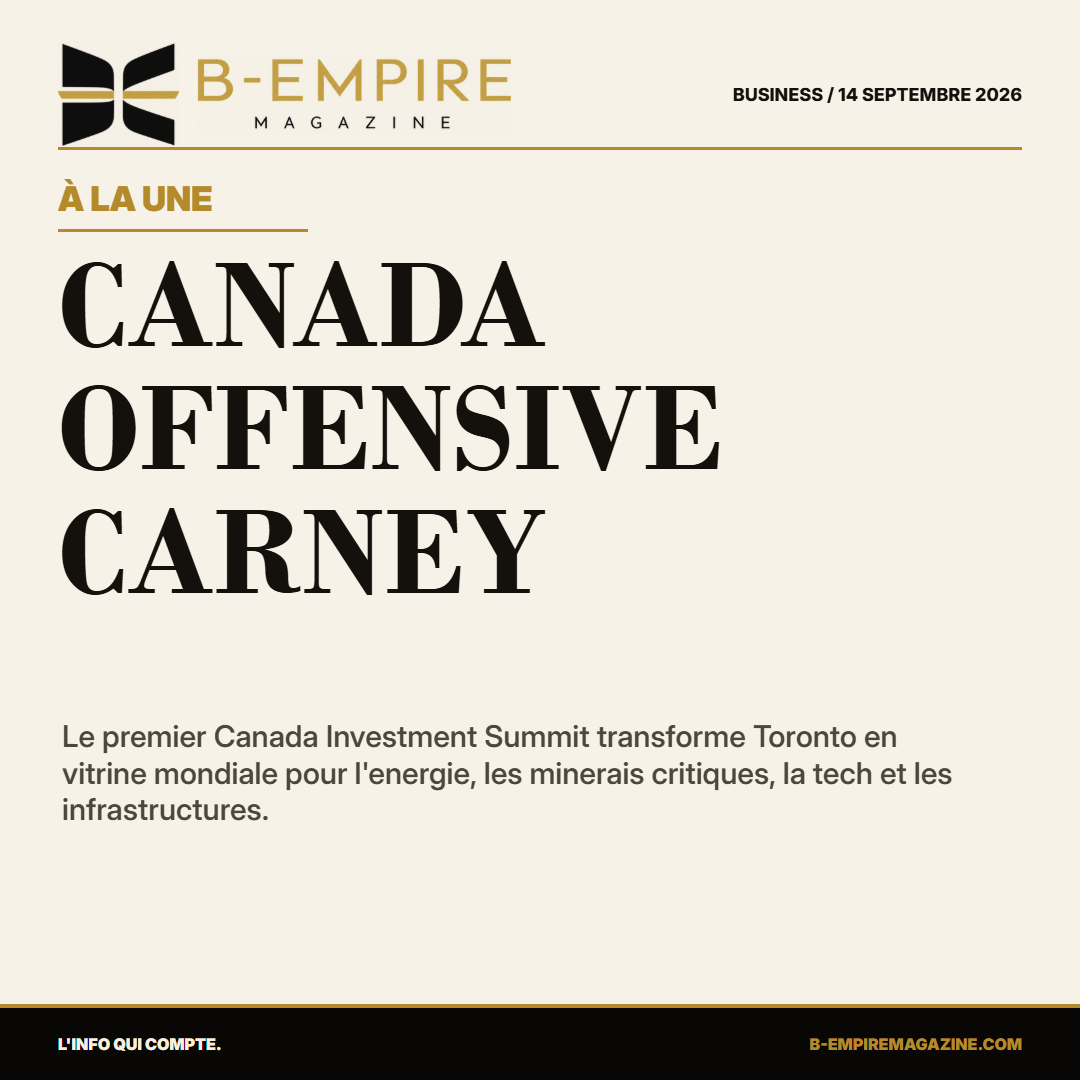
Mark Carney wants to turn tension with Washington into an economic opportunity. In Toronto, the first Canada Investment Summit is bringing together hundreds of global executives and investors around a simple idea: in an unstable world, Canada can sell trust as a strategic asset.
According to the Associated Press, the summit gathers more than 300 senior economic leaders collectively managing more than $120 trillion in assets. The political message is clear. While Donald Trump is trying to pull factories and investment back into the United States, Carney is trying to draw capital north by highlighting Canada’s institutional stability, natural resources, energy, critical minerals, technology and trade access to 1.5 billion consumers.
Trust Becomes a Raw Material
In the old language of globalization, countries sold themselves through labor costs, tax policy, ports, talent and market size. Those criteria still matter. But the current moment adds a decisive variable: predictability. Investors are not only looking for yield. They are looking for political systems capable of keeping promises, rules that do not change with every crisis and projects that can survive electoral cycles.
Carney, a former central banker, understands that grammar. His bet is to present Canada as a platform state: rich enough in resources to matter in energy and critical minerals, integrated enough into major trade agreements to serve several continents, and stable enough to reassure pension funds, asset managers and industrial groups. Trust is no longer an abstract quality. It becomes infrastructure.
A Summit Against American Dependence
Canada is not starting from a blank page. Its economy remains deeply tied to the United States, its main trading partner. That dependence has long been an advantage. It also becomes a vulnerability when Washington uses tariffs, public procurement or industrial policy as instruments of pressure. The Toronto summit is therefore both an attraction exercise and a diversification move.
Ottawa’s stated goal is ambitious: to catalyze $1 trillion in investment over five years. The summit’s official site emphasizes nation-building projects, high-quality jobs, supply-chain integration and economic resilience. In other words, Carney does not only want to seduce Wall Street. He wants to convince the world that Canada can once again be a place where capital builds productive assets, not just financial valuations.
Critical Minerals at the Center of the Battle
The industrial subtext is enormous. Batteries, power grids, artificial intelligence, defense, data centers and electric vehicles all depend on resources and infrastructure that few countries can provide at scale. Canada has nickel, graphite, uranium, hydropower, natural gas, mining expertise and the capacity to host major energy projects. It can therefore present itself as an economic-security partner as much as an investment destination.
For investors, the question is not only whether the resources exist. It is whether permits, grids, local communities, provinces and the federal government can move together. Global capital is available, but it hates administrative traffic jams. That is where part of Canada’s credibility will be tested: turning a geopolitical promise into real construction sites.
The Soft Reply to Trump
Carney does not need to answer Donald Trump with the same political theater. His reply is colder, almost banking-like: if the United States becomes less readable, Canada must become more investable. The message speaks to long-term capital. It also speaks to Europeans, Asians and companies that want to remain close to the American market without depending entirely on its political mood.
This strategy is not without risk. Attracting major funds can raise concerns over sovereignty, housing, energy prices or the place of local communities in large projects. A country does not become more powerful simply because it welcomes billions. It becomes more powerful if those billions create factories, networks, jobs, technologies and public revenues capable of lasting.
Why This Moment Matters Beyond Canada
Canada is testing one possible response to the new economic age. Faced with trade fragmentation, U.S.-China tensions and the race for critical infrastructure, middle powers can no longer simply be open. They must be useful. They must offer a combination of resources, law, talent and stability rare enough to attract capital despite competition from larger powers.
If the summit produces tangible announcements in the months ahead, Carney will be able to say he turned American pressure into a Canadian advantage. If the promises remain symbolic, Toronto will merely have hosted a grand stage of financial diplomacy. Between the two lies the real issue: in the global economy now taking shape, trust is not proclaimed. It is financed, built and delivered.
That delivery test will be unforgiving. Investors can applaud a summit in September and still walk away in December if approval timelines, political disputes or infrastructure bottlenecks make the promised projects harder than advertised. Canada’s pitch is powerful because it is practical, but that also makes it measurable. The world will judge it less by speeches than by mines opened, grids reinforced, ports expanded, factories financed and partnerships signed.