

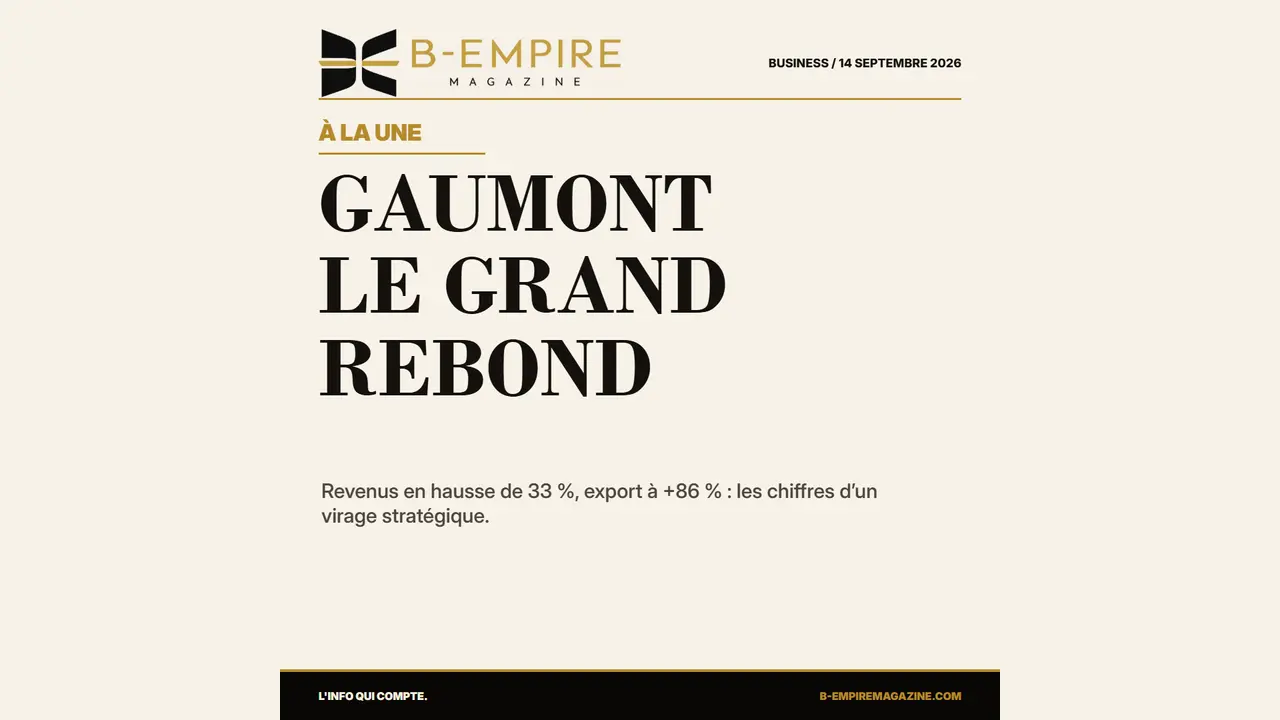
French cinema may have delivered one of its most encouraging economic signals of the year. Gaumont reported consolidated revenue of €85 million for the first half of 2026, up 33% year over year. Even more strikingly, international film sales jumped 86%. Behind those percentages is a decisive battle: whether a historic French studio can turn its stories into lasting global successes.
The accounts through June 30 show a company that is still loss-making but much closer to balance. Net loss attributable to the group fell to €1.3 million from €5 million a year earlier. Profit from production and distribution activities before overhead rose 11% to €18.9 million. This is not a final victory, but the direction is clear enough to command attention.
The Number the Industry Cannot Ignore
Cinema provided the main engine. Revenue from French film production and distribution reached €50.6 million, compared with €36.2 million in the first half of 2025, a 40% increase. French theatrical distribution revenue rose from €9.8 million to €12.9 million. Four films released during the period attracted 4.2 million admissions, compared with 3.6 million admissions for four releases a year earlier.
The increase highlights a fact that is easy to miss: a film group no longer depends on a single opening weekend. Money comes from cinemas, television channels, video on demand, platforms and foreign territories. Gaumont advanced across several of those lines at once, making the rebound more meaningful than one isolated hit.
Exports Become the Strategic Weapon
The strongest figure concerns international sales. They reached €16.5 million, up from €8.9 million one year earlier. Gaumont attributed part of that surge to the availability of recent films with strong export potential, including The Wizard of the Kremlin. A French catalog is therefore not only cultural heritage; it is also global commercial infrastructure.
That export capacity matters when worldwide platforms are looking for local stories with a recognizable identity. International audiences do not necessarily want French films that imitate Hollywood. They often respond to works carried by writers, performers and worlds that could come from nowhere else. Gaumont has both that signature and a distribution network capable of turning it into revenue.
Series Give the Group a Second Engine
Television production also contributed to the acceleration. Revenue from producing and distributing programs rose 26%, from €22.5 million to €28.3 million. Deliveries during the period included Traqués, Lupin – Part 4, the German production Unfamiliar, the American television film Mexico 86 and a partial delivery of the animated program Copains perdus.
The list reveals the strategy: produce in France, Germany and the United States while working with broadcasters able to open several markets immediately. The international success of Lupin already proved that the French language is no longer an automatic border. A title born in Paris can become a worldwide brand when distribution and visibility follow.
A Real Improvement, but No Premature Victory
The results still require caution. Gaumont remains in the red and warns that the first half does not predict the full-year outcome. Video-on-demand and physical video revenue slipped from €5.4 million to €5.2 million. Investment fell 17% to €38.2 million, a move that may protect cash in the short term but also raises questions about the future pace of production.
The release calendar therefore remains central. Studio activity moves in waves: spending happens long before films and series generate receipts. One favorable half can be followed by a quieter period. The real measure of the rebound will be the ability to renew success, rather than merely benefit from a few well-timed titles.
The Other Issue: Leaving the Stock Market
These results also arrive during a major ownership transition. The Seydoux family and Ciné Par have launched a public buyout offer for Gaumont, with the price increased to €100 per share. The transaction is intended to delist the group. It could provide more freedom to invest for the long term, away from quarterly market pressure, but it would also reduce the public visibility that comes with listed-company status.
For a studio founded in 1895, the paradox is remarkable. One of the world’s oldest film companies is adapting its governance to an era dominated by platforms, consolidation and instant content circulation. The improved results support the idea that independence and heritage can still create value when paired with genuine international ambition.
Why the Rebound Matters Beyond Gaumont
The signal concerns the entire French cultural economy. Rising exports can benefit producers, performers, technicians, distributors and commercial partners while giving French works greater exposure. It also strengthens their bargaining position against American conglomerates and global platforms.
Gaumont cannot solve every pressure facing cinema: uneven attendance, high costs, competition from home screens and fragile financing. Yet its first-half performance shows that a hybrid model remains possible. Theaters create an event, broadcasters give value to rights, platforms provide global reach and the catalog extends the life of each work.
The final message is simple: French cinema does not have to choose between identity and commercial strength. Gaumont’s 2026 results suggest it can export more without erasing what makes it distinctive. The world is still watching French stories; the challenge now is to turn that attention into durable growth.