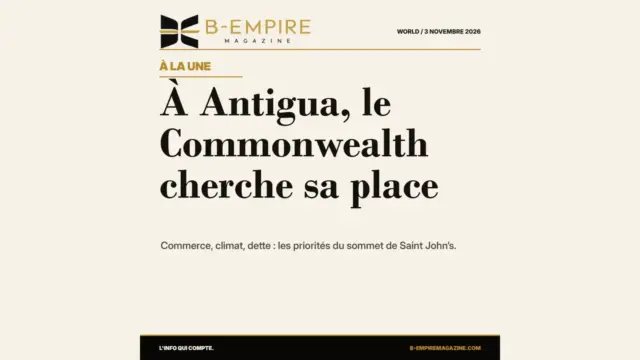
In Antigua, King Charles III’s words opened a political moment that the Commonwealth can no longer treat as a simple exercise in remembrance. Addressing leaders gathered in St John’s on 3 November, he called the transatlantic slave trade a “shameful chapter of history” and said its consequences still cast a shadow over the islands and Commonwealth members. He spoke of horror and “the most profound personal sorrow.” The choice of language matters. So does its limit: the King did not issue a formal apology or announce financial reparations.
A powerful statement, carefully bounded
The official speech, published by the Royal Family, links the past to a proposal focused on the future. Charles said he wanted to find forms of modern partnership to address historical wrongs, including through education, investment in jobs, trade among Commonwealth countries and climate resilience. That framework points in a direction, but it is not by itself a reparations plan: it specifies no timetable, funding or accountability mechanism.
The distinction is essential. An expression of sorrow recognises the moral gravity of a crime and its enduring effects; an official apology carries a different institutional weight; a reparative-justice policy raises further questions: who decides, who benefits, according to what criteria and with what resources? Blurring these levels would obscure what Caribbean advocates are specifically asking for: recognition should open a concrete process, not close one.
The summit as a stage for a regional debate
The Commonwealth Heads of Government Meeting brings leaders from its 56 member states to Antigua and Barbuda. Talks address present-day issues such as climate, trade and development, yet the memory of slavery and calls for reparations have become highly visible in public debate around the summit. This tension is not new. It is less a contest between past and present than between two ways of connecting them. Reparations advocates argue that the legacies of the slave trade and colonial rule can also be seen in wealth gaps, debt pressures and unequal exposure to crises.
In his address, the King argued that history cannot be changed, but societies can learn from it. He referred to the Royal Navy’s role in ending the international trade in enslaved people. That later abolition, however, does not by itself answer demands concerning accumulated benefits, violence and their institutional consequences. The political question therefore remains open: how much influence will affected communities have in defining the responses?
Partnerships must be judged by results
Education, jobs, trade and climate adaptation are areas where cooperation can produce tangible effects. But to be credible in this context, programmes would need clear goals, beneficiaries, funding and meaningful participation by affected communities. Useful development projects do not automatically become reparations simply because they are announced alongside a historical speech. The language used and the governance of programmes matter as much as their budgets.
The summit is therefore a test of consistency. Can leaders turn symbolic recognition into structured dialogue and then into monitored commitments? Can member states discuss historical justice without reducing their differences to a dispute over wording? Will proposed measures reach the populations most in need, with enough transparency to assess outcomes? The King’s speech answers none of these questions. It does, however, give them additional international visibility.
The meaning of a phrase depends on what follows
In Antigua, Charles III offered a personal recognition of the slave trade’s moral weight, accompanied by a call for future action. It was neither a formal apology nor an announcement of reparations. The distinction may seem narrow, but it defines the debate: words can signal a willingness to listen, while policies reveal how far institutions are prepared to go.
For Commonwealth peoples, the next step will not be determined by a speech alone. It will be measured in decisions made after the summit, in the role given to affected communities and in governments’ ability to report on their commitments. Memory becomes politically useful when it informs present choices; it remains unfinished when recognition has no verifiable follow-through.
That standard also applies to the summit itself. A communiqué can capture shared language, yet delivery depends on national budgets, institutions and public scrutiny after delegations leave Antigua. Civil-society groups and historians will watch whether consultation continues beyond the meeting and whether announced cooperation is reported in ways people can verify. Without that continuity, even carefully chosen words risk becoming a ceremonial endpoint. With it, they could become the beginning of a difficult, measurable conversation among governments and communities with very different understandings of responsibility.
The credibility of that follow-through will also depend on access to evidence. Public reporting on funding, beneficiaries and deadlines would allow citizens across the Commonwealth to distinguish lasting commitments from summit diplomacy.