
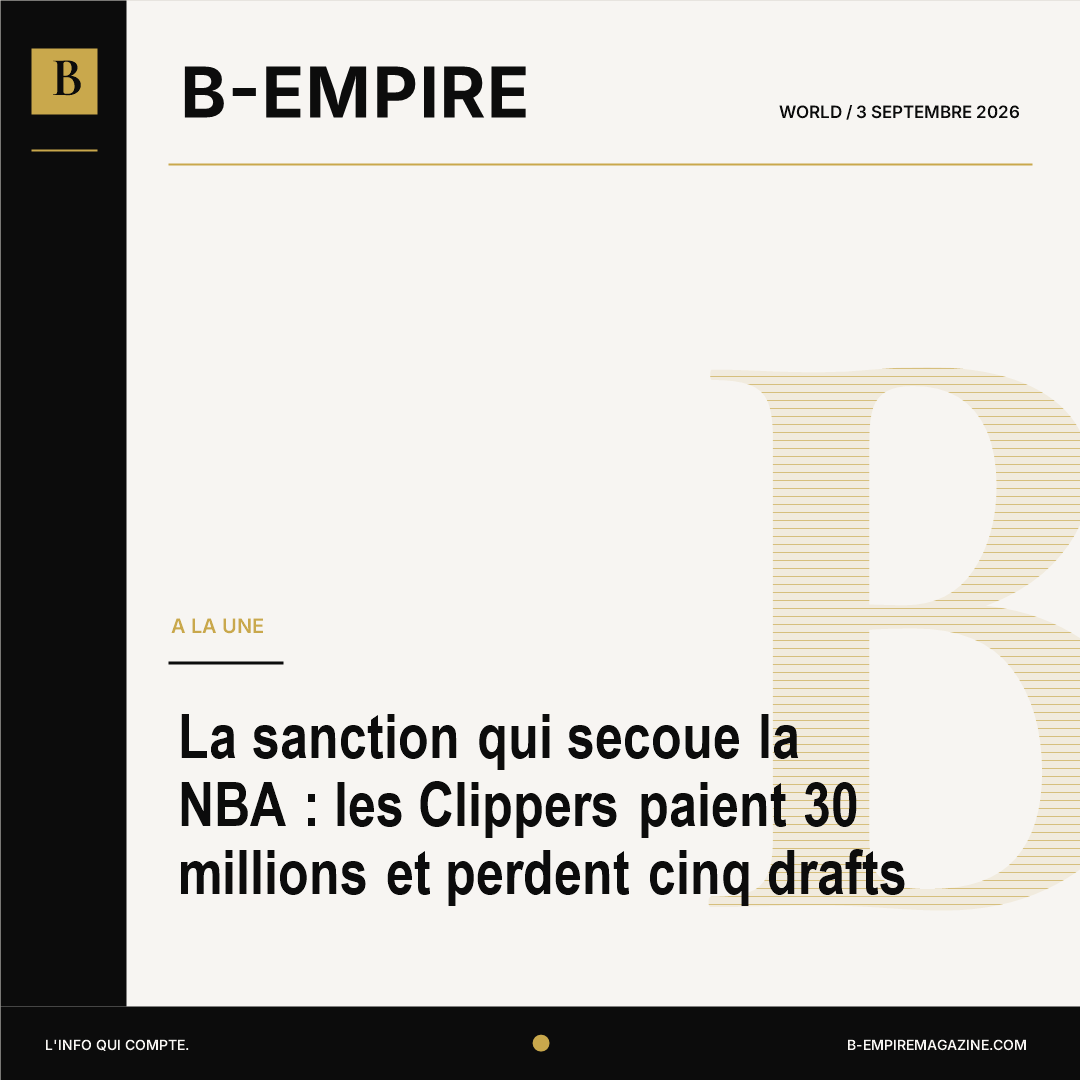
The NBA has just sent a warning that all major sports franchises around the world will hear. The Los Angeles Clippers have been fined $30 million and stripped of five first-round draft picks following an investigation into financial arrangements related to Kawhi Leonard. Owner Steve Ballmer has been suspended for one year. For an organization that wanted to embody power, modernity, and ambition in Los Angeles, the shock is immense.
The decision announced on September 2, 2026, goes beyond mere sports news. It touches on the rule that underpins the entire economic credibility of the NBA: no team should circumvent the salary cap by indirectly offering a player income that does not appear in their contract. The league claims that an independent investigation established a set of significant violations. The Clippers contest key elements of the case, but the sanction is already one of the heaviest in the recent history of American sports.
A Punishment That Leaves No Room for Doubt
The figures immediately convey the magnitude of the decision. The franchise will have to pay $30 million and forfeit a first-round pick in each of the drafts from 2029 to 2033. Steve Ballmer, former head of Microsoft and owner of the Clippers since 2014, is barred from all league and team activities for twelve months.
The president of business operations, Gillian Zucker, is also suspended without pay for one year. Lawrence Frank, president of basketball operations, receives a six-month suspension. Kawhi Leonard must pay $700,000, an amount presented by the NBA as restitution for undue benefits granted to his entourage. His former representative, Dennis Robertson, is banned from business dealings with the league.
In addition to this accumulation, there will be five years of institutional oversight. The NBA is not only sanctioning individuals or a past operation; it is placing the organization under prolonged control. This detail transforms the punishment into a genuine governance crisis. The message is clear: the league believes the problem cannot be resolved with a simple check.
What the NBA Accuses the Clippers Of
The case revolves around outside income obtained by Kawhi Leonard and the company Aspiration, which was once a partner of the Clippers before its bankruptcy. According to the findings published by the NBA, the organization allegedly actively sought off-court compensation opportunities for the star and linked certain business relationships to an endorsement contract intended for the player.
This mechanism is particularly sensitive in a league governed by a salary cap and a collective bargaining agreement. Advertising contracts are perfectly permissible. They become problematic if a franchise, its owner, or its partners use them as hidden compensation to persuade a player to sign, extend, or accept an official salary lower than their true value.
The NBA claims that Ballmer knowingly sought to help Leonard obtain these revenues and approved a business deal presented as a prerequisite for the arrangement between Aspiration and the player. The league also accuses the organization of having paid certain personal expenses. These conclusions were established after nearly a year of investigation conducted by the firm Wachtell, Lipton, Rosen & Katz.
The Clippers Contest, Leonard Claims Good Faith
The severity of the sanction does not erase the battle of narratives. The Clippers have repeatedly asserted that they did not organize a circuit intended to compensate Leonard outside the salary cap. The organization notably argued that the league’s legal advisors did not believe in the existence of a direct agreement aimed at funneling money from Aspiration to the player.
Kawhi Leonard, for his part, claims to have entered into his contracts in good faith, unaware of any potential intention to circumvent the rules. However, the star acknowledges errors in judgment within his entourage and accepts responsibility for the disruption caused. This nuance will be central to what follows: the NBA has sanctioned a system and behaviors, while those involved seek to distinguish their personal actions from a deliberate intent to cheat.
A legal or arbitration challenge remains possible according to the avenues provided by regulations and collective agreements. But in the media arena, the league’s decision is already having its effect. The name of the Clippers is now associated with a salary cap circumvention case, and Ballmer’s reputation as an innovative and generous owner has taken a severe blow.
Why Five Draft Picks Are Worth More Than $30 Million
For a billionaire like Steve Ballmer, a $30 million fine is spectacular yet not destructive. The loss of first-round picks, however, could handicap the Clippers for a decade. The draft allows teams to recruit young talent at a controlled cost, prepare for a rebuild, or facilitate major trades. Removing five consecutive selections equates to stripping away a significant portion of their maneuverability.
These picks pertain to the years 2029 to 2033, precisely the period when the franchise will have to manage the post-current generation. Even a wealthy team cannot directly buy first-round picks. They must be obtained through performance or trades, and other clubs now know that Los Angeles will negotiate from a position of weakness.
The sanction may also impact recruitment. Players, agents, and executives want stability. An organization monitored by the league, deprived of draft capital, and temporarily separated from its owner loses some of its allure. The Intuit Dome remains a spectacular arena, the Los Angeles market is unique, but infrastructure is insufficient when the sporting future becomes narrower.
A Warning for the Entire Sports Business
The case is of interest far beyond American basketball. In all major leagues, clubs develop partnerships, affiliated companies, image contracts, brand activations, and personal agreements with athletes. The more complex the ecosystem becomes, the more the boundary between legitimate commercial income and concealed sports compensation must be monitored.
The NBA is protecting two essential assets here: competitive balance and trust. If a franchise can use the wealth of its owner or that of a sponsor to circumvent collective limits, the salary cap becomes a fiction. Teams that adhere to the rules find themselves penalized, and fans may doubt the sincerity of the competition.
This logic resonates in Europe, where football constantly debates financial fair play, commercial contracts with related parties, and the ability of owners to inject money. The systems are different, but the question is the same: how to prevent private financial power from breaking common rules while allowing clubs to develop their brand?
Kawhi Leonard, a Career Even Harder to Narrate
Kawhi Leonard remains one of the most unique players of his generation. A two-time Finals MVP, champion with San Antonio and then Toronto, he has long embodied silent efficiency. His time with the Clippers was supposed to transform a franchise accustomed to disappointments into a perennial title contender. Injuries, eliminations, and instability have already complicated this narrative.
The case now adds an economic dimension to his legacy. It does not detract from the performances that made him a champion, but it alters how his arrival in Los Angeles will be narrated. The recruitment of 2019 is no longer just a sporting masterstroke: it becomes the starting point of an investigation into how a superstar can be attracted and compensated in the modern NBA economy.
The player is not suspended and can continue his career, but the amount of his sanction and the ban on his former representative show that the league does not consider him entirely outside the case. Every future statement will be scrutinized, as will the reaction of his business partners.
The Signal That No One in the NBA Can Ignore
The decision against the Clippers sets a precedent of power. It tells owners that their wealth does not place them above collective mechanisms. It tells agents that benefits granted to associates will be scrutinized. It tells sponsors that their contracts can become central pieces of a sports investigation.
For Los Angeles, rebuilding trust will be as challenging as rebuilding the roster. The franchise will have to operate without Ballmer for a year, under surveillance for five years, and without its first-round picks during a crucial period. It may contest, negotiate, and attempt to succeed despite everything. But it cannot erase the symbolic weight of this sanction.
The Clippers wanted to show that nothing was too great for them. The NBA has just reminded them that ambition without limits remains subject to rules. The $30 million will attract headlines. The five lost drafts, however, could determine the future.
Sources
- NBA â Official statement on the investigation and sanctions against the Clippers, September 2, 2026.
- Associated Press â Sanctions against the Clippers, Steve Ballmer, and Kawhi Leonard, September 2, 2026.
- The Guardian â Clippers stripped of five first-round draft picks, September 2, 2026.
- Al Jazeera â International implications of the NBA sanction, September 3, 2026.