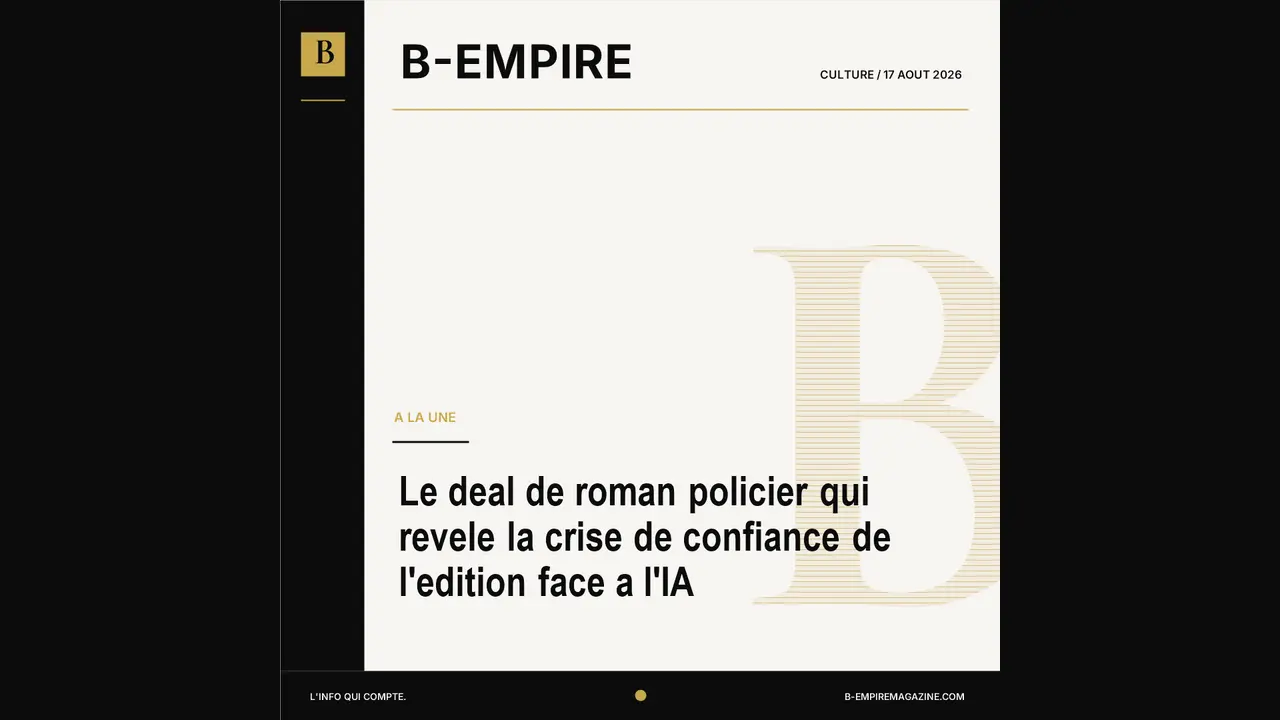
The novel that was supposed to become one of the major commercial events in Anglo-American crime fiction has turned into a trust test for the entire publishing industry. Call Me, I’ll Hide the Body, attributed to Jerry Falade, had attracted a spectacular international auction before its agents withdrew the manuscript from sale, saying they could no longer authenticate its complete evolution. The Guardian reported that the American offer was worth more than $2 million, with Minotaur, a Macmillan US imprint, at the centre of the deal. Since then, the case has acted like a brutal mirror: in 2026, the question is no longer only whether AI can produce text, but whether the cultural industry can still prove what it is buying.
The case is delicate because it cannot be reduced to a simple accusation. Falade denies using artificial intelligence and has connected the suspicion around him to racial bias in publishing. His agents, for their part, have not publicly said they possess definitive technical proof. Their wording is more administrative, but more vertiginous: they can no longer authenticate the manuscript’s path. That is exactly the grey area frightening the sector. Publishing knows how to sell stories, build reputations, negotiate rights and launch debuts. It is much less prepared to audit the intimate provenance of a style.
A cancelled deal, an awakened market
The economic scale explains the shock. A debut crime novel able to trigger a fourteen-way auction and six- or seven-figure international bids is not an ordinary manuscript. It is potential intellectual property: book, possible sequels, screen adaptation, foreign rights, author brand. When such an object disappears from the market within hours, this is no longer just a literary quarrel. It is a business alarm.
Crime fiction is especially exposed. Its efficiency rests on recognizable architectures: a fast hook, a strong central character, a mechanism of tension, reversals and a promise of series potential. Those elements suit generative models, not because machines understand crime or morality, but because they are good at imitating conventions. For a publisher, the danger is not only buying a text assisted by AI. It is buying a text whose creative process becomes impossible to defend before authors, readers and the courts of reputation.
Detection is not enough
The Guardian had already shown, in a wider investigation published in the spring, that tools for detecting AI-generated text remain fragile. Researchers and professionals explained that these systems can be bypassed, fooled or produce false signals. That is the central point: the industry cannot simply buy software and declare the problem solved. The more generative tools improve, the more automatic detection becomes a race the sector is unlikely to win.
The real work is therefore contractual and cultural. Publishers will have to ask for more precise declarations, preserve working drafts, document revision stages and clarify what counts as acceptable assistance and what changes the nature of a work. Correcting a sentence with a tool is not the same thing as entrusting the structure of a novel to a machine. Brainstorming a plot is not generating whole chapters. Yet between those poles, practices quickly become ambiguous.
The paradox of assumed talent
The affair is even more troubling because the manuscript was reportedly loved by seasoned professionals before doubts emerged. In an opinion piece published on August 16, the New York Post emphasized that paradox: if a text suspected of AI use seduced so many market players, what does that say about the border between editorial taste, commercial efficiency and human signature? The question is uncomfortable, but necessary. Publishing can no longer simply say readers will always know the difference. Sometimes the market does not know the difference.
Yet the easy conclusion should be avoided. A novel is not only a sequence of effective sentences. It is a relationship between experience, voice, imagination, social trajectory and a promise made to the reader. AI can produce the plausible. It can even produce the highly readable. But the cultural value of a book also depends on the responsibility of the person who signs it. When that responsibility becomes blurred, the reading pact weakens.
A question of trust, not only technology
The key word of 2026 may be less “authenticity” than “traceability”. Publishing houses do not need to turn every novelist into a permanent suspect. They need a protocol clear enough to protect honest authors, reassure rights buyers and prevent digital pile-ons. Transparency should not become paranoid surveillance, but the absence of a framework leaves the field open to rumours.
Authors are also placed in an unstable position. Many already use digital tools to research, organize, translate, reread and annotate. Should every form of assistance be declared? Or only substantial generative assistance? Will a young author without long archives be more easily suspected than an established name? And who will have the resources to defend themselves if an accusation appears before publication? The Falade affair shows that the AI debate is also about power: who is believed, who is checked, who is removed from the market.
What readers will ask for
Readers will not form a single bloc. Some will refuse any text associated with a machine. Others will accept AI as a tool, provided the author remains master of the vision. Others will not care if the book captivates them. The industry will have to live with those contradictory expectations. But one thing is becoming certain: silence will no longer be durable. A book sold as the expression of a human voice will have to be able to explain its relationship to generative tools.
That requirement does not concern novels alone. It will touch reviews, translations, covers, audiobooks, marketing copy and adaptations. The Guardian also reported in March that the New York Times had dropped a critic who used AI in a book review. The entire chain of cultural value is involved. The book is no longer an isolated object. It is an ecosystem of trust.
The signal for B-EMPIRE
For B-EMPIRE, this story marks a turning point for creative industries. AI will not only automate tasks. It will force cultural brands to define what they are really selling: a plot, a style, a name, a community, proof of origin, a human emotion. Houses that treat the question as a simple legal risk will arrive too late. Those that build readable standards can turn the crisis into an advantage.
The collapsed deal around Call Me, I’ll Hide the Body is therefore not an anomaly. It is a prototype conflict. Tomorrow, the same questions will appear in music, cinema, fashion, journalism and luxury. Creation has entered an economy where proof becomes part of the product. The public will no longer buy only a story. It will want to know how that story was born.
Sources
- The Guardian, collapse of the deal around Call Me, I’ll Hide the Body
- New York Post, Sam Munson opinion piece on the $2.4 million deal
- The Guardian, investigation into the difficulty of detecting AI-written books
- The Guardian, Hachette precedent and the novel Shy Girl
- The Guardian, the New York Times and an AI-assisted book review