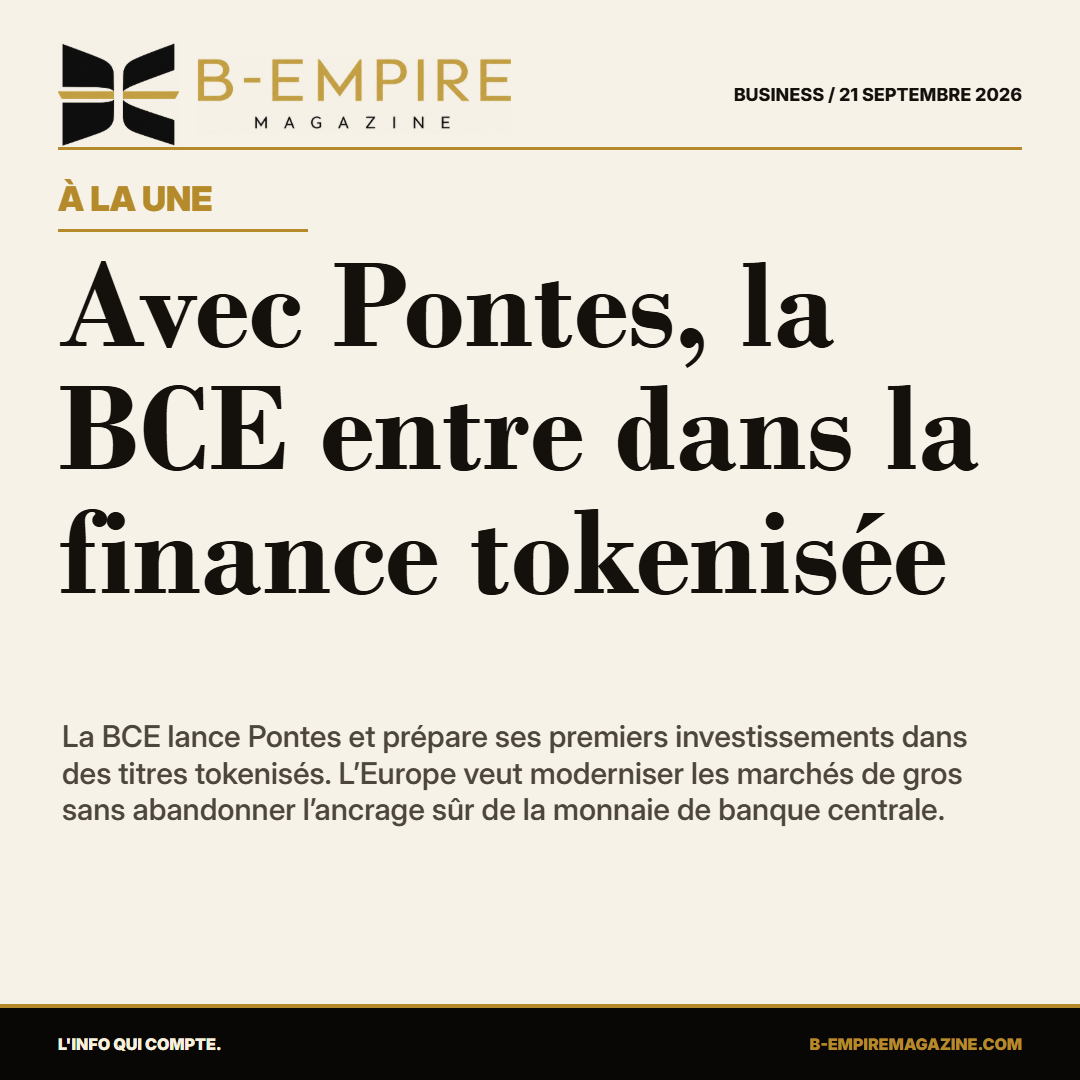
The European Central Bank no longer wants merely to observe tokenised markets: it wants to use them. On September 21, the Eurosystem launched Pontes, a solution enabling transactions in tokenised assets to settle in central bank money. At the same time, the ECB is preparing to invest a small part of its own funds in euro-denominated digital securities.
The move is limited in size but important in nature. The central bank will gain direct experience across the investment lifecycle: execution, settlement, systems and portfolio management. Initial purchases are expected to focus on securities issued by euro area governments, regions, public agencies and European supranational institutions. Timing and operational details will be decided after preparatory work.
A Bridge Between New Ledgers and Safe Money
Tokenising a security means representing it as a digital token, generally recorded on distributed ledger technology, or DLT. The promised advantage is automation across steps that are now separate: issuance, trading, settlement, custody and servicing. Programmable contracts can also trigger operations when predefined conditions are met.
The digital asset alone does not solve payment. A buyer must transfer safe value to the seller when ownership changes. Pontes connects market DLT platforms with the Eurosystem’s TARGET Services. It preserves central bank money as the settlement asset instead of relying exclusively on a stablecoin, a private tokenised deposit or foreign infrastructure.
This anchoring role is essential. In the traditional system, different forms of money remain accepted because they can be converted at par and settled on a common foundation. If tokenisation creates multiple closed networks, each with its own tokens and rules, markets gain technology but lose unity. Pontes is designed to stop innovation from producing new silos.
The ECB Becomes Its Own Laboratory
By investing a fraction of its own-funds portfolio, the ECB is adding a real-world test to technical experiments. This portfolio is separate from monetary policy and generates income that helps cover the institution’s operating expenses. The choice allows the ECB to learn without presenting the initiative as an interest-rate instrument or an asset-purchase programme intended to influence the economy.
That distinction matters. The announcement does not mean the ECB is replacing conventional reserves with tokens or declaring ordinary public bonds obsolete. It means an emerging infrastructure will be tested by an institutional investor capable of identifying frictions that prototypes may miss: availability, reconciliation, legal rights, incident handling and compatibility with existing tools.
Settlement Remains the Critical Point
The promise most often associated with DLT is atomic settlement: the security and payment move simultaneously, or neither moves. This can reduce the risk of one party delivering without receiving the expected countervalue. Yet the Bank for International Settlements notes that operational token transfer and legally final settlement may not coincide, depending on the architecture.
The first version of Pontes remains connected to TARGET infrastructure. Later development is expected to add more native functions, programmability and eventually extended operating hours. The challenge is to modernise without reducing resilience. A market available for longer requires supervision, liquidity, cybersecurity and recovery capacity suited to that schedule.
Pontes Now, Appia for the Long-Term Architecture
Europe is following two complementary tracks. Pontes supplies an operational bridge in the short term. Appia is intended to define a broader architecture for a European tokenised financial ecosystem, with a blueprint expected in 2028. A contact group of 61 financial-market participants and public institutions is supporting the work on user needs, risk management and technical evolution.
This method recognises that no single institution can impose an effective infrastructure. Banks, custodians, platforms, issuers, investors and central banks must agree on standards, governance and interoperability. Without sufficient volumes and available assets, a network remains a demonstration. Without common rules, multiplying networks increases the costs they claim to reduce.
An Industrial Strategy as Well as a Monetary One
The issue extends beyond transaction efficiency. The Eurosystem links Pontes to European financial autonomy. If tokenised markets grow around currencies, platforms and standards controlled elsewhere, Europe may depend on infrastructure it cannot easily govern. Providing euro settlement in central bank money gives private actors a European foundation on which to build services.
Pontes is therefore neither a spectacular embrace of cryptocurrency nor a guarantee of success. It is an attempt to preserve the financial system’s core qualities in a new architecture: monetary unity, settlement finality, risk management and institutional trust. By preparing to use its own money, the ECB now faces the most useful test of all: proving that the bridge works when a real transaction must cross it.
Pontes should not be confused with the digital euro intended for everyday retail payments. This project serves wholesale financial markets and institutional transactions, not consumer wallets. Keeping the distinction clear matters because the technologies, users and policy questions differ, even though both initiatives seek to preserve trusted public money as finance becomes more digital.