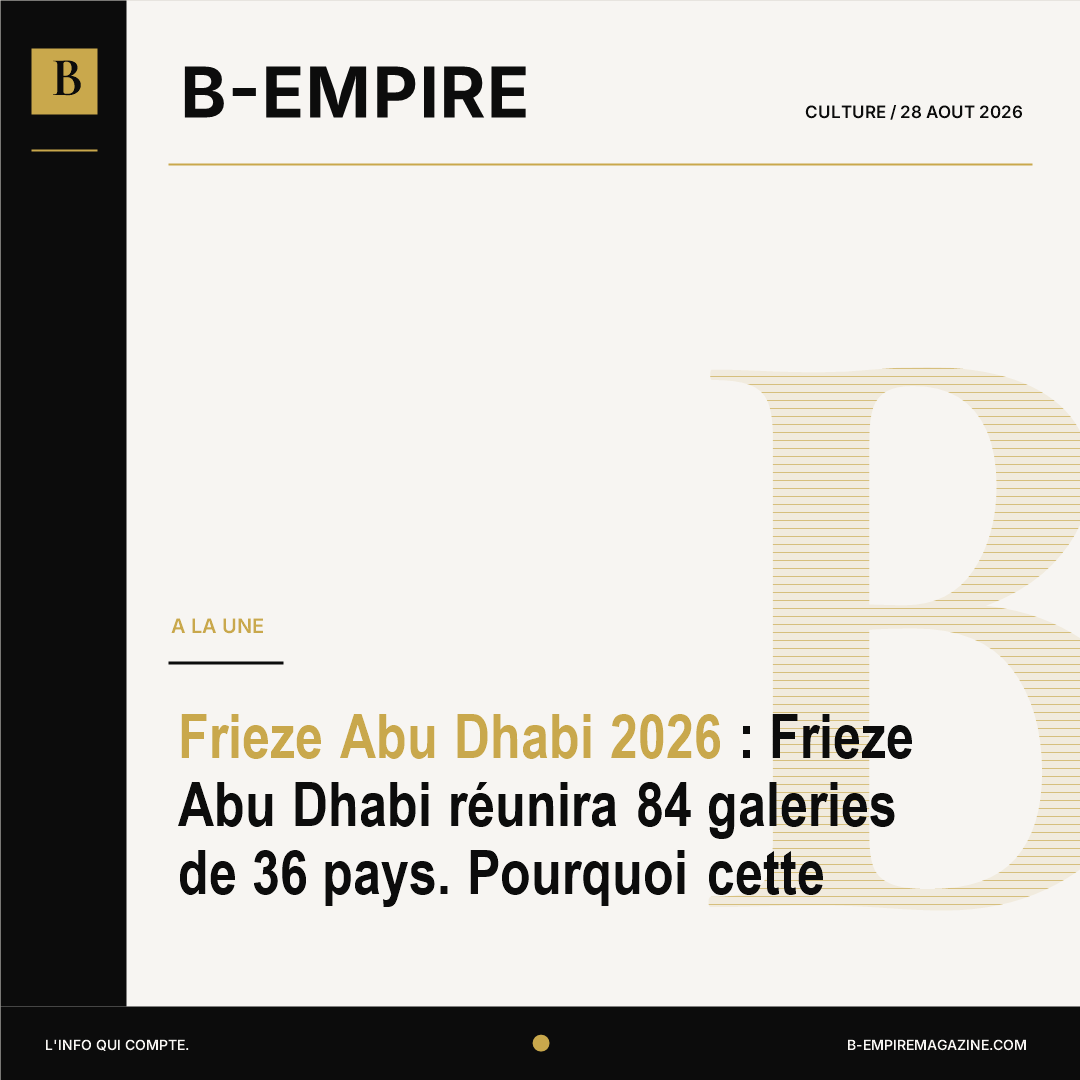
The global art market is no longer solely focused on London, New York, Paris, or Seoul. It is now looking at Abu Dhabi with an attention that cannot be minimized. The inaugural edition of Frieze Abu Dhabi will gather 84 galleries from 63 cities and 36 countries and territories, from November 19 to 22, 2026, at Manarat Al Saadiyat. This announcement is not merely a fair calendar; it materializes the gradual shift of cultural power, collectors, and capital towards the Gulf.
Frieze presents this edition as its first major fair in the WANASA region, which encompasses Western Asia, North Africa, and South Asia. The event joins an already established network in London, Los Angeles, New York, Chicago, and Seoul. For Abu Dhabi, the stakes are clear: to no longer be just a destination that hosts international institutions but to become a place where the market, artists, and narratives of the region impose their own rhythm.
84 Galleries, But Above All, a Map of Cultural Power
The numbers immediately convey the scale of the project. Gagosian, Pace Gallery, and Vito Schnabel Gallery are among the announced American names. On the European side, Thaddaeus Ropac, Victoria Miro, Timothy Taylor, and Waddington Custot will notably be present. However, reducing the fair to an import of major Western brands would be a mistake. The selection also includes Carbon 12, Lawrie Shabibi, The Third Line, and Tabari Artspace from the Emirates, Saleh Barakat Gallery and Galerie Tanit from Beirut, Athr and Hafez Gallery from Saudi Arabia, Dastan from Tehran, as well as a significant Indian presence.
This composition tells a more polycentric market story. International galleries are seeking collectors and institutions in the Gulf, while regional players gain a stage that connects them directly to Europe, the United States, and Asia. Frieze Abu Dhabi thus becomes an interface: a place where artworks are negotiated, but also the visibility, legitimacy, and place of artists in the global history of art.
Why This Inaugural Edition Could Change Everything
Frieze Abu Dhabi follows Abu Dhabi Art, an event developed over seventeen years. This continuity is essential. The new fair does not start from a blank slate; it builds on an already established network of galleries, collectors, museums, and artists. The Frieze brand brings global media strength and additional commercial attraction, but the local ecosystem constitutes the true foundation.
The choice of Manarat Al Saadiyat further amplifies the message. The site is located at the heart of the Saadiyat Cultural District, where the Louvre Abu Dhabi has already transformed the cultural image of the emirate. The Zayed National Museum and the Guggenheim Abu Dhabi complement this institutional ambition. With the fair, Abu Dhabi now clearly connects three dimensions: museums, the market, and international events.
From Antiquity to Contemporary Art
The announced programming is not limited to contemporary art. It is set to showcase works ranging from antiquity to the 21st century. Four major sections will structure the fair: the main Galleries section, Focus for younger international galleries, Global Futures dedicated to individual artist presentations, and Frieze Masters Abu Dhabi, oriented towards cultural exchanges around the Indian Ocean.
This choice broadens the audience and the narrative. It allows for a dialogue between historical objects, regional modernities, and contemporary creation without forcing the region to fit into a chronology written solely from the West. Commerce remains central, but it is enveloped in an intellectual ambition: to show that the circulations between Africa, the Middle East, South Asia, and Europe have produced their own stories of forms, materials, and ideas.
The Gulf Accelerates in the Cultural Economy
This rise in power goes beyond prestige. A major fair attracts collectors, advisors, artists, auction houses, journalists, hotels, restaurants, and luxury brands. It transforms culture into economic infrastructure. Each arrival can generate sales, commissions, residencies, collaborations, and visibility that extends well beyond the closing of the booths.
For the United Arab Emirates, this strategy also contributes to economic diversification. Art creates high-end tourism, enhances international attractiveness, and helps build an image of an open platform between continents. Frieze’s long-term partnership with Deutsche Bank also reminds us that the world of art and finance often move together: artworks are cultural objects but also assets, status markers, and relationship tools.
An Opportunity, But Also a Test of Credibility
The size of an exhibitor list does not guarantee success on its own. Frieze Abu Dhabi will need to prove that regional galleries are not merely serving as a backdrop for a few international giants. The fair must also convince on curatorial quality, diversity of artists, depth of exchanges, and the ability to attract active collectors, not just prestigious visitors.
The absence of certain giants, noted by Artnet, also shows that the game is not yet won. Fairs compete for calendars, budgets, and the best artworks. Abu Dhabi must therefore create its own identity, distinct from London, Seoul, or other Gulf events. Its advantage could precisely be this geography of crossroads between the Indian Ocean, the Arab world, Africa, and Asia.
What This Announcement Says About the World
Major fairs have long confirmed an already established cultural hierarchy. Today, they rather reveal a competition among cities capable of gathering institutions, money, talent, and media attention. Frieze Abu Dhabi shows that the next chapter of the art market will be less centralized. Collectors can come from Riyadh, Mumbai, Lagos, Seoul, or Dubai, while artists circulate between scenes that no longer systematically require validation from Paris or New York.
For Europe and France, this movement is not necessarily a loss. The European galleries present find enhanced access to new audiences, and French institutions can multiply collaborations. But the signal is powerful: influence is not preserved by inheritance. It is built through investments, coherent programming, and the ability to create events that the world does not want to miss.
The B-EMPIRE Verdict
Frieze Abu Dhabi is not just a new fair on an already busy calendar. It is a declaration of cultural power. With 84 galleries, 36 countries, and a location at the heart of Saadiyat, the event brings together the ingredients of a new center of gravity: institutions, market, tourism, cultural diplomacy, and global visibility.
The true verdict will come in November when visitors enter the booths and sales, discoveries, and conversations begin. But the announcement is already making its impact felt. It compels the market to look towards Abu Dhabi and take seriously a region that no longer wants to merely participate in the global art narrative. It wants to contribute to writing it.