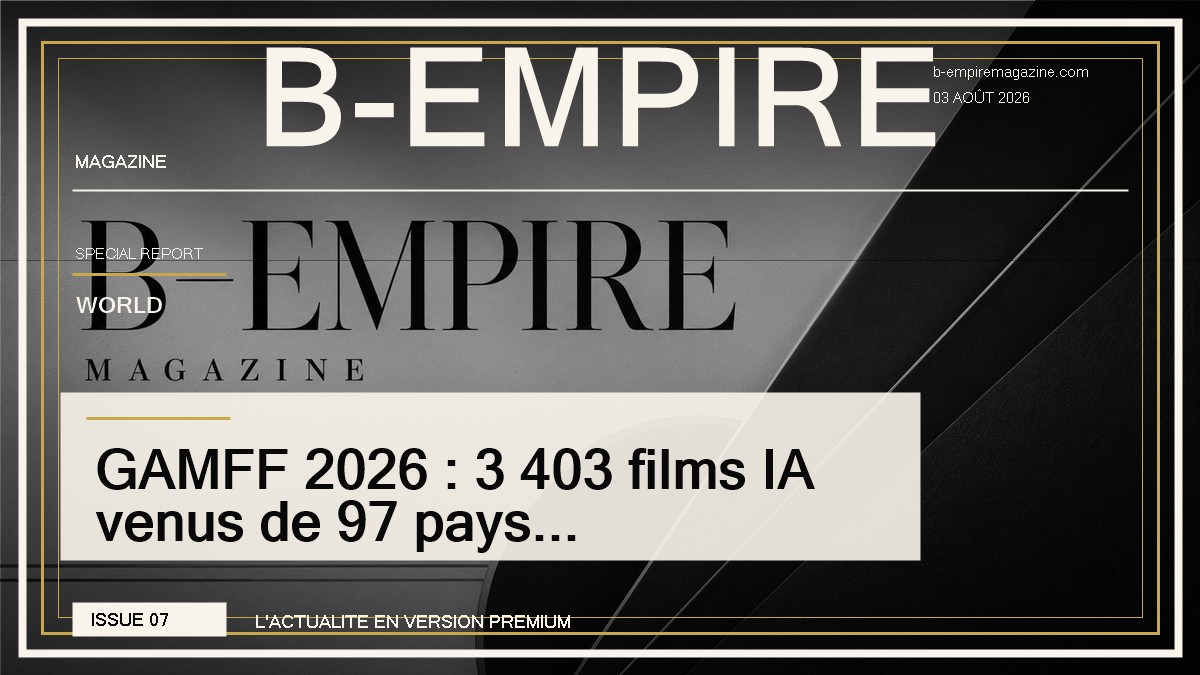
AI-generated cinema is no longer an experience reserved for a few tech studios. In South Korea, GAMFF 2026 has received 3,403 creations from 97 countries, a volume that transforms a regional competition into a global barometer of new audiovisual production. The selection announced on August 3 now opens a verification period ahead of the September ceremony. Behind the numbers, one question becomes urgent: what remains of the traditional rules of cinema when thousands of creators can produce images, voices, sets, and movements with generative tools?
The Gyeongsangbuk-do International AI & Metaverse Film Festival, simply known as GAMFF, will take place from September 3 to 6, 2026, in several cities in the South Korean province of North Gyeongsang. Its international competition covers four categories: narrative films created with AI, game videos, advertisements, and short formats optimized for social media. The competition accepts both professionals and students, teenagers, studios, or independent collectives.
3,403 Creations: A Number That Changes the Scale
According to an official statement from the province, the registrations that closed on June 30 reached 3,403 works from 97 countries. This geographical diversity is almost as significant as the volume. It shows that generative video tools are not only advancing in the United States, China, or South Korea: they are now circulating within a truly global creative community.
The barrier to entry has collapsed. A small team can design a visual universe, simulate complex effects, produce multiple versions of a shot, and localize content without the infrastructure of a large studio. The result does not guarantee originality or quality, but it enables a profusion that would have been financially unimaginable just a few years ago.
GAMFF offers approximately 100 million won in prizes, including 20 million for the grand prize. While this amount remains modest compared to traditional cinema budgets, it is significant for emerging creators. Moreover, the festival provides a public stage, screenings, an international conference, masterclasses, and a B2B space where works can meet producers, broadcasters, and tech companies.
South Korea Aims to Become the AI Cinema Laboratory
The choice of South Korea is not incidental. The country has already built global influence through K-pop, series, cinema, and video games. By placing AI at the intersection of these industries, the organizers aim to capture the next cycle of the cultural economy. Gumi will host the opening, awards ceremony, an international conference, and a business exhibition; Pohang will focus on technological art, while Gyeongsan will develop the gaming aspect.
The festival thus speaks not only of films. It connects storytelling, advertising, social media, game engines, VFX, and immersive media. This blend corresponds to the new attention market: a single creator can produce a short narrative, its vertical trailer, an interactive universe, and a brand campaign using a largely automated toolchain.
The advertising format is particularly revealing. The regulations invite candidates to promote festivals, businesses, and traditional markets in the region. AI thus becomes a tool for territorial development. A global technology is used to sell local products, culinary specialties, or tourist destinations, with the hope that a spectacular aesthetic will accelerate their international circulation.
Copyright: The Tension Point That Cannot Be Avoided
The success of the competition does not eliminate controversies. The official regulations generally assign rights to the participants but require them to ensure they have the necessary permissions when their work incorporates elements belonging to third parties. It also specifies that the responsibility related to AI tools and their outcomes rests with the creators.
This precaution summarizes the global problem. An image can be technically new while being produced by a model trained on millions of works whose authors have not always consented to the use. Synthetic faces can resemble real people, voices can imitate artists, and styles can be reproduced at high speed. The line between inspiration, transformation, and appropriation becomes increasingly difficult to trace.
GAMFF requires that a mention indicates the use of AI in the submitted videos. This transparency constitutes a first level of response, but it does not suffice to resolve issues regarding data provenance, compensation for rights holders, or proof of human labor. The competition will thus be observed as much for its works as for its ability to document the tools and exclude contentious content during the verification phase, which lasts until August 14.
What This Wave Means for France and Europe
For France, a historical powerhouse of cinema and animation, the signal is direct. Schools, independent studios, advertising agencies, and visual effects companies will need to train their teams in these methods without abandoning the protection of authors. The challenge is not to choose between human cinema and automated cinema, but to determine which tasks can be accelerated, which data can be used, and how to credit each contribution.
Europe has an advantage: its legal framework emphasizes transparency, data protection, and copyright. However, it also risks losing ground if its creators do not have access to the infrastructures, funding, and tools available in Asia or North America. Faced with 3,403 international proposals, the response cannot be limited to prohibition. It must include laboratories, residencies, traceability standards, and new contracts.
Film unions are also monitoring employment. Storyboarding, dubbing, pre-visualization, sets, editing, localization, and visual effects are directly concerned. AI can reduce certain costs and make fragile projects possible; it can also concentrate value in the hands of the platforms that control the models. The central question will thus be one of sharing: who owns the tool, who takes the artistic risk, and who receives the revenue?
A Festival That Already Exposes the Future
Quantity will never replace the vision of an author. Among thousands of videos, many are likely to employ the same textures, the same impossible camera movements, and the same overly perfect faces. The next aesthetic challenge will be precisely to break free from this uniformity. The strongest works will likely not be those that use the most AI, but those that understand why they use it.
Yet, GAMFF 2026 highlights an undeniable rupture. When 97 countries respond to the same call and produce 3,403 contents in a few months, the phenomenon has surpassed the stage of demonstration. Traditional festivals, platforms, and studios will need to create categories, selection criteria, and transparency obligations capable of keeping pace with this production.
In September, the winners will reveal whether AI cinema has already found its first great authors or if it is still searching for its language. But the number revealed today is enough to establish one certainty: global audiovisual creation has just entered a period of radical abundance. The real challenge will no longer be whether a machine can generate images, but whether humans can give them meaning, rules, and a signature.
Sources
- North Gyeongsang Province, official report on applications: 3,403 works from 97 countries.
- GAMFF 2026, official regulations, schedule, categories, prizes, and provisions on rights.
- Official GAMFF festival website, program from September 3 to 6, 2026, and event distribution.
- Gyeongsangbuk-do Culture and Tourism Organization, institutional announcement of the 2026 competition.