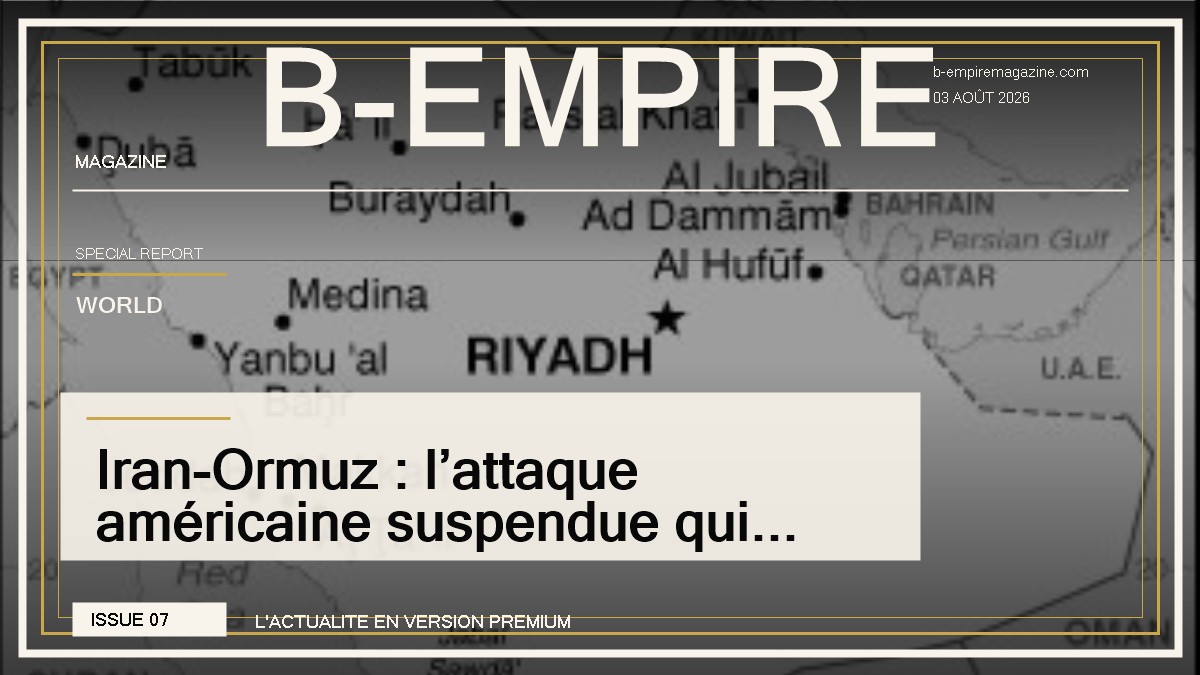
An American attack described as potentially massive has been suspended at the last moment, and global markets have immediately breathed a sigh of relief. On Sunday, August 2, 2026, Donald Trump announced that he had decided against ordering new strikes against Iran following interventions from the leaders of Qatar, Saudi Arabia, and the United Arab Emirates. The American president claims that the parameters for a way out of the war are beginning to emerge. However, behind this dramatic military halt, a reality imposes caution: no final agreement has been signed, negotiations must resume, and Tehran is already contesting the American version regarding the reopening of the Strait of Hormuz.
The signal is nonetheless global. According to the Associated Press, Donald Trump indicated that an attack plan was ready before he chose to give diplomacy more time. A few hours later, oil prices fell sharply. The market immediately integrated the hope of a reduced risk in the Gulf, where the closure and attacks around Hormuz have disrupted one of the planet’s most strategic energy routes for months. This relaxation remains fragile, but it is already affecting businesses, transportation, and consumers from Paris to Tokyo.
The Last-Minute Offensive Suspended
Donald Trump told reporters aboard Air Force One that a new American operation against Iran was set to be launched on Sunday. He described it as an attack of exceptional magnitude. This presidential assertion has not been independently detailed by the Pentagon in the information available at the time of publication. It should therefore be reported as the White House’s version, rather than as proof that a precise and irreversible offensive was already underway.
The American president explained that he asked Gulf officials whether they preferred an attack or an additional chance for an agreement. Their response was reportedly clear: escalation risked opening a sequence that would be impossible to control. The role of Saudi Crown Prince Mohammed bin Salman appears particularly significant, alongside Qatari Emir Tamim bin Hamad Al Thani and Emirati President Mohammed bin Zayed. These three capitals are not only defending peace as a principle. They are also protecting their cities, energy infrastructures, ports, and their ability to remain global investment hubs.
Hormuz Remains the Key to Any Crisis Exit
The economic heart of the issue lies in the Strait of Hormuz. Before the conflict, about one-fifth of the world’s energy passed through this narrow passage between Iran and Oman, as noted by the Associated Press. Since the outbreak of war on February 28, attacks, restrictions, and maritime risks have disrupted the movement of oil tankers. Shipments have been immobilized, insurance costs have skyrocketed, and companies have had to arbitrate between waiting, rerouting, and military exposure.
Donald Trump asserts that the scheme under discussion would include an immediate and complete reopening of the strait as well as a resolution of American concerns regarding Iran’s nuclear program. However, Iranian Foreign Ministry spokesman Esmail Baghaei stated that Hormuz would not return to the situation that prevailed before February 28. He confirmed discussions with Oman regarding navigation while denying that a simple reopening was already being negotiated. This contradiction is essential: the two sides do not yet describe the same agreement.
Oil Prices Drop, but Peace Is Not Yet Bought
The market’s reaction demonstrates the power of even the slightest hope. The Associated Press reported a significant drop in oil prices on Sunday evening following the announcement of the American pause. A lasting end to hostilities could free oil tankers trapped in the Gulf, facilitate exports, and reduce a risk premium that has impacted gasoline, diesel, aviation, freight, and numerous industrial chains. Hydrocarbon producers have accumulated significant profits during the crisis, while importing economies have suffered from higher energy costs.
This drop, however, does not guarantee an immediate return to normalcy. The oil market reacts to probabilities as much as to actual volumes delivered. If discussions fail, prices could sharply reverse. Donald Trump has already announced several pauses since the war began before hostilities resumed. The current episode should therefore be read as a diplomatic window, not as an accomplished peace.
The Gulf Takes Control of Global Diplomacy
The most spectacular change may be political. For decades, Gulf monarchies have often been described as partners aligned with Washington. In 2026, they appear as actors capable of halting an American military decision and organizing an exit between powers. Their influence relies on personal relationships, considerable financial capabilities, and immediate geographical vulnerability.
Riyadh, Doha, and Abu Dhabi know that a new wave of strikes could provoke retaliation against oil terminals, gas facilities, military bases, or trade routes. Qatar remains a central power in liquefied natural gas. Saudi Arabia remains a pillar of the oil market. The Emirates are a leading air, logistics, and financial hub. Their preference for a compromise is therefore neither passive nor symbolic: it corresponds to the direct defense of their economic model.
What the Proposed Agreement Would Entail
According to a regional official cited by the Associated Press, the proposal would bring the United States and Iran back to the negotiating table. It would include the resumption of navigation in the strait, the cessation of attacks in the region â including those attributed to Iran-backed groups â as well as the end of the American naval blockade. Tehran could once again export its oil under the proposed ceasefire.
The formula is ambitious because it attempts to link four explosive issues: direct war, Hormuz, Iranian exports, and nuclear matters. Each of these topics has already derailed discussions. The regional official also emphasized that no agreement has yet been concluded. Israel had not publicly confirmed the announced conditions at the time the first information circulated. Therefore, the coming hours should be observed more than celebrated.
Why France and Europe Are Directly Concerned
For France, the crisis is not distant. A lasting détente in Hormuz could help reduce fuel costs, air transport, freight, and certain industrial productions. It could also lessen inflationary pressure at a time when European households remain sensitive to energy prices. Conversely, a new escalation would quickly impact gas stations, airlines, and corporate budgets.
Europe also has a diplomatic interest. It has been trying for years to preserve a framework for controlling Iran’s nuclear program and freedom of navigation. If Gulf countries become the main architects of a way out of the crisis, Paris and Brussels will need to support mediation without merely observing. Maritime security, access to energy, and the stability of regional partners are too important to be left to a fluctuating bilateral negotiation between Washington and Tehran.
The Signal Markets Cannot Ignore
The drop in oil prices already tells a significant story: after five months of war, the world pays a premium for every sign of de-escalation. This shows how much Hormuz has become a button capable of simultaneously affecting inflation, financial markets, airline tickets, Asian trade, and European purchasing power. A few phrases spoken on Air Force One were enough to shift billions of dollars in expectations.
But the true headline of this day is not “the war is over.” It is more precise and, at its core, more tense: an American attack has been suspended, the Gulf powers have gained time, and the markets have bet on diplomacy. Now, negotiators must transform this pause into verifiable commitments. As long as Hormuz is not reopened under accepted rules, as long as strikes do not cease permanently, and as long as the nuclear issue remains unresolved, relief remains reversible.
Sources
- Associated Press â Trump suspends new strikes and details the role of Gulf leaders, August 2, 2026.
- Associated Press â oil prices drop after announcement of military pause, August 2, 2026.
- Axios â cancellation of the attack and state of negotiations, August 2, 2026.
- El PaÃs â context of the conflict and conditions discussed around Hormuz, August 2, 2026.