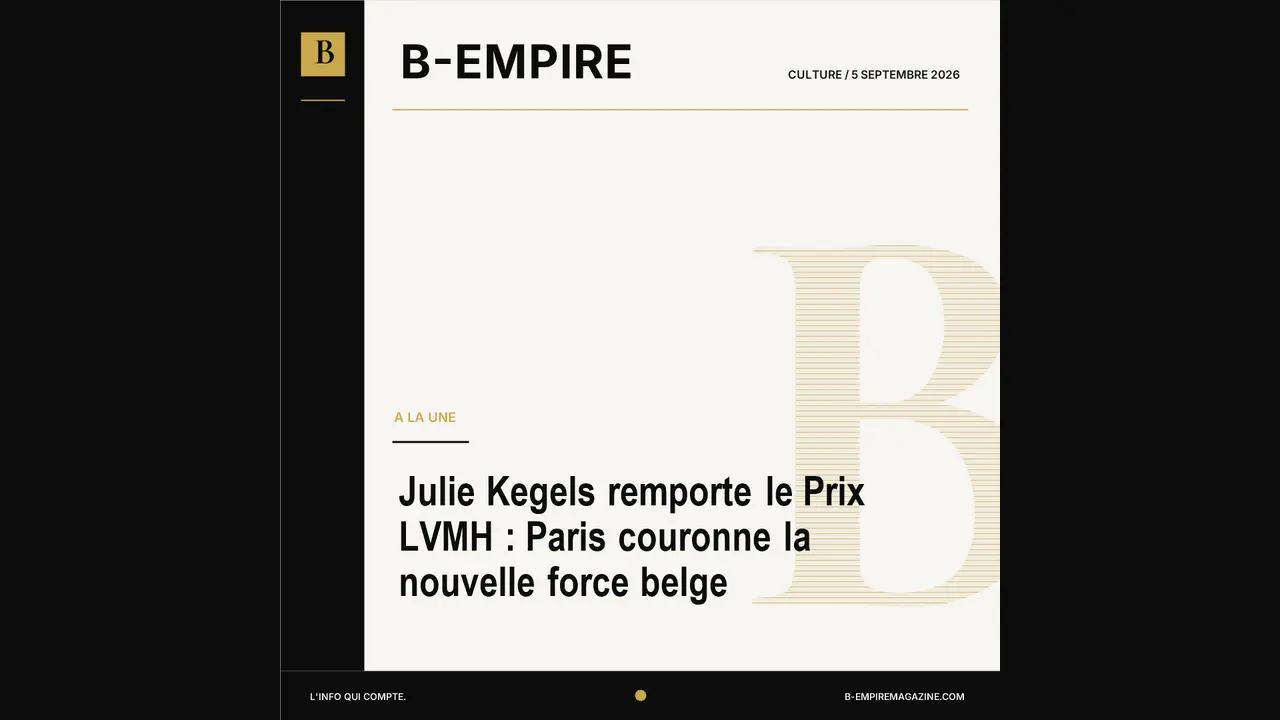
In Paris, a still-confidential Belgian designer has just crossed one of the most watched doors of global fashion. Julie Kegels won the LVMH Prize 2026 for Young Fashion Designers on Friday, September 4, at the Louis Vuitton Foundation. The prize includes 400,000 euros, a year of personalized mentorship from the group’s teams, and, most importantly, international exposure capable of changing the scale of a label launched just two years ago.
The victory transcends the mere prestige of a trophy. In an industry where creativity must now coexist with production, margins, distribution, and the power of images, the LVMH Prize acts as an accelerator. Julie Kegels is not just receiving a check: she is gaining time, skills, and rare access to the infrastructure of the world’s leading luxury group.
Julie Kegels, making the ordinary strangely desirable
Julie Kegels’ language starts from familiar elements. A jacket, a skirt, or a dress initially seem to belong to an almost ordinary wardrobe. Then a shift appears: a proportion is displaced, a construction surprises, a classic silhouette becomes slightly unstable. It is this tension between banality and sophistication that has allowed her work to stand out in a particularly international final.
Vogue France highlights this ability to transform garments that seem to have already lived a life. The result is neither cold minimalism nor spectacular accumulation. Kegels rather works with ambiguity: the garment remains wearable, but it refuses to become predictable. In a market saturated with products that are immediately recognizable on social media, this subtlety can become a powerful signature.
The designer launched her eponymous label in 2024 after experiences at Alaïa and with Meryll Rogge. This trajectory matters. It connects the Parisian demand for tailoring, a Belgian sensitivity historically associated with experimentation, and a contemporary understanding of the real woman. The LVMH Prize now offers her the means to transform this grammar into a sustainable business.
A global final held in the heart of Paris
The thirteenth edition brought together nine finalists from Belgium, the United States, France, Georgia, China, Sweden, the United Kingdom, Spain, and, for the first time, Kenya. LVMH indicates that over 2,400 applications were reviewed before the semi-final held at La Samaritaine. This geography speaks to the current state of fashion: talent no longer has a single center, but Paris retains the ability to consecrate trajectories.
Julie Kegels was selected by a jury that included Jonathan Anderson, Sarah Burton, Maria Grazia Chiuri, Nicolas Ghesquière, Marc Jacobs, Stella McCartney, Phoebe Philo, Nigo, and Pharrell Williams, alongside the group’s executives. Being judged by creators who lead Dior, Givenchy, Louis Vuitton, Fendi, Loewe, Celine, Kenzo, or Pucci gives this victory a particular value: the young Belgian convinced those who already define a large part of the global landscape.
The award presentation by Jennifer Lawrence added a cultural and media dimension to the ceremony. The gesture illustrates how fashion, cinema, and celebrity now function as a single ecosystem of attention. A collection no longer circulates solely on a runway: it spreads through red carpets, campaigns, social platforms, and international communities.
400,000 euros, but above all a decisive year
The endowment of 400,000 euros can finance a collection, strengthen a team, secure materials, or support production. However, the one-year mentorship could be even more decisive. Many young brands do not disappear due to a lack of ideas, but because growth arrives faster than their structures. International orders, deadlines, cash flow, intellectual property, and logistics suddenly become as important as design.
The support from LVMH teams should help Kegels navigate this fragile transition between an admired label and a viable house. The challenge will be to increase volumes without banalizing the product, to find partners without losing control of the narrative, and to build a distribution that protects desirability. The victory creates global expectations; it does not guarantee economic stability on its own.
Three prizes, three visions of the fashion of tomorrow
The final also distinguished two other proposals. Zane Li, based in New York with his label LII, received the Karl Lagerfeld Prize, endowed with 200,000 euros and accompanied by mentorship. His approach brings sportswear and couture closer through clean volumes, tactile materials, and sculptural construction. It confirms that traditional categories continue to blend.
The Craftsmanship Prize went to Anil Padia for Yoshita 1967. The designer, who connects a Parisian training with his Indo-Kenyan roots, works particularly with crochet, corsetry, and artisanal techniques. His presence marks a historic milestone for Kenya in the competition and reminds us that truly global fashion is not about standardizing references, but about providing a broader platform for situated know-how.
Belgium confirms its creative power
For Belgium, Julie Kegels’ success extends a reputation built over several decades. The country has established a school of thought where garment construction, irony, and aesthetic independence are as important as spectacle. Kegels belongs to a new generation: she inherits this freedom without merely reproducing its signs.
This victory also comes at a time when European luxury is seeking new narratives. Major groups must attract younger customers, manage irregular demand, and renew their artistic directions. Supporting small labels allows for the detection of emerging sensitivities, but also preserves a creative pool that the major houses will need tomorrow.
Paris crowns not just a name, but a possibility
The next test will be visible as soon as the upcoming collections. Julie Kegels will need to convert curiosity into orders, professional recognition into a loyal public, and the support received into an even more precise identity. Such a powerful reward can accelerate a career; it can also impose a difficult rhythm to maintain. Her strength will be to retain that slight unease that makes her garments recognizable without locking them into a formula.
For Paris, the final confirms a unique role. The French capital remains a place where creators from several continents can access a global stage. For LVMH, the prize maintains a dialogue with the next generation. For Julie Kegels, finally, September 4, 2026, will remain the day when a young Belgian label ceased to be merely a promise to become one of the most watched names in international fashion.
Sources
- Vogue France, September 4, 2026, on Julie Kegels’ victory, the other winners, and the designer’s profile.
- LVMH, official presentation of the thirteenth edition, the endowment, the finalists, and the jury.
- LVMH Prize, official page of the 2026 edition and list of selected designers.
- Le Figaro, September 5, 2026 edition confirming Julie Kegels’ selection by the jury.