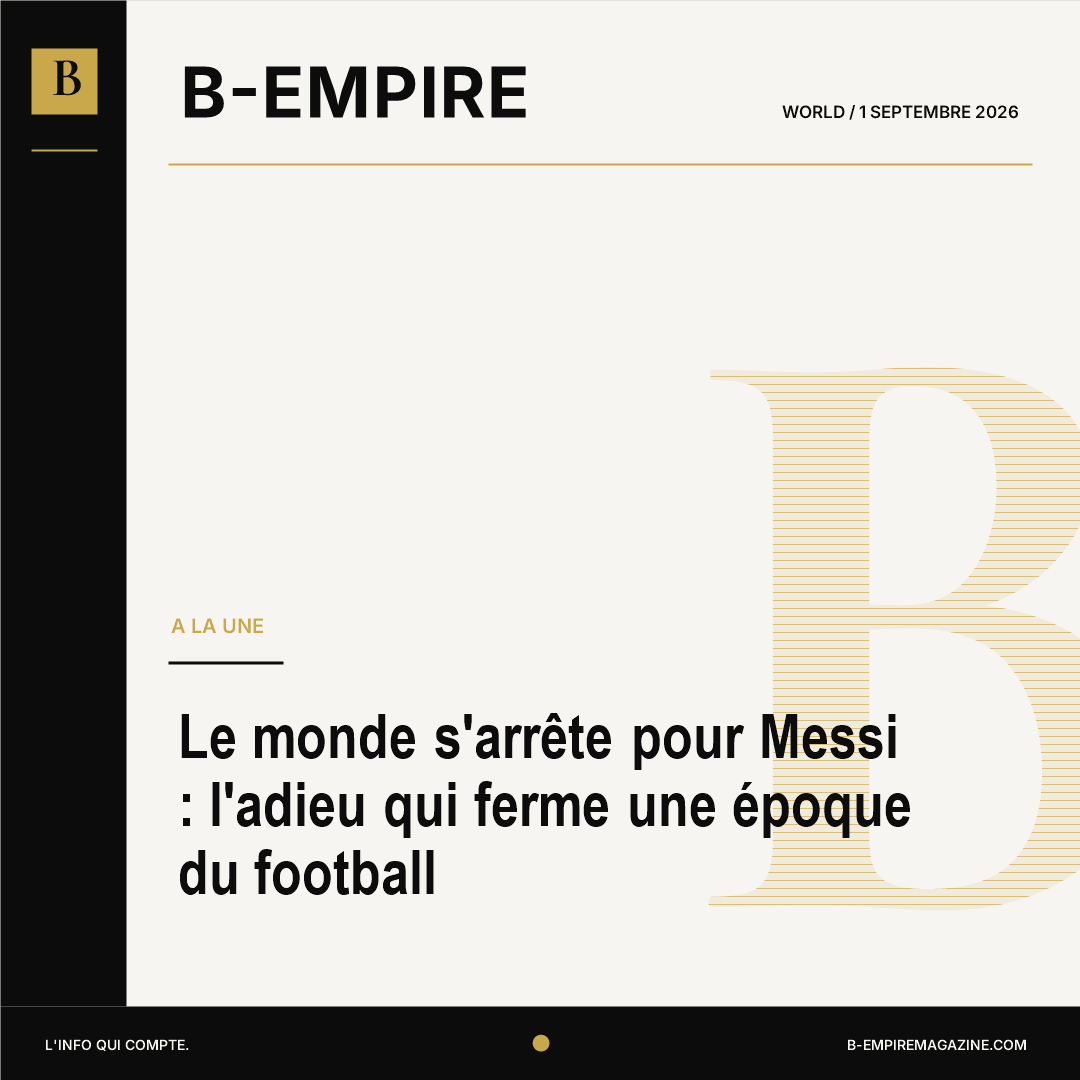
The world of football has just lost one of its last eternal references. At 39 years old, Lionel Messi has announced his international retirement, bringing to an end a twenty-one-year story with Argentina. The captain of the Albiceleste leaves the national team after 207 matches and 125 goals, one World Cup title, two Copa América victories, and one Finalissima. This is not just the departure of a great player; it is the closing of an era that has accompanied several generations, from Buenos Aires to Paris, from Barcelona to Miami.
The announcement, published on August 31 on Messi’s social media and subsequently confirmed by FIFA and major international media, comes after Argentina’s loss to Spain in the 2026 World Cup final. His last match in blue and white will thus remain a world final. A cruel exit in sporting terms, but consistent with the magnitude of his career: Messi will have left the international stage at the final act of the greatest tournament, having once again led his country to the brink of the title.
A Shocking Announcement for the Football World
In his message, Messi explains that he has given everything for the Argentine jersey and feels that the time has come to make way for a new generation. FIFA echoed a phrase that encapsulates the emotional exhaustion of the captain: he has emptied himself for the national team. Behind these words lies the fatigue of a career that began in 2005, marked by criticism, lost finals, a first false retirement in 2016, and then a spectacular reconciliation with his country.
The significance of this decision extends far beyond Argentina. Messi is one of the few figures capable of transforming a match into a global cultural event. His number 10, his celebrations, his dribbles, and his silences have circulated across all continents. For two decades, he has embodied a form of continuity in a football landscape disrupted by social media, new investors, streaming, and the economic explosion of competitions.
207 Caps and 125 Goals: Almost Unreal Numbers
The numbers tell part of the story. According to Le Monde and L’Ãquipe, Messi finishes with 207 caps, far ahead of Javier Mascherano in the Argentine hierarchy, and 125 goals, more than double Gabriel Batistuta’s total. He played in six World Cups and reached three finals, in 2014, 2022, and 2026. Most importantly, he delivered to Argentina the trophy that had seemed elusive, in Qatar in 2022.
However, to reduce Messi to mere records would miss the essence. His international journey was long portrayed as the only weakness in a perfect career. Each defeat with Argentina seemed to weigh more than his club exploits. The Copa América 2021 broke this narrative. The 2022 World Cup definitively overturned it. From then on, Messi was no longer just the genius of Barcelona; he had become the captain who restored pride to an entire nation.
From the Pain of 2016 to the Pinnacle of 2022
The farewell in 2026 inevitably echoes that of 2016. After another Copa América final lost to Chile, Messi announced he was leaving the national team. He returned a few weeks later, driven by popular attachment and the feeling that his story with Argentina could not end that way. Ten years later, the context is radically different.
This time, he departs after having won everything. He has experienced the Copa América, the Finalissima, the World Cup, and another World Cup final in 2026. Frustration exists, but it no longer defines his legacy. The loop is closed. The one who was sometimes accused of not feeling the national jersey leaves the team as its most capped player, its top scorer, and the absolute symbol of the Lionel Scaloni era.
Argentina Faces the Most Difficult Void to Fill
For Argentina, the challenge begins now. Replacing Messi does not merely mean finding a new creator or redistributing offensive responsibilities. It requires rebuilding an identity without the player around whom the entire emotional ecosystem of the national team has been organized. For years, teammates, coaches, and supporters have learned to believe that every match could hinge on a gesture from the number 10.
Scaloni and the federation will need to navigate a delicate transition. Young talents are emerging, as Messi himself has pointed out, but none can bear the weight of this succession alone. The post-Messi era must be collective. The risk would be to immediately seek a unique heir, comparing every new playmaker to the greatest player in Argentine history and turning the reconstruction into an impossible contest.
The French Perspective: A Story Also Experienced from Paris
France holds a special place in Messi’s international narrative. It was against the French that he won the 2022 World Cup, culminating in a final that instantly became legendary. It is also in Paris that he spent two club seasons, donning the PSG jersey, in a relationship that was sometimes complicated with the public but at the center of a global media exhibition.
For French supporters, his international retirement also closes the significant chapter of Messi-Mbappé. Their duel in the final in Doha symbolized a possible transition between two generations. The new era now belongs to Mbappé and the stars who grew up watching Messi. Yet, the absence of the Argentine number 10 will leave a void in major competitions: less a rival, football loses a universal point of comparison.
Messi Is Not Leaving Football Yet
This announcement pertains only to the national team. Messi continues his club career with Inter Miami. His sporting, commercial, and cultural influence will therefore not disappear. MLS will continue to benefit from his drawing power, and every decision regarding the next steps of his career will remain closely followed on an international scale.
This detail is important: the world is not yet saying goodbye to the player, but to the most emotionally charged version of Messi. The Argentine jersey has always represented for him something more than a contract or a professional step. It carried the expectations of a country, the comparison with Diego Maradona, and the desire to transform an individual genius into a national hero.
Why This Farewell Surpasses All Records
Great sporting retirements create a shock because they force the public to measure the time that has passed. Children who discovered Messi in 2005 are now parents. Players who wore his jersey in the stands have become internationals. His departure brutally reminds us that the Messi-Cristiano Ronaldo era, which has structured world football for nearly twenty years, is coming to an end.
This is why the announcement possesses such powerful emotional and viral potential. It unites Latin America, Europe, Africa, Asia, and the Middle East around a shared memory. Everyone holds onto a goal, a dribble, a final, or an image. Few athletes have constructed such a universal language.
The Signal That No One Can Ignore
Lionel Messi’s international retirement is not ordinary news. It marks the official end of a global cycle. Argentina loses its captain, football loses its most consistent hero, and an entire generation realizes that its references are changing. The statistics will remain, as will the trophies. But the essence lies elsewhere: for twenty-one years, every appearance of Messi with the Albiceleste carried the promise that an impossible gesture could still happen.
The world will now watch Argentina learn to move forward without him. Messi, for his part, will continue at the club level, but his international story is complete. A story that began in doubt, traversed pain, and ended at the pinnacle of legend. The number 10 leaves the stage. An entire era departs with him.
Reliable Sources
- FIFA – Messi bids farewell to the Argentine national team (August 31, 2026)
- Le Monde – Lionel Messi announces his international retirement (August 31, 2026)
- L’Ãquipe – Messi ends his international career with Argentina (August 31, 2026)
- Euronews – Lionel Messi announces his international retirement (August 31, 2026)