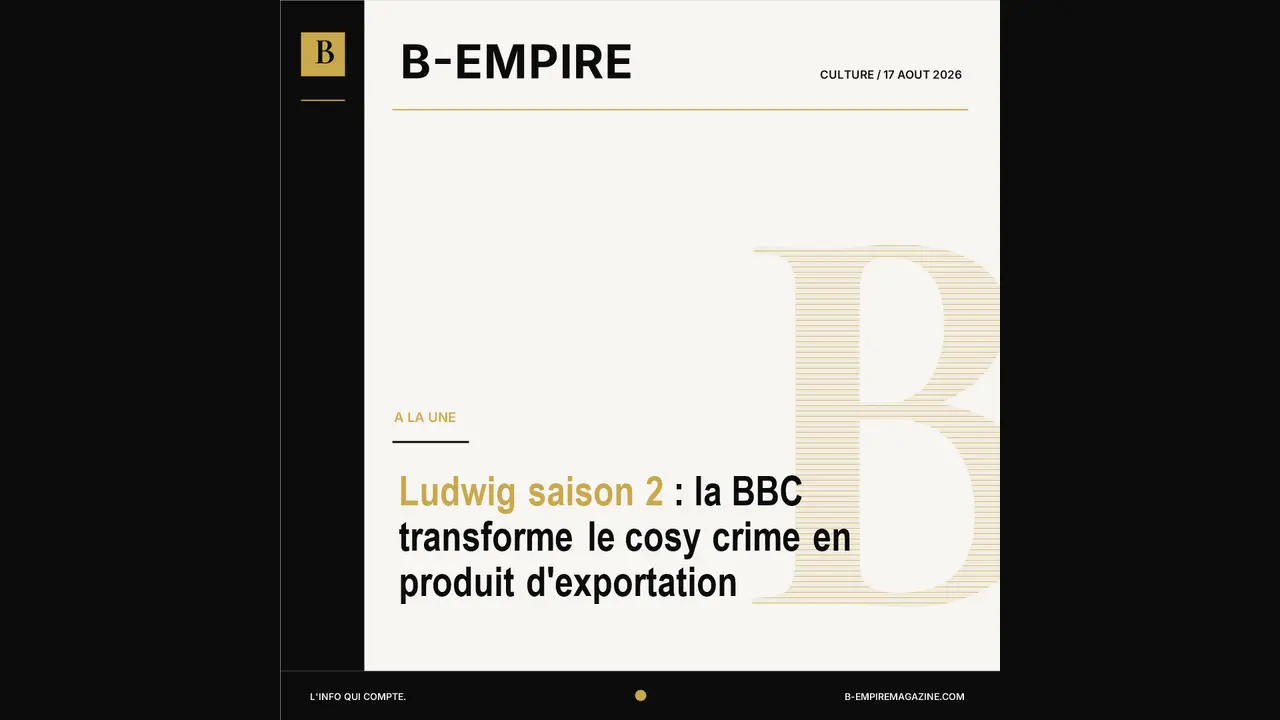
Days before its return to BBC One, Ludwig looks less and less like a simple British comic curiosity. The second season of the David Mitchell series is due to arrive on August 20, 2026, according to The Times, while a third season has already been commissioned before the second has even aired. In a global television market dominated by dark franchises, industrial procedurals and platforms searching for the next algorithmic jolt, that BBC decision tells a different story: audiences still want intelligent mysteries, awkward characters, precise writing and a family-friendly appointment that can travel.
Ludwig begins with a simple, almost theatrical idea. John Taylor, a solitary puzzle maker, assumes the identity of his missing twin brother, a Cambridge detective, and finds himself solving crimes with a logical brilliance that compensates for his total lack of social ease. The promise can be understood in one sentence, but it opens a much richer territory: embarrassment comedy, case-of-the-week mystery, serialized family intrigue and the pleasure of the puzzle.
The return of a comfortable but not lazy genre
Cosy crime is sometimes treated as a minor genre, too polite to be prestigious and too popular to feel fashionable. Ludwig proves the opposite. Its strength lies in respecting the intelligence of the audience without crushing it under darkness. Murders exist, but they do not become an aesthetic of suffering. The puzzles matter, but they remain attached to faces, places and a very human loneliness. It is comfort television, yes, but comfort built with precision.
David Mitchell is central to that balance. His performance rests on a rare tension: he can seem fragile, arrogant, brilliant and panic-strickenly ordinary in the same scene. Viewers are not only watching a fake policeman solve a case. They are watching a man who should not survive social life discover, against all expectations, a public use for his obsessive mind. That dimension gives the series a tenderness many thrillers forget.
An audience performance turned into an industrial argument
The numbers explain the BBC’s confidence. ITV Studios described Ludwig as the BBC’s biggest new scripted show of 2024, with more than 9.5 million viewers across consolidated 28-day viewing. Royal Television Society and C21Media then reported the commissioning of a third season, a rare move in a market where broadcasters often hesitate before extending expensive series. The decision means Ludwig is no longer just a good programme. It is an asset.
An asset in 2026 television has to do several things at once. It must perform on linear channels, feed catch-up viewing, keep value in streaming, sell outside its home country, attract talent and remain identifiable enough to exist in an overloaded conversation. Ludwig checks many of those boxes. Its episodic shape helps circulation. Its British humour gives it a signature. Its detective mechanism reassures international buyers. Its cast supplies a clear point of entry.
The paradox of the exportable local show
The series is deeply British: Cambridge, local policing, social embarrassment, dry irony and an almost religious relationship with puzzles and details. Yet that specificity makes it more exportable, not less. At a time when many shows try to look global by smoothing away their edges, Ludwig chooses a clear texture. It does not try to speak to everyone through neutrality. It speaks to many people because it knows exactly what it is.
ZDF’s presence in the ecosystem and the sales reported by ITV Studios confirm that logic. International broadcasters are not only looking for gigantic universes. They are also looking for formats that can establish a habit. The audience can enter an episode for a case, stay for the missing brother and return for the pleasure of watching John Taylor try to function in a world that seems to have been coded by somebody else.
Why season two is the real test
The second season will have to prove that the concept does not depend only on its initial disguise. According to details reported by Royal Television Society, John is now working more officially as a consultant on impossible crimes, while still being tied to the mystery of his brother James. That is a delicate evolution. If the series removes the lie too quickly, it loses part of its comic tension. If it prolongs it artificially, it risks repetition.
The right path is to grow the personal stakes without damaging the procedural pleasure. The best popular series know how to repeat a form while slightly shifting the emotional centre. Ludwig can do that if the weekly cases remain inventive, if Anna Maxwell Martin keeps real dramatic weight, and if the family mystery is treated not as a simple suspense button but as a wound that explains the characters’ choices.
A lesson for platforms
Ludwig’s success should interest more than the BBC. Platforms have often pursued dependence through shock: brutal cliffhangers, violence, scandal and endless universes. Ludwig recalls another route: attachment through clarity. A good character, a recognizable world, episodes one can recommend to parents as well as friends, and a tone distinct enough not to dissolve inside the catalogue.
That strategy is quieter, but it may last longer. A series such as Ludwig does not need to be the global event of one week. It can become a long habit, a title subscriptions keep as background value, a format sold to multiple territories and perhaps eventually adapted elsewhere. In a tired attention economy, trust can be worth more than noise.
The discreet power of a well-set puzzle
Ludwig season two therefore arrives with a precise mission: confirm that the phenomenon was not an accident. The third-season commission gives it symbolic momentum, but it also adds pressure. The BBC, Big Talk Studios and ITV Studios now know they have a brand. The audience will simply ask that the pleasure remain intact: an impossible crime, an elegant deduction, human awkwardness and a mystery that moves forward.
For B-EMPIRE, the story of Ludwig is the story of an industry rediscovering an obvious truth. Not every international success is born from explosions, dragons or colossal budgets. Some come from an anxious man, a board of clues, a university city and an impossible question. When the puzzle is set well, the world is still willing to play.