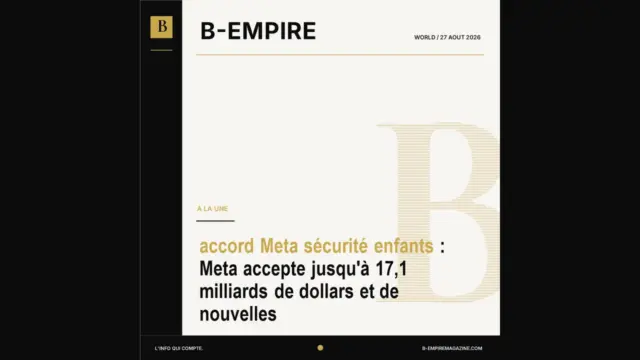

This is no longer just a warning to the tech giants. A jury in New Mexico has determined that Meta‘s platforms have harmed the mental health and safety of children, imposing a penalty of $375 million. For the parent company of Facebook and Instagram, this amount is manageable. However, the message sent to markets, families, and governments is far more significant: the very design of social media can now become the heart of legal responsibility.
This decision comes during an exceptional sequence of events. In the same week, a California jury found Meta and YouTube liable in a landmark case involving a young woman who claimed to have been drawn into the platforms from childhood. Both companies contest the findings and still have avenues for appeal. Nevertheless, the accumulation of verdicts is already changing the global balance of power.
A $375 Million Penalty That Changes the Scale
According to the Associated Press, the New Mexico jury concluded that Meta’s platforms were harmful to the mental health and safety of children, in violation of state law. The $375 million penalty is a small fraction of the $201 billion in revenue generated by Meta in 2025. Its power is therefore less about accounting and more about symbolism and legality.
The verdict reflects a major shift: platforms are no longer just questioned about the content published by their users. Their architecture is under scrutiny. Notifications, infinite scrolling, algorithmic recommendations, autoplay, and mechanisms of constant engagement can be presented as product choices designed to maximize screen time.
Meta regularly argues that adolescent mental health is a complex issue that cannot be linked to a single application and that the group has developed safety tools. This defense matters, and the upcoming appeals will be decisive. However, the jury found that the safeguards presented were insufficient to absolve the group of responsibility.
Instagram and YouTube Also Targeted in a Landmark Case
The second shock comes from California. In a separate proceeding, a 20-year-old woman, referred to by her initials KGM, explained that she started using YouTube at age 6 and Instagram at age 9. She claimed that this intensive use had exacerbated her psychological difficulties. After more than forty hours of deliberation, the jurors awarded her $3 million in damages, then recommended an additional $3 million in punitive damages.
The judge retains the final say on the total amount. Meta and YouTube have announced their disagreement and are considering appeals. Nevertheless, the jury assigned 70% of the responsibility to Meta and 30% to YouTube. TikTok and Snap, initially defendants, had reached settlements before the trial began.
The significance of this case far exceeds the $6 million being considered. It constitutes a test case likely to influence thousands of similar lawsuits across the United States. If several juries successively hold platforms accountable for design-related issues, the risk could become industrial: an increase in compensation claims, insurance costs, new warning obligations, and forced modifications of certain features.
The Attention Economy Model on Trial
The core of the debate is not whether every minute spent online automatically causes a psychological disorder. Such a claim would be scientifically and legally excessive. The question posed to jurors is more precise: did the companies know the risks to minors, and did their design choices constitute a significant factor in the alleged harm?
This nuance is fundamental. Platforms can continue to highlight the roles of family, school, social context, and individual vulnerabilities. However, they must also explain why their products eliminate almost all stopping points. When one video triggers another, when a feed has no end, and when a notification constantly brings the user back, the line between an attractive service and a product designed to be deliberately addictive becomes the central issue of the trial.
The parallel with tobacco or opioids, often mentioned by the plaintiffs’ lawyers, must be handled with caution. Social media are not substances, and their use can also provide information, creativity, and social connection. However, the parallel becomes powerful on one point: an industry can be compelled to answer for what it knew, what it measured, and how it designed its products despite warning signals.
Why France is Directly Concerned
In France, this American shift arrives at a time when protecting minors on social media has become a political priority. French lawmakers have approved a broad measure aimed at restricting access for those under 15, while Paris pushes Europe towards more robust age verification. Technical and legal difficulties remain numerous, but the principle is advancing: responsibility should no longer rest solely on parents or on a declared date of birth.
The American verdicts provide an additional argument for proponents of a firm stance. They show that the debate is no longer limited to access bans. It also concerns how applications function once the user is logged in. For a French teenager, an account officially suitable for young people can remain highly engaging if the infinite feed, recommendations, and prompts retain their original logic.
However, France and the European Union operate under a different framework. The Digital Services Act requires very large platforms to assess and mitigate certain systemic risks, with particular attention to minors. Brussels can act through administrative investigation and fines, whereas American cases bring forth liability before juries and through civil damages.
A Global Effect Well Beyond Meta
Snap, TikTok, YouTube, Roblox, streaming platforms, and even new artificial intelligence assistants will be watching the appeals closely. If the notion of an addictive or negligent product takes hold, each player will need to document their choices: why autoplay is enabled, how recommendations are calibrated for minors, what signals trigger intervention, and what data proves the effectiveness of safeguards.
This evolution may also alter competition. A platform that significantly reduces youth engagement may lose screen time to a less cautious rival. It is precisely to avoid this race to the bottom that states are seeking common rules. Without a shared standard, safety becomes a cost borne by virtuous companies, while the more aggressive ones continue to capture attention.
Investors will now need to factor in a new category of risk. A single fine may be absorbed. However, thousands of pilot procedures, age restrictions in multiple countries, and redesign obligations could weigh heavily on growth, targeted advertising, and the value of users recruited at a very young age.
The Signal That Silicon Valley Can No Longer Ignore
The New Mexico verdict does not close the debate. Meta can contest the decision, the amounts may evolve, and the links between social media and mental health will continue to be discussed. However, a line has just been crossed: a jury has translated collective concern into a $375 million penalty, at a time when another landmark case has held Meta and YouTube accountable.
For families, the question is immediate. For platforms, it becomes financial and legal. For France and Europe, these verdicts offer a real-world laboratory for digital responsibility. The world is no longer asking social media to merely promise that they protect children. It is now demanding that they prove their products were not designed to keep users engaged at all costs.
Sources
- Associated Press â New Mexico Verdict Against Meta, July 31, 2026.
- Associated Press â Instagram and YouTube Found Liable in California Pilot Case, updated July 31, 2026.
- Associated Press â The French Framework for Social Media and Those Under 15, 2026.
- European Commission â Protection of Minors Under the Digital Services Act.