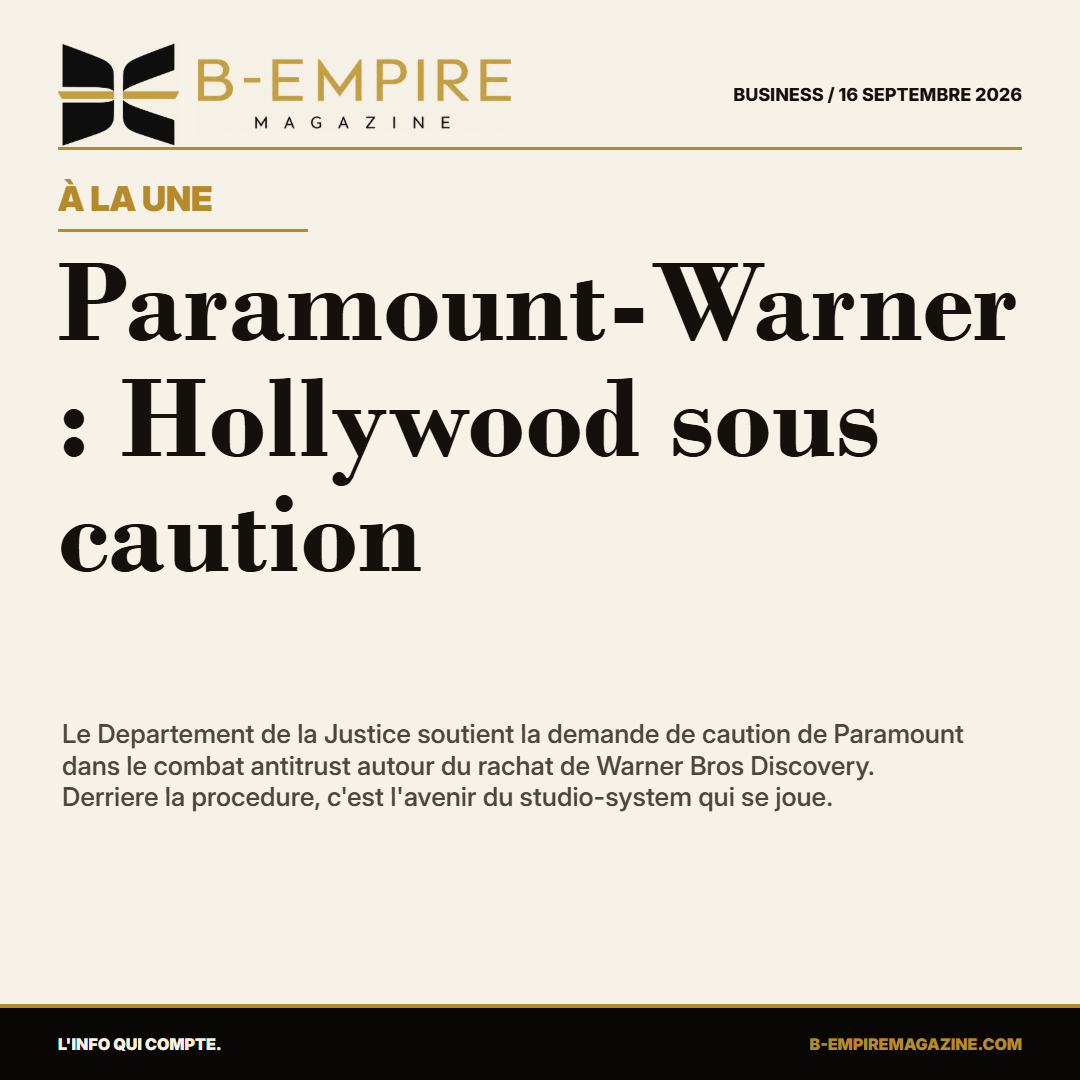
Hollywood loves spectacular mergers, but this one feels less like a blockbuster finale than a courtroom thriller. Paramount Skydance’s proposed takeover of Warner Bros Discovery, valued at roughly $110 billion, is no longer only a matter of studios, catalogs and streaming scale. It has become a strength test between industrial consolidation, antitrust law, creator unions and the cost of time.
On September 15, 2026, Reuters reported that the U.S. Department of Justice had backed Paramount’s request in federal court to require a bond from the states and private plaintiffs seeking to block the transaction. The idea sounds simple: if opponents obtain an injunction that delays the deal, they should guarantee potential financial damages if that injunction is later overturned. In practice, however, that bond can become a strategic weapon. It can make opposition more expensive, more risky and harder to sustain.
Paramount is asking for $1.88 billion. The company says every day of delay after the planned closing deadline costs it $7 million in timetable-related fees, and that the judicial calendar could turn waiting into a massive bill. In a September 8 statement, Paramount said it had satisfied all closing conditions under the agreement and received clearances from regulators in 69 jurisdictions. According to the company, the cases brought by a coalition of states and by the Writers Guild of America are the only remaining obstacles.
For opponents, the issue is not the speed of the transaction but the power it would concentrate. A coalition of twelve states, led by California, is challenging the deal by arguing that it could create a media giant able to raise prices in film and television. The Writers Guild of America is also attacking the combination. In its public communication, the union says a more dominant Paramount-Warner entity would have both the incentive and the ability to cut costs by suppressing writers’ compensation and reducing production output.
This battle tells a larger truth: old Hollywood no longer knows whether it must get bigger to survive or remain fragmented in order to breathe. Platforms have changed the industry’s logic. A catalog is no longer simply a library; it is a reserve of licenses, franchises, data and bargaining power. Theaters need event films. Streaming needs recurrence. Wall Street wants synergies. Creators want jobs, rights and a diversity of buyers. Each camp has a credible version of the future, but none of those futures comes free.
The Justice Department‘s position adds political nuance. Backing the bond request does not necessarily mean endorsing the entire merger on the merits. It means, more narrowly, that parties asking to suspend a transaction should accept financial responsibility if their block later proves unjustified. For Paramount, that is a way of saying opposition must pay the price of the risk it imposes. For states and unions, it could create enormous pressure: challenging a giant becomes more dangerous when every month of litigation may translate into a nine- or ten-figure exposure.
The case may also reshape the way Hollywood negotiates with public power. Since the strikes, generative artificial intelligence, the collapse of some streaming models and the return of theatrical release as a premium showcase, studios know size is no longer enough. They must prove that concentration does not destroy the ecosystem that produces the stories. A merger can promise savings and better competition against technology platforms; it can also reduce the number of buyers for talent and weaken the bargaining power of writers, independent producers and distribution partners.
What may be most interesting is what this fight says about the value of time. In the old system, a delay was an inconvenience. In the current system, a delay becomes a daily cost line, a threat to investor confidence and a legal argument. Media deals are no longer measured only by capitalization or debt, but by speed of execution. A merger that waits too long can lose the strategic moment that made it desirable in the first place.
For B-EMPIRE, this case reaches well beyond U.S. law. It asks a universal question of the cultural industry: who has the means to build the world’s great stories, and at what price for the people who write them? If Paramount wins, Hollywood will receive a signal favoring rapid consolidation. If the opponents hold, studios will have to accept that maximum size is no longer a natural right. Either way, the future of entertainment is being shaped as much in courtrooms as in cinemas. The screen is now a balance sheet too, and every delay changes who can afford the next scene.
Sources
- Reuters – US DoJ backs bond demand in Paramount-Warner Bros antitrust fight
- Paramount Skydance – Moves to Protect Against Costs of Delay as WBD Merger Is Ready to Close
- Writers Guild of America – WGA Files Lawsuit to Block Paramount-Warner Bros. Discovery Merger
- Justia – Writers Guild of America v. Paramount Skydance docket