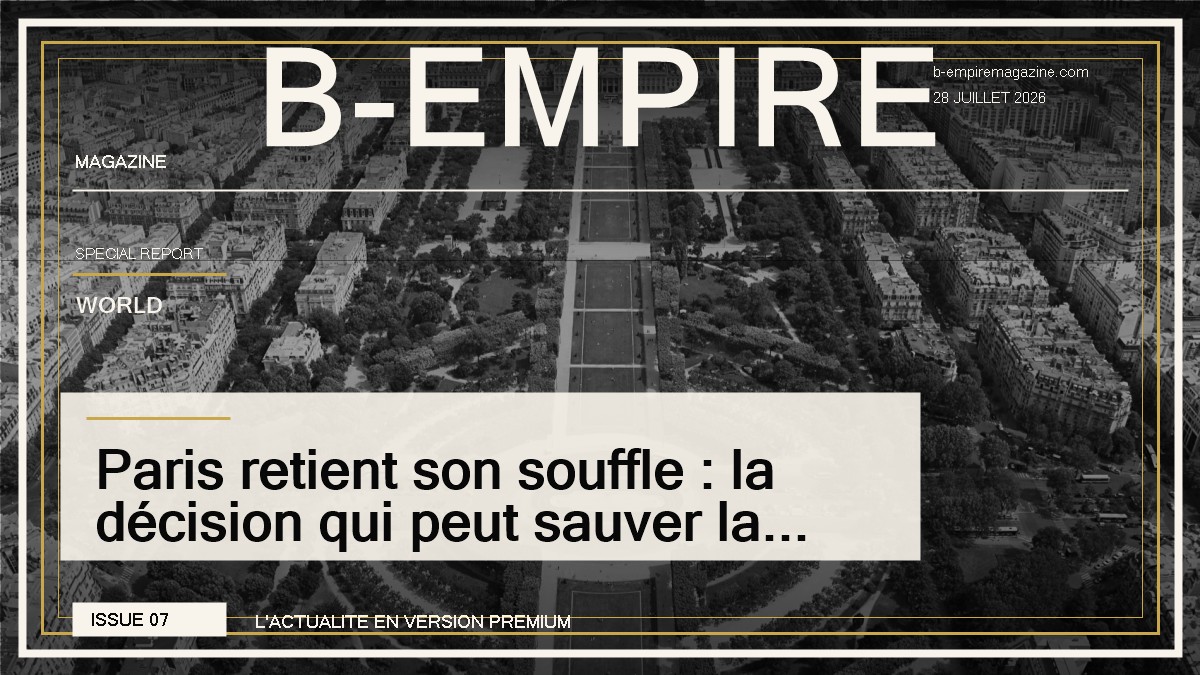
Paris thought it finally had the transformation of its most controversial skyscraper in hand. But, just days before a crucial deadline, the future of the Montparnasse Tower is now at stake in a standoff between co-owners. On Monday, July 27, 2026, Paris Mayor Emmanuel Grégoire gathered key stakeholders at City Hall to try to unblock a renovation now estimated to cost nearly 800 million euros. The meeting has yet to produce the definitive agreement expected, but it has laid the groundwork for high-pressure negotiations.
The issue extends far beyond a mere real estate dispute. Standing at 210 meters, visible from much of the capital and long criticized for its dark facade, the tower has become a symbol of 1970s Parisian urbanism. It was vacated in spring 2026 to allow for the launch of a project announced nearly a decade ago. A failure now would leave a massive empty building in the heart of Paris and jeopardize the entire transformation of the Maine-Montparnasse district.
A Crisis Meeting to Prevent a Catastrophic Scenario
According to information published by Le Figaro and confirmed by several specialized media, Emmanuel Grégoire has urged co-owners to quickly find a compromise. The first meeting organized at City Hall primarily served to bring the various parties to the same table. Further discussions are necessary, as the timeline leaves almost no room for maneuver.
The MGEN, one of the stakeholders involved in the operation, indicated that an agreement among the owners of the floors designated for the future hotel must be reached before July 30 to allow the project to proceed. Another date looms over all discussions: the building permit must be implemented before November 26, 2026. After this deadline, the project may need to be significantly revised and face new urban planning regulations.
This urgency explains the direct intervention of the City Hall. The City does not own the tower and cannot impose a financial solution on its own. However, it can act as a mediator, remind stakeholders of the public interest of the project, and maintain pressure on investors whose decisions shape a significant part of the Parisian landscape.
Why an 800 Million Euro Project is Stalled
The crux of the problem is both legal, financial, and real estate-related. The Montparnasse Tower is owned by several co-owners, each with different interests, timelines, and strategies. To launch such a complex transformation, votes must achieve specific majorities, and holders of certain lots must agree on their new distribution.
During the general assembly on July 21, the overall launch of the works did not receive the necessary support. LFPI, presented as the main co-owner of the building, opposed certain resolutions, although a first phase of asbestos removal was nonetheless approved. This distinction is crucial: asbestos treatment can proceed, but it does not guarantee that the complete renovation will follow.
Cost is another point of contention. Estimates have evolved over the years due to inflation, technical complexity, environmental standards, and changes in the office market. An investment approaching 800 million euros requires a shared vision of the future value of the spaces. However, remote work and rising interest rates have altered profitability calculations in the European tertiary real estate sector.
The Promised Transformation Was to Change the Tower’s Image
The architectural project led by the Nouvelle AOM collective aims to transform the silhouette and uses of the tower. The dark facade is to be replaced by a lighter and more efficient envelope, while a glass and green extension is planned for the top. The program combines offices, publicly accessible spaces, a hotel, and new services, with a stated ambition to reduce energy consumption.
The image challenge is considerable. Since its inauguration in 1973, the tower has divided Parisians. For some, it remains a jarring break in the Haussmannian skyline. For others, it represents an architectural testimony of an era and one of the few observation points that allows for a panoramic view of the entire capital. The renovation was supposed to reconcile these two perspectives: to preserve the urban landmark while correcting its technical and aesthetic flaws.
A Real-World Test for Office Real Estate in Europe
What is happening at Montparnasse is being observed far beyond Paris. From London to Frankfurt, many major cities are seeking to reinvent aging office buildings without demolishing them. Reusing an existing structure can limit waste and carbon footprint, but this strategy imposes heavy work, particularly in high-rise buildings.
The tower encapsulates almost all the difficulties of the moment: fragmented co-ownership, historical presence of asbestos, high financing costs, strengthened climate standards, and uncertainty about office demand. If Paris manages to save the operation, the project could become a showcase for the conversion of European skyscrapers. If it fails, it will instead illustrate the difficulty of aligning urban interest with private yield.
What Paris Risks If No Agreement is Reached
The first visible risk is a closed and empty tower for an extended period. The panoramic observatory has stopped welcoming the public, and businesses have vacated the floors. Without a comprehensive project, the building could remain immobilized even as preparatory work has already disrupted its operation.
The second risk concerns the neighborhood. The renovation of the tower must align with the broader transformation of Maine-Montparnasse, which envisions new public spaces, more greenery, and a restructuring of the shopping center. A stalled tower would complicate the coherence and attractiveness of the whole area, frequented daily by travelers, residents, and employees.
Finally, an abandonment could trigger a long series of disputes and new studies. The co-owners have already invested significant sums. Starting from scratch would not eliminate the asbestos, the aging of the building, or the obligation to meet more stringent energy standards. It would merely delay decisions while likely increasing their costs.
The Coming Days Will Be Decisive
The meeting at City Hall did not save the Montparnasse Tower, but it prevented the dialogue from being officially broken. The immediate priority is to resolve the disagreement over the hotel lots, then secure the necessary votes and financing for the complete project. Each day brings the stakeholders closer to the operational deadline.
For Emmanuel Grégoire, who succeeded Anne Hidalgo as Mayor of Paris, this issue already represents a significant political test. The capital wants to demonstrate that it can transform an iconic building without abandoning its climate goals. However, it depends on private owners who, by their agreement or refusal, can decide the fate of the only true skyscraper in central Paris.
The Montparnasse Tower was meant to become a symbol of a Paris capable of correcting the mistakes of the past. It is now a symbol of another reality: even when an architectural project is ready, partially funded, and awaited for years, a few votes can still halt everything. The agreement sought this week will determine whether the capital can finally open the construction of its grand transformation or if one of its most visible monuments will remain frozen in uncertainty.
Sources
- Le Figaro Immobilier, July 28, 2026: crisis meeting and project estimate.
- AFP via Boursorama, July 25, 2026: conflict among co-owners and deadline of July 30.
- Batiweb, July 23, 2026: vote on asbestos removal and positions of co-owners.
- City of Paris: validity of the building permit until November 26, 2026.
- Administrative Court of Paris: legal validation of the building permit.