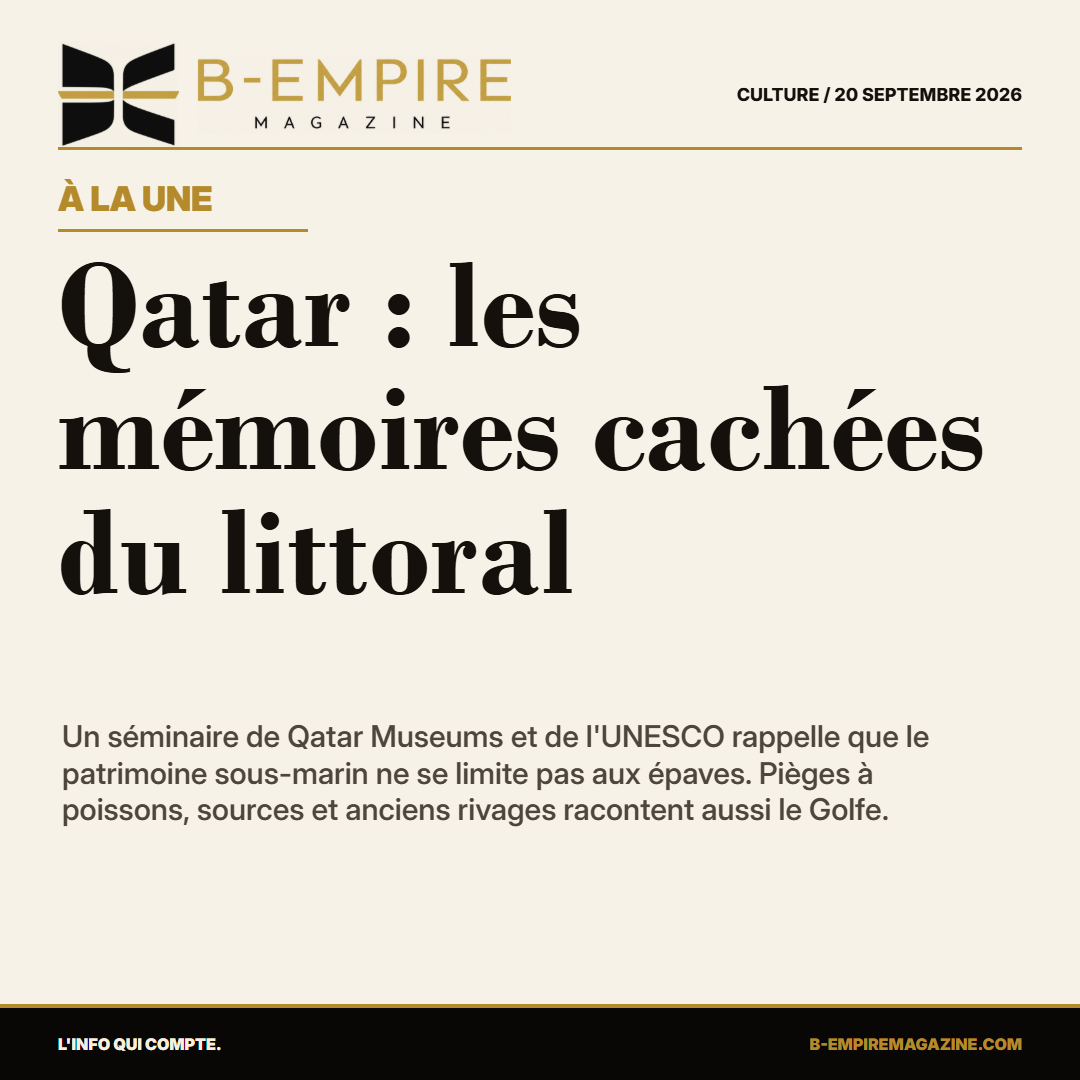
Maritime history is not found only in spectacular shipwrecks. It can survive in a spring that is now submerged, a fish trap built along the shore or traces of a settlement shaped by changes in the sea. This broader perspective was central to a seminar organised by Qatar Museums and UNESCO‘s regional office for the Gulf States and Yemen at the National Museum of Qatar. A report published on September 16, 2026 describes archaeologists, researchers and heritage professionals discussing how to understand and protect coastal cultural landscapes. Behind the technical language is a practical question: how can fragile evidence of the Gulf’s relationship with the sea be kept intact?
A story larger than recovered objects
A shipwreck naturally draws attention. Yet underwater heritage also includes the context in which something is found: its position, the sediment around it, its links to other sites and the changing shoreline. The Doha seminar stressed this wider reading. Participants discussed submerged cultural landscapes, traditional maritime practices and evidence of historic exchanges between people and the sea. An object removed without proper documentation may lose much of its meaning. Protecting the site protects our ability to understand earlier work, travel routes and economies.
Among the examples discussed were the masakir, traditional tidal fish traps. According to UNESCO’s account, Faisal Abdulla Al Nuaimi, director of archaeology at Qatar Museums, pointed to their distribution along the coast and their role in local and regional economies during the late Islamic period. He also called for more ethnographic and documentary research into how they were built, maintained and used. The point is worth dwelling on. A structure designed around the movement of water is simultaneously a technology, an ecological adaptation and a record of collective labour. Its visible shape today is only part of the story.
Reading a changing shoreline
The site of Al Sirriya in southwestern Qatar was also discussed. First documented in 2012 and believed to date to the Islamic period, it offers a way to investigate connections between sea-level change and human settlement. That dating and interpretation are those reported at the seminar, not a new conclusion from excavations announced this week. Other presentations addressed historic pearling grounds and submerged freshwater springs. Together these subjects show that a coastline is not a fixed boundary. It has been a place of work, movement and adaptation, sometimes transformed so much that traces are difficult to find without scientific methods.
The value of such research extends beyond historical curiosity. Studying where resources lay, how they were used and why settlements changed can illuminate how communities responded to environmental pressures. It would still be misleading to turn every archaeological feature into a direct answer to today’s climate challenges. Contexts differ. What archaeology can responsibly offer is a longer time horizon, documented observations and better questions about the relationship between society and the coast.
Protect first, display second
Qatar deposited its instrument of ratification of UNESCO’s 2001 Convention on the Protection of the Underwater Cultural Heritage in 2023. The convention gives preference to preservation in situ, at the place where a site is found, before intrusive work. It rejects commercial exploitation of heritage objects and promotes research, inventories, training and cooperation between countries. This does not mean that no object can ever be moved. Recovery can be justified to protect it or make an important scientific contribution. It does mean that taking something out of the water is not automatically the best way to save it.
The seminar also raised the question of public access. A site can be explained through an exhibition, a map, a photograph or a supervised visit without being opened without limits. Responsible access requires an understanding of vulnerable materials and the effects of visitors. The tension between showing and preserving is familiar to museums on land. Underwater, it is more complex: currents, visibility, corrosion and human interventions make observation harder. Public interpretation must therefore tell the story without encouraging the collection of souvenirs.
Expertise built over time
Speakers called for stronger local underwater archaeology skills, better survey and documentation tools and more cooperation between institutions. None of these goals can be achieved by a single conference. They require teams able to compile inventories, retain comparable records and decide when intervention is justified. UNESCO presents the seminar as a forum for exchange, not as the launch of a fully funded excavation or a complete new inventory. Progress should therefore be measured through research programmes that actually take place, methods that are made available and protection afforded to identified sites.
This change of perspective makes maritime heritage richer and less dependent on the discovery of treasure. A fish trap, a submerged spring or an older shoreline can tell us about economic life, practical knowledge and a society’s choices. For Qatar and the wider Gulf, protecting them keeps open an inquiry into the connections between communities and the sea. The most important part of the story may not be what we bring to the surface, but what we learn not to destroy while searching.