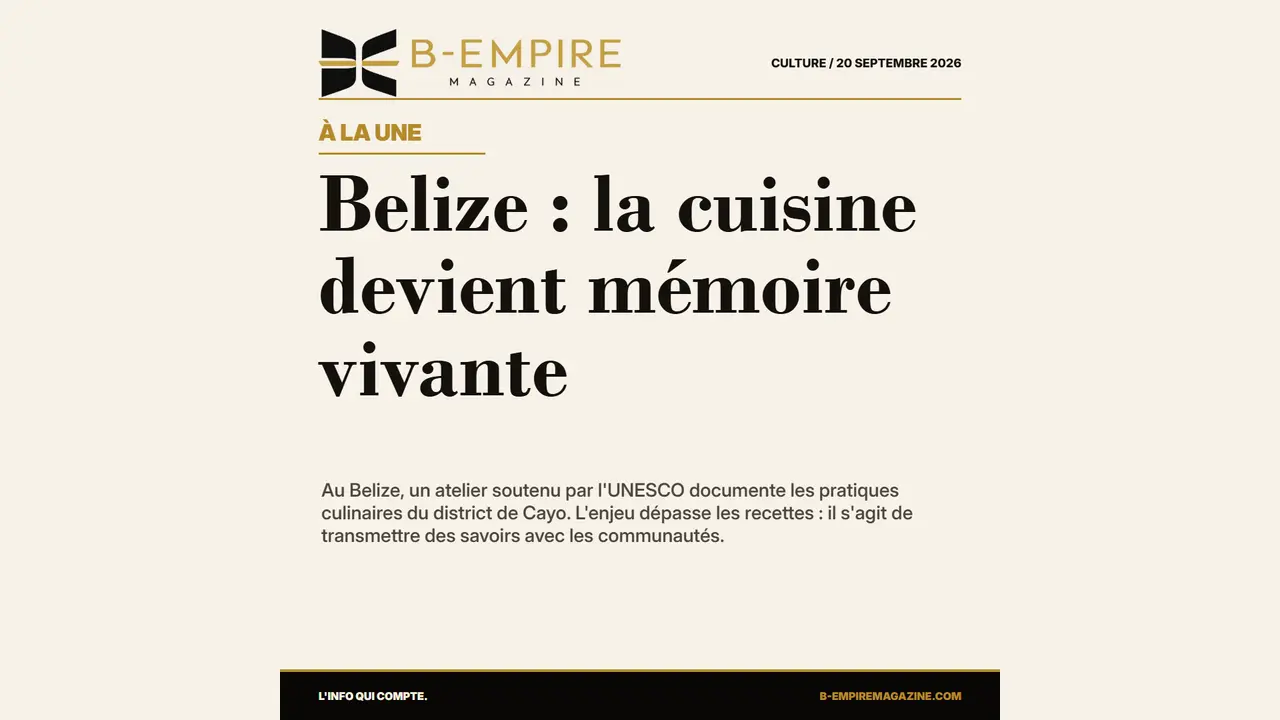
A recipe alone cannot capture everything a community knows about food. Techniques, seasonal ingredients, occasions for sharing and the person who teaches a dish can matter as much as quantities written on a card. In Belize, a UNESCO-supported project is trying to document that richness without reducing it to a catalogue of meals. In an article published on September 16, 2026, the organisation reported on a workshop completed on August 13 in Cayo District. Participants explored the 2003 Convention on intangible cultural heritage and practised documenting local food traditions. The work is intended to feed into a national inventory. Its significance extends beyond keeping an archive: it raises the question of who gets to describe a living culture, and for whom.
Document before celebrating
The Belize foodways project is scheduled to run for twenty-four months, from April 2025 to April 2027. Its official description sets a goal of at least 80 food-related elements representing the country’s different cultural groups. UNESCO approved financial assistance of $98,600 in 2024, and Belize’s National Institute of Culture and History is implementing the work. These figures describe objectives and resources, not an inventory already completed. The September report documents one district workshop, not the final publication of 80 entries.
What should be recorded when studying a culinary tradition? An ingredient list is a start, but techniques, occasions, environmental knowledge and the people who pass it on also matter. A preparation may differ between families or places without losing its continuity. The community-based documentation described in the project therefore covers recipes, methods, rituals and associated practices. It can record variations and stories rather than search for a supposedly single definitive version. That is the difference between inventorying living heritage and freezing a cuisine in a picture book.
Communities are not anonymous sources
The 2003 Convention emphasises the participation of communities, groups and relevant organisations in identifying intangible heritage. This requirement is more than a formality. People who hold knowledge may wish to share some techniques while keeping other details within their own circles. They may also disagree about how a tradition is named or attributed. A rigorous inventory should therefore make contributors visible, explain how information will be used and allow mistakes to be corrected. In an economy where local cuisines can attract brands, tourism and content creators, the way knowledge is collected also affects how its value circulates.
The project plans consultations with practitioners and workshops at national and district levels. This approach can help prevent an inventory from being written solely from a capital city or an office. It does not automatically guarantee balanced representation, however. Future reporting should show which groups were consulted, who was able to participate despite travel or time constraints and how their contributions appear in the final work. The quality of the conversation will matter more than the number of entries alone.
A culture facing change
UNESCO names globalisation, rapid urbanisation and climate change among the pressures on Belize’s food traditions. These forces do not all work in the same way. An ingredient may become harder to obtain, a place used for preparation may disappear, a younger generation may lack time to learn a method, or the commercial value of a dish may change its place in everyday life. No inventory can solve those changes by itself. It can, however, help identify what is at risk and give communities a stronger basis for organising transmission.
The project description also links safeguarding foodways to disaster preparedness and resilience. That link deserves precision. Local knowledge about ingredients, preservation or mutual support can matter in difficult periods, but the programme has not yet published results measuring an effect on food security during a crisis. Culinary heritage should not be presented as a magical solution to material problems. It can form part of a community’s ability to adapt when the people who carry it also have the resources they need.
Passing on knowledge without turning it into a display
The programme plans educational videos and an awareness campaign around the inventoried elements. Such tools can give younger generations a way in and make overlooked knowledge more visible. Their design must avoid turning practitioners into extras in their own story. A video showing only the finished plate erases the labour, choices and relationships that give it meaning. By contrast, an account built with the people who practise a tradition can explain how it changes, who transmits it and why it matters today.
The same balance applies to tourism and economic opportunity. Promoting a cuisine may help producers and cooks, but visibility does not automatically generate fair income. It will be worth watching whether benefits return to communities, whether knowledge is used with their agreement and whether traditions retain the freedom to evolve. Safeguarding is not about preventing change. It is about giving the people concerned the means to keep practising, interpreting and sharing what they know.
What can be checked later
The Cayo workshop shows that fieldwork is moving ahead, but it is too early to assess the entire project. Before its scheduled end in 2027, useful measures will include the diversity of elements documented, genuine community participation, the quality of educational materials and whether the inventory can be updated. Food culture remains alive precisely because people cook it, discuss it and pass it on. Belize’s success will not be placing its flavours behind glass, but making their stories easier to tell by the people who keep them alive.