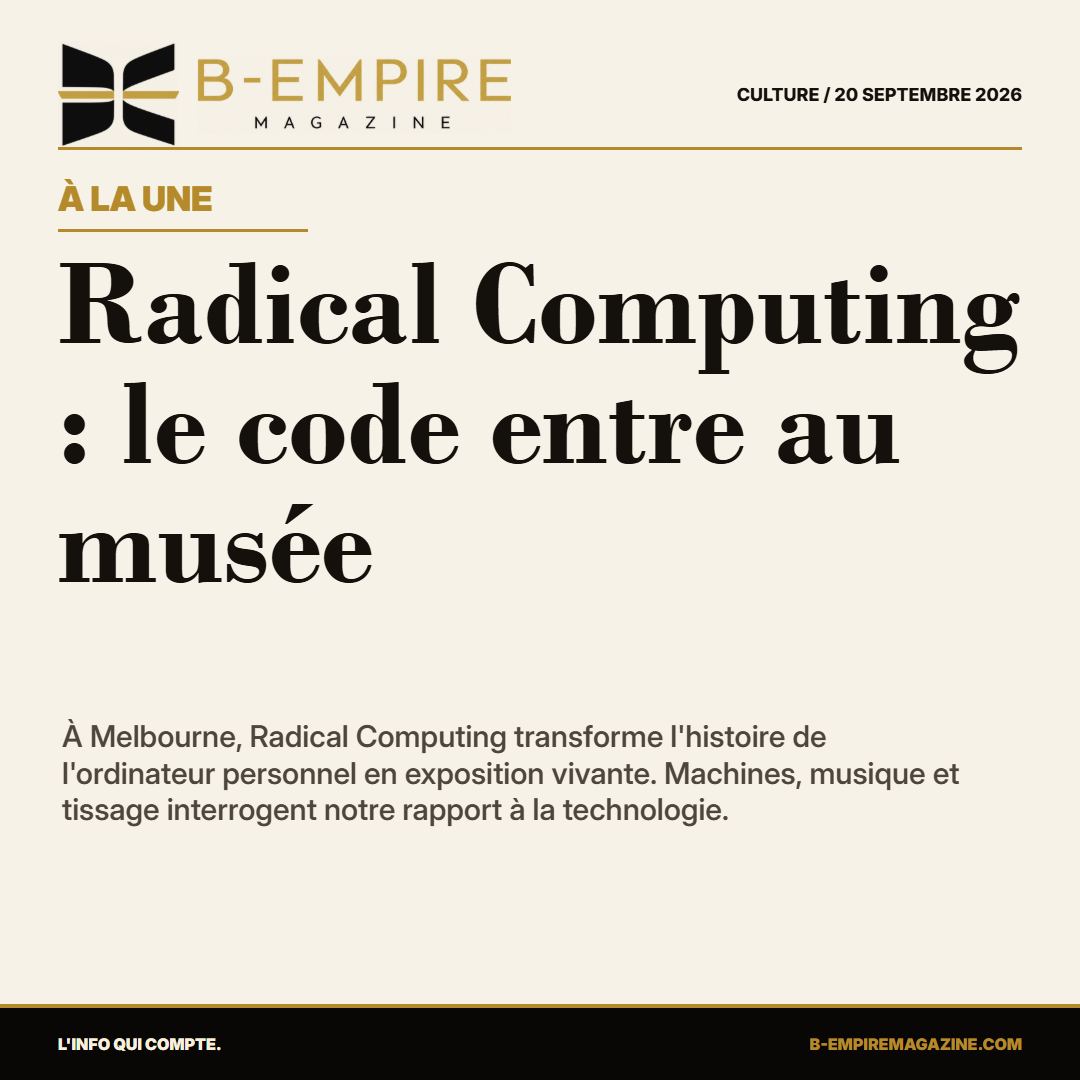
What if computing history were about more than the power of machines? Opened on 19 September 2026 at the National Communication Museum (NCM) in Hawthorn, greater Melbourne, Radical Computing starts from another idea: the personal computer has also been a tool for appropriation, tinkering and creativity. Guest curated by Mel Huang Buntine, the exhibition is scheduled to run until 21 February 2027. The museum brings together older computers, artworks and interactive experiences to connect technical history with contemporary imagination.
When owning a computer changed the possibilities
The story begins before screens became ubiquitous. In the 1970s, the NCM notes, computing largely belonged to large machines and specialists. The arrival of smaller, more affordable computers gradually made it possible to own one at home and then to change what it could be used for. The exhibition follows people who did more than obey an instruction manual: they assembled, repurposed, programmed, played and shared their discoveries. This is the sense of “radical” that shapes the show, rather than simple nostalgia for early keyboards.
Machines from the Buntine Computer Collection sit alongside references to the demoscene, Australian rave and hacker cultures, creative coding and open-source software. The museum names Altair, Amiga, Atari and Microbee models among the machines on display. This range keeps digital history from becoming only a succession of commercial product launches. It also gives space to people who make new forms with existing tools, often in communities that receive little attention in conventional accounts of technology.
A rare machine and another way to see computation
One object draws particular attention: a Connection Machine CM-2 restored by NCM teams with the involvement of Tamiko Thiel, who worked on its industrial design. The museum also reports acquiring a CM-5 for its collection, without saying that it is necessarily exhibited in the same way. The CM-2, developed in the late 1980s, gives parallel computing a striking physical form, with lights that make its activity visible. It reminds us that technology is also an object to design, preserve and interpret, not merely a list of specifications.
The contrast with the present is hard to miss. Many artificial-intelligence services hide their workings behind a smooth interface; the CM-2, by comparison, reveals something of its activity. Blinking lights do not, of course, make a system fully understandable. But the object helps visitors ask an approachable question: what can we actually see when we use a machine, and what are we asked to believe without being able to look inside? This comparison is an interpretation of the exhibition, not a claim that the museum has solved AI transparency.
Code as an artistic material
Radical Computing is not a static archive room. The NCM announces commissions from Chia Amisola and Chok Si Xuan, as well as a revival of Music Mouse, the software instrument conceived by composer Laurie Spiegel in 1986. The exhibition also makes room for weaving, looms and contemporary textile work, including pieces by Kate Geck. This connection rejects the idea that computing emerged only from male-dominated laboratories: creating patterns, arranging sequences and passing on techniques belong to a much longer history.
Workshops and demonstrations during the opening weekend extended that approach. An all-ages weaving workshop, a conversation with the curator and presentations on demoscene culture were advertised by the museum. Their value is more than educational. They invite visitors to become experimenters rather than only spectators, even for a short time. In a digital environment where interfaces make many decisions on our behalf, learning that a tool can be altered becomes a useful form of general knowledge.
An exhibition that questions the present
The exhibition website also offers an index hand-coded by Mel Huang Buntine and the museum’s studio. The NCM highlights its small size, about 2.8 MB, as a gesture toward a less energy-hungry web. That idea should not be confused with a full impact assessment: page weight alone cannot measure an entire environmental footprint. It does show, however, that even a modest design decision can make a choice for restraint visible to visitors.
The NCM frames the project as a response to concerns about AI, surveillance and concentrated platform power. It does not offer a universal solution to those questions; it opens a space to discuss them through objects, sounds and actions. That is what makes the exhibition timely. It asks not only what computers used to be, but who can still understand, repair and reinvent them. Such questions reach beyond the gallery: schools, artists, software makers and ordinary users all make decisions about which tools they trust and how much control they retain. For B-EMPIRE, the lesson is cultural as much as technological: an innovation also matters for the creative freedoms it leaves to the people who take it up.