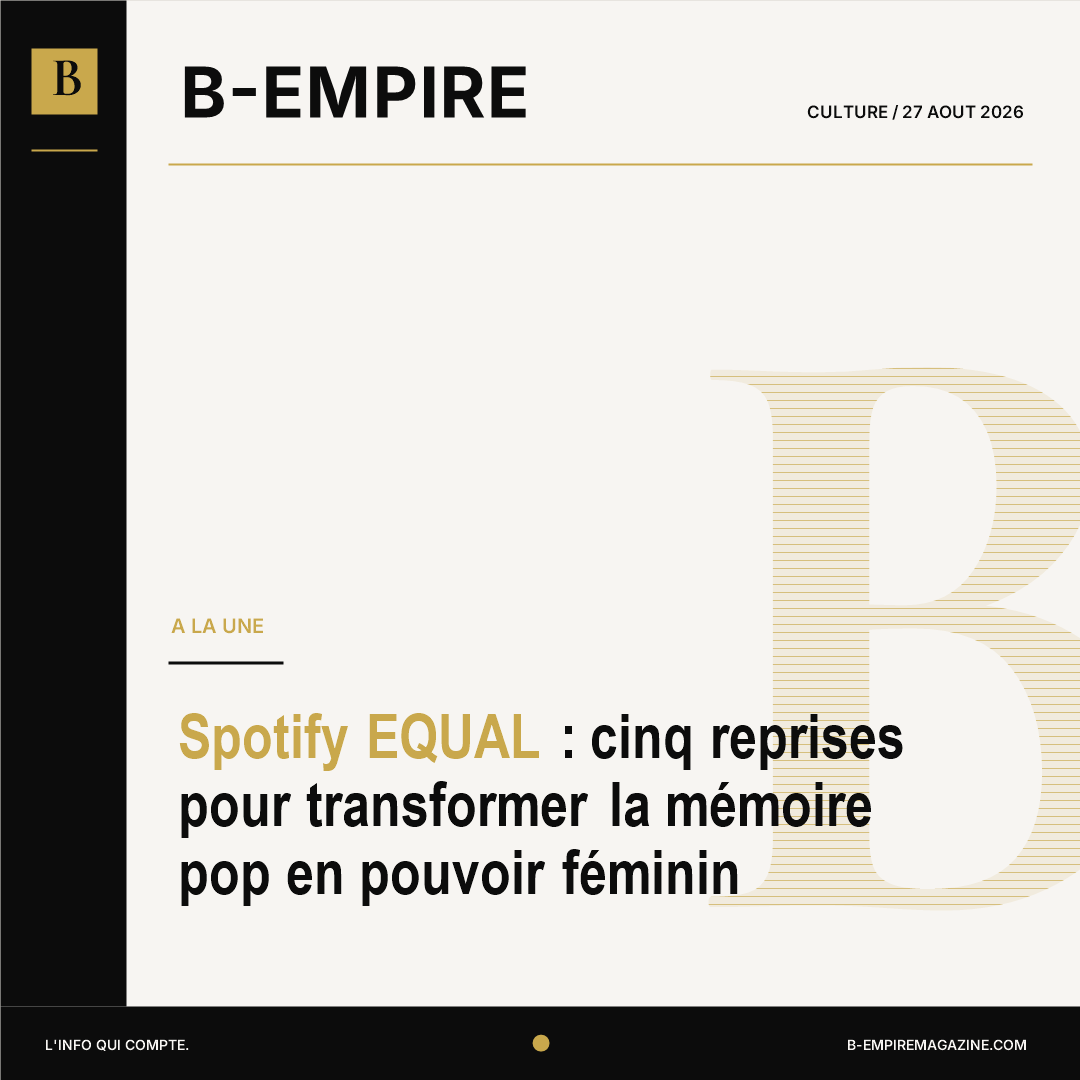
Spotify is not merely celebrating an anniversary: it is staging a transfer of memory. On August 26, 2026, the platform announced a limited series of Spotify Singles for the fifth anniversary of EQUAL, its global program dedicated to visibility for women in music. The concept is simple and powerful: five current artists reinterpret five songs carried by major female figures. Namasenda takes on Britney Spears, badmomzjay revisits Rihanna, MARO rereads ROSALIA, Willow Avalon tackles Carly Simon and Shekhinah pays tribute to Lebo Mathosa.
On paper, the operation looks like an elegant editorial campaign. In reality, it says something deeper about the cultural economy of streaming. In a world where the algorithm can turn a song into a global phenomenon or let it disappear silently, the issue is no longer only producing music. The industry has to create contexts, narratives, bridges between generations and spaces where artists can be identified as cultural forces, not as simple lines inside an infinite catalogue.
The cover as manifesto
The choice of the cover is smart because it rejects the overly easy opposition between nostalgia and novelty. Covering Lucky, Rehab, Sauvignon Blanc, You’re So Vain or I Love Music is not only about proving lineage. It shows that a song can change body, emotional language, texture and audience without losing its symbolic charge. Each artist enters a conversation the public already knows, while adding her own position.
Namasenda speaks about the mix of glitter and sadness in Lucky. badmomzjay sees Rehab as a story of healing and taking back power. MARO chooses ROSALIA to underline Iberian cultural proximity. Willow Avalon finds in Carly Simon the rebellious energy that pushed her toward songwriting. Shekhinah chooses Lebo Mathosa as a figure of stage presence, joy and transmission. Together, these choices map women’s music in a way that is intimate, geographical, generational and political at once.
EQUAL is no longer just a playlist
Spotify launched EQUAL in 2021 to respond to a persistent reality: women artists, writers, producers and audio creators still face fewer opportunities, less visibility and less access to the systems that build careers. Five years later, the program has grown beyond its initial editorial space. The platform says it has supported more than 1,400 ambassadors across more than 40 markets and generated more than 50 billion editorial streams for artists connected to the program.
That number matters because it turns intention into infrastructure. In streaming, editorial work is not decorative: it is a circulation tool. A banner, a playlist, a podcast, a session, a local event or a global campaign can change the way an audience discovers a name. EQUAL has become a kind of signposting system in a saturated industry where talent is not lacking but attention remains unequally distributed.
The business of visibility
The economic context makes this series even more strategic. Spotify announced in August that it had reached 300 million Premium subscribers and 777 million monthly active users in the second quarter of 2026. At that scale, an editorial initiative is never neutral. It can shape the listening habits of millions of people, move artists into new markets and give the platform an image as a cultural tastemaker, not merely a distributor.
EQUAL’s success therefore rests on a tension. On one side, Spotify is responding to a demand for equity and representation. On the other, the platform is also building a cultural brand around that mission. This ambiguity does not cancel the value of the program; it makes it more interesting. In the contemporary music industry, visibility is simultaneously a cause, a commercial lever and a battle of narration. Artists need fairer spaces; platforms need proof that their ecosystems can create something beyond volume.
When catalogues become lineages
The beauty of this series lies in the way it turns catalogue into lineage. Britney Spears, Rihanna, ROSALIA, Carly Simon and Lebo Mathosa are not used as reassuring references. They become starting points for measuring what current artists inherit, shift or contest. Pop is no longer only a flow of new releases: it becomes active memory again, capable of opening doors for those who come next.
This is where Spotify’s editorial move works. The five covers do not say that the story is settled. They say, instead, that it must be reinterpreted, reheard and redistributed. In an industry where numbers can sometimes crush nuance, the gesture reminds us that music also lives through invisible filiations, songs learned as teenagers, models that give courage and stages where an artist discovers she has the right to occupy the whole room.
The fifth anniversary of EQUAL therefore arrives as a maturity test. Can Spotify turn a visibility program into a real engine of careers and cultural memory? The Singles series cannot solve every inequality in the industry on its own. But it offers a strong image of what streaming can do when it accepts its role as mediator: not only counting streams, but organizing encounters between heritage, desire and the future.
Sources
- Spotify Newsroom – announcement of Spotify Singles for EQUAL’s fifth anniversary
- Spotify Newsroom – EQUAL program results, ambassadors and editorial streams
- Spotify Newsroom – EQUAL’s expansion into podcasts and audiobooks
- Spotify Newsroom – second-quarter 2026 earnings and 300 million Premium subscribers