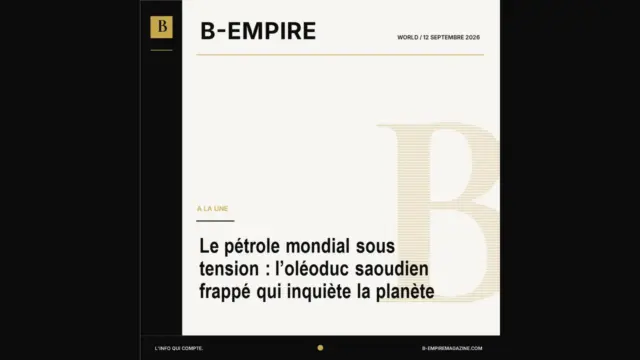

The period of calm has come to a thunderous end. In the night from Wednesday to Thursday, the U.S. military announced it had completed a ‘heavy wave’ of strikes against Iran, hitting dozens of targets linked to the Revolutionary Guards. This retaliation follows an Iranian missile attack targeting a base housing U.S. forces in Jordan. Within hours, the conflict spilled over into several countries, oil markets reacted, and the Strait of Hormuz returned to the center of all concerns.
The issue extends far beyond the face-off between Washington and Tehran. Saudi Arabia has participated with the United States in strikes against Iran-backed groups in Iraq. Ships carrying gas were hit at the Egyptian port of Damietta, although responsibility for this attack has not been immediately established. Meanwhile, Saudi oil infrastructures and maritime routes in the Red Sea are under pressure. The signal is brutal: several essential arteries of energy and global trade can now be affected simultaneously.
Dozens of Targets Struck in Two Hours
According to U.S. Central Command, operations targeted command centers, missile and drone facilities, as well as surveillance and coastal defense sites belonging to the Revolutionary Guards for about two hours. Iranian state media reported casualties on Qeshm Island, located in the Strait of Hormuz, and explosions in Khuzestan province.
Washington presents the operation as a response to Iranian fire against the Muwaffaq Salti airbase in Jordan. The Jordanian military claims to have intercepted five missiles. Donald Trump had promised to strike Iran ‘very hard.’ This sequence of actions and retaliations primarily illustrates how a tactical decision can now trigger a regional chain reaction.
Saudi Arabia Reinterprets the Conflict
The most striking element is Saudi Arabia’s military involvement alongside the United States against armed groups in Iraq. Riyadh accuses Iran-backed militias of launching drones against its energy facilities. The U.S.-Saudi strikes have targeted several logistical sites and weapon depots in eastern Iraq.
The Iraqi government condemned these operations, arguing that they occurred while it was still attempting to address the accusations diplomatically. This tension places Baghdad in an extremely fragile position: Iraq seeks to maintain relations with Washington, Riyadh, and Tehran while asserting its sovereignty over armed groups present on its territory.
For Saudi Arabia, the objective is twofold. It aims to protect oil infrastructures and send a warning to Iran’s allied groups while continuing to call for de-escalation. However, this strategy could produce the opposite effect if Tehran now views Riyadh as a directly engaged actor in military operations.
Hormuz and the Red Sea: The Scenario Markets Fear
The Strait of Hormuz remains the most obvious point of vulnerability. This maritime route is crucial for the export of oil and gas from the Gulf. Iran has rejected an Omani proposal to jointly organize ship traffic and asserts that passage will not simply revert to its pre-war functioning. For shipping companies, insurers, and traders, this uncertainty immediately translates into additional costs.
Brent surged by more than 7% according to data reported by the Associated Press, surpassing $88 per barrel in the wake of the resumption of hostilities. This movement reflects not only fears of a production drop but also the risk that shipments may be blocked, insurance premiums may skyrocket, or tankers may be forced to wait in safer areas.
The pressure is not limited to Hormuz. The Houthis have announced attacks on facilities allowing Saudi Arabia to transport oil to the port of Yanbu on the Red Sea. This route is precisely one of the main alternatives when the Strait of Hormuz becomes impassable. If both Hormuz and the Red SeaâBab el-Mandeb axis are disrupted simultaneously, the market loses some of its fallback options.
Why France and Europe Are Directly Concerned
For France and the European Union, the first effect is felt at the pump, but not only. A sustained rise in oil prices increases transportation, aviation, petrochemicals, and part of industrial production costs. Gas and maritime freight can also come under rapid pressure, with consequences for prices paid by businesses and households.
This shock comes at a time when central banks are still monitoring inflation and technology markets are experiencing a phase of high volatility. More expensive energy complicates interest rate decisions: supporting activity becomes more difficult when imported costs start to rise again. The euro, airline stocks, and energy-intensive industrial sectors could therefore react well before a physical shortage appears.
Europe must also manage maritime risk. A significant portion of its trade with Asia passes through routes connected to the Red Sea. Detours lengthen delays, immobilize ships, and increase logistics costs. Consumers do not immediately see these surcharges, but they ultimately end up reflected in the prices of imported goods.
The Real Test: Preventing the Escalation
Regional mediators are still seeking a return to calm and a resumption of discussions. However, each new strike reduces the available political space. States want to demonstrate their capacity for retaliation without appearing to yield; armed groups maintain their own timelines; energy infrastructures become instruments of pressure. This is precisely the mechanism that transforms a limited crisis into a lasting regional conflict.
In the coming hours, three indicators will be decisive: the scale of any potential Iranian response, the actual security of traffic in the Strait of Hormuz, and Saudi Arabia’s ability to protect its facilities without multiplying offensive operations. Iraq must also be monitored, as its territory risks becoming the theater of a confrontation it does not control.
The signal that the world cannot ignore is now clear: the resumption of strikes is not an isolated episode. It connects military bases, oil terminals, merchant ships, inflation, and monetary decisions. As long as de-escalation remains fragile, every missile could have a shockwave far beyond the Middle East.
Sources
- Associated Press, July 30, 2026: U.S. strikes in Iran, response to missiles targeting Jordan and impact on oil.
- Associated Press, July 30, 2026: new regional attacks and updated toll in Qeshm.
- Le Monde, July 29, 2026: joint operation of the United States and Saudi Arabia in Iraq.
- Axios, July 29, 2026: Saudi discussions in Washington and de-escalation efforts.