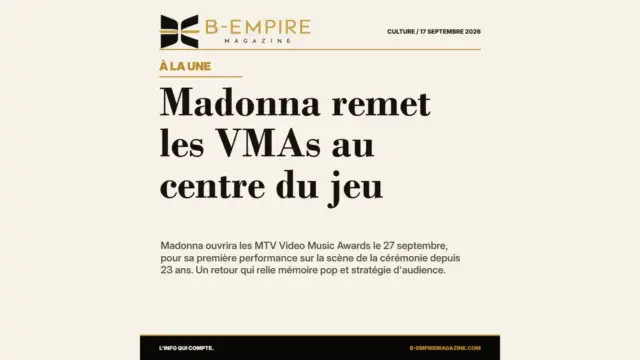
The 2026 MTV Video Music Awards nominations, announced on August 18, say more than a ranking of music videos. Madonna leads with eleven nominations, Taylor Swift follows with nine, while Ariana Grande and Sabrina Carpenter have seven each. On paper, it is a pop competition. In reality, it is a power demonstration: an industry turning nostalgia, visual performance and fan voting into an advertising machine for MTV, CBS and Paramount+.
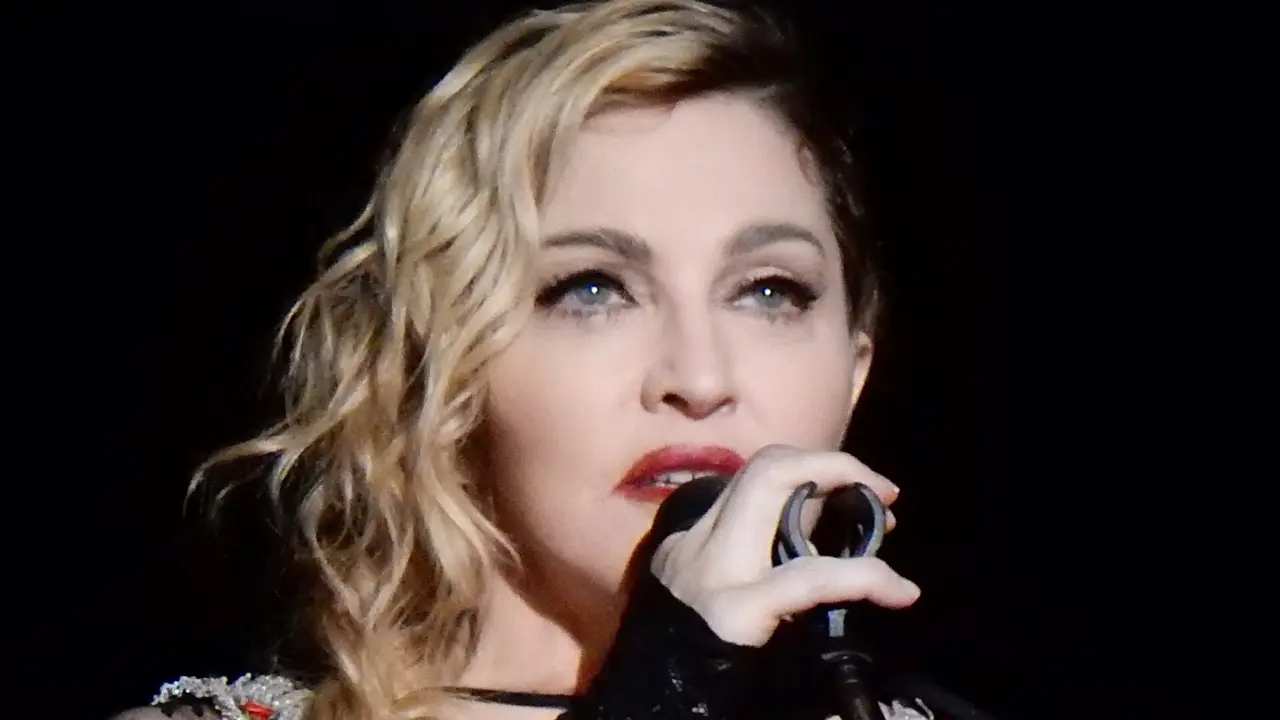
The Associated Press underlines the symbol. Madonna remains nominated in every decade of her career and, with a sweep, could join Beyonce and Taylor Swift among the most-awarded artists in VMA history. That statistic is almost as valuable as an award. It proves that the Madonna brand remains legible to several generations, even in a landscape where videos circulate more on social platforms than on a linear music channel.
Taylor Swift plays another kind of dominance. With nine nominations, she needs only one more win to stand alone at the top of the all-time VMA winners list, according to AP. This type of suspense is media fuel. It turns a ceremony into a statistical serial: records, fans, hashtags, awards, archives, revenge, possible coronation. The VMAs know very well that the battle is not limited to the night of September 27. It starts now, with nominations and voting.
The return of public voting is central. People reports that fans can vote in thirteen categories until September 25, with Best New Artist voting continuing into the live broadcast. That mechanism changes the nature of the campaign. Artists no longer compete only through video quality or cultural weight; they mobilize communities able to come back daily, organize instructions, produce support content and transform an award into proof of collective strength.
Paramount has every reason to encourage this dynamic. The official Paramount Press Express page says the 2026 VMAs will air live from Los Angeles on Sunday, September 27, simultaneously on CBS and MTV, with streaming on Paramount+. This structure is strategic: CBS brings mass reach, MTV brings brand heritage, and Paramount+ captures subscription and on-demand value. A music award thus becomes a cross-platform programming tool.
The 2026 selection highlights an interesting paradox. The VMAs were born in the era of televised music videos, but their current power comes from fragmented image circulation. A video no longer has to be awaited in front of MTV; it exists as clips, memes, reactions, choreography, edits and fan montages. Yet the VMA institution still gives an official shape to that dispersed energy. It says: these images mattered, these artists dominated, these fans moved the market.
Pitchfork also notes several category choices, including the absence of older fields such as Best Rock or Best Group in the published nominations. That apparently technical detail says something about the pop moment. Awards follow the priorities of attention. Visual pop, collaborations, R&B, dance, K-pop, hip-hop and production effects take the place of old genre borders. The ceremony maps less a record collection than an economy of shareable moments.
Madonna leading this edition is therefore not merely nostalgic surprise. It is ideal narrative strategy. It allows the VMAs to connect 1984 and 2026, historic scandal and current platforms, the video as television object and the video as streaming asset. Taylor Swift adds organized fandom and the possibility of a historic record. Ariana Grande and Sabrina Carpenter represent contemporary pop built on aesthetic detail, visual storytelling and high virality. Together, they create a bill television can sell and networks can amplify.
The business stakes go beyond music. For CBS, the VMAs are a fall event in a season where major networks still search for live appointments capable of producing urgency. For MTV, they are a way to remain relevant beyond its golden age. For Paramount+, they are a catalogue, replay and live argument. For labels, they are a campaign that is both free and paid: nominations restart videos, videos restart songs, and songs restart tours.
The first nominations also have discovery value. AP mentions twenty-six first-time nominees, while People highlights new names such as Noah Kahan, Olivia Dean, Stella Lefty and Tucker Wetmore. The system needs that breathing room. Without new faces, the VMAs would become a museum of superstars. With them, the ceremony can claim to organize succession, even if the biggest fandom machines remain at the centre of attention.
For B-EMPIRE, the strong signal is the revaluation of the music video as a premium asset. For a while, it seemed the video had lost its commercial function, absorbed by short formats and live performances. The VMAs show the opposite: when properly exploited, a video becomes an image bank, a brand argument, proof of ambition and a support for mobilization. It no longer sells only a song. It sells an era.
The September ceremony will reveal the winners. But the industry has already obtained part of what it wanted: lists, debates, frustrations, possible records, votes, links, clips and fans at work. The 2026 VMAs prove that modern pop is not only about streaming. It is an economy of rituals. Madonna and Taylor Swift are not just competing. They are reminding the market that the pop star remains one of global entertainment’s most profitable attention technologies.