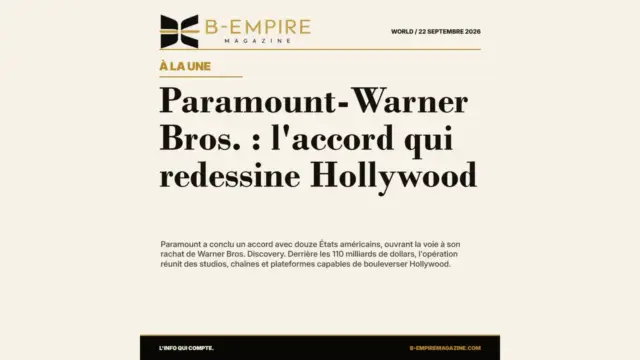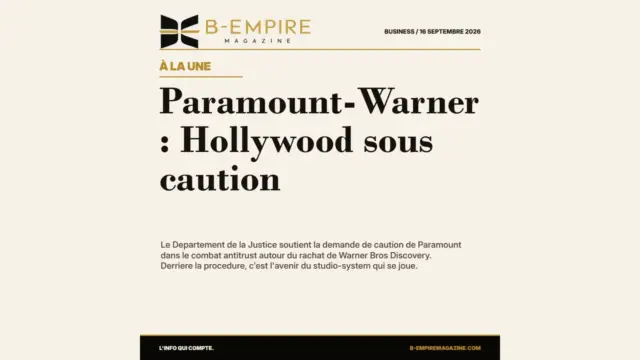

The entertainment world has just crossed a threshold that could reshape Hollywood. The UK has given its green light to the acquisition of Warner Bros. Discovery by Paramount Skydance, a deal valued at nearly $111 billion, including debt. However, the British approval does not close the case: in the United States, twelve states still want to block the merger in court. With the promise of a champion capable of competing with tech giants and the fear of unprecedented concentration, the battle is just beginning.
This operation brings together under one roof brands that structure the global imagination: HBO Max, Warner Bros., Harry Potter, DC, CNN, and TNT Sports on one side; Paramount Pictures, CBS, Nickelodeon, MTV, Showtime, and Paramount+ on the other. Therefore, the merger does not only concern two American companies. It impacts films seen in French cinemas, series offered to European subscribers, news channels, sports rights, creative jobs, and the future pricing of platforms.
The Decision That Shakes the Global Media Market
On August 6, 2026, the British Competition and Markets Authority announced that it was approving the acquisition after its phase 1 investigation. The regulator concluded that the merger would not result in a substantial reduction in competition in the UK. The British Culture Secretary also refrained from intervening, but only after obtaining legally binding commitments from Paramount.
These guarantees reflect the concerns surrounding the merger. Paramount has committed to preserving the editorial independence of Channel 5, with a distinct management from CBS and CNN. The group must also keep certain linear and on-demand services separate, as well as youth channels like Nickelodeon and Cartoon Network. The British government will monitor the implementation of these promises and will receive annual compliance statements.
$111 Billion and an Almost Vertiginous Catalog
The often-cited price of $81 billion corresponds to the value of the shares, while the operation approaches $111 billion when including debt. This scale gives a measure of the gamble. Paramount Skydance is not just looking to buy a studio: it aims to build an integrated group capable of producing films, controlling channels, distributing information, owning global franchises, and uniting two major streaming offerings.
For Paramount’s leaders, size has become a condition for survival against Netflix, Amazon, Apple, YouTube, and Disney. The group promises at least thirty quality films per year benefiting from a full theatrical release, the maintenance of licenses granted to third parties, and independent creative direction for iconic brands. This promise addresses a central fear: that a giant merger would mechanically reduce the number of productions and turn each project into a mere variable of savings.
Why the European Green Light Does Not Solve Everything
Before London, the European Commission had already approved the operation on July 22. Paramount claims that authorities representing 65 jurisdictions have approved the transaction or chosen not to contest it, including at the federal level in the United States, in China, Canada, Australia, Brazil, South Africa, and several European countries. France has also granted its approval under foreign investment control.
Brussels considered that there were still enough competing studios in the European Economic Area, citing traditional majors as well as Amazon MGM, A24, and Lionsgate. The Commission also integrated the competition between streaming platforms and linear television into its analysis. This reading favors Paramount: if the boundaries between cinema, television, and digital platforms disappear, the new group can present itself as a challenger to tech companies rather than as a giant absorbing a direct rival.
In the United States, the Scenario Remains Wide Open
The main obstacle now lies before the American courts. Twelve states led by California have filed a lawsuit to block the merger. They argue that the Paramount-Warner entity could reduce competition in Hollywood and leave fewer choices for both cinema-goers and pay-TV customers. Professional organizations, including the Writers Guild of America, are also contesting the operation.
Paramount and Warner have agreed to delay the closing until five days after a decision on the merits or until June 1, 2027. An antitrust trial is set to begin in March. This pause is significant: even with the green lights from the UK, Europe, and federal authorities in the US, the marriage cannot be considered a done deal. Legal costs are rising, teams remain in uncertainty, and launch strategies must be planned without knowing when integration will be possible.
The Real Stakes for Subscribers: Price, Choice, and Algorithms
For the public, the most concrete question is simple: what will happen to HBO Max and Paramount+? A platform uniting their catalogs could offer exceptional power, from HBO series to Warner films, from DC and Harry Potter franchises to Paramount, Showtime, and CBS productions. It could also simplify access to content currently scattered across multiple subscriptions.
However, concentration carries the opposite risk. Less competition may provide more freedom to raise prices, remove works, impose advertising, or favor the most profitable franchises. Decisions made by a single group could simultaneously affect theatrical releases, exclusivity duration, international sales, and the visibility of independent creations. The catalog would be larger, but the power to choose what is financed, distributed, and recommended would also become much more concentrated.
What the Merger Could Change for France
In France, the potential impact goes beyond streaming interfaces. Warner and Paramount distribute films in theaters, purchase productions, employ teams, and negotiate with broadcasters. A more powerful group could invest more in European projects to meet local obligations and enrich its catalog. It could also strengthen its bargaining power against exhibitors, producers, authors, and French channels.
French regulations, the media chronology, and European rules on local works will continue to apply. They limit total standardization. However, the decisions made in Los Angeles will have effects in Paris: films selected for theatrical release, marketing budgets, series schedules, subscription prices, and the prominence given to Francophone talents. The French approval under foreign investment does not mean that all economic and cultural effects are already known.
Hollywood Plays Its Next Economic Model
The merger comes after years of massive spending in streaming, a decline in traditional television, and intense pressure on studios. Platforms promised unlimited abundance before seeking profitability through price increases, advertising, content removals, and consolidations. Paramount-Warner represents the culmination of this cycle: to compete with digital giants, historical groups are also choosing size.
The gamble can succeed if the new entity uses its scale to finance more works, distribute them better, and build a truly competitive offering. It can fail if the announced savings translate into layoffs, fewer original films, and increased dependence on franchises. This is why the British green light is important but not definitive. It brings two legendary libraries closer together, but leaves the question that haunts the industry entirely open: will one more giant provide more choice for the public, or simply more power to a single player?
Reliable Sources
- Associated Press â British green light, commitments, and American legal battle
- Competition and Markets Authority â official decision of August 6, 2026
- Paramount â European approval, concerned jurisdictions, and industrial commitments
- Associated Press â merger delay and lawsuit filed by twelve US states