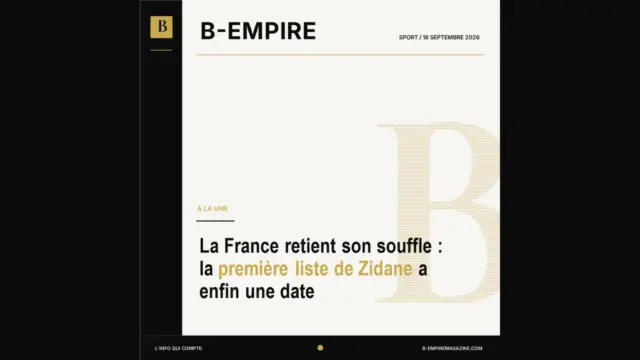

France has awaited this image for years: Zinédine Zidane facing the microphones, no longer as a legend of the Bleus, but as their new head coach. On Tuesday, July 28, 2026, the French Football Federation officially announced the appointment of the former number 10 for four years, until the 2030 World Cup. At 54 years old, the 1998 World Champion succeeds Didier Deschamps and takes the reins of a team immense in talent, exposure, and the expectations it generates.
This announcement goes far beyond a mere coaching change. It closes fourteen years of Deschamps’ reign and finally brings together one of the greatest symbols of French sports with the position he has long desired. Zidane explained that he had turned down offers for four or five years because the French national team was the project he wanted after his adventure at Real Madrid. The dream has become reality. The pressure, however, begins immediately.
An Official Appointment Until the 2030 World Cup
The president of the FFF, Philippe Diallo, introduced Zidane after an extraordinary executive committee meeting. The contract covers the upcoming Nations League campaigns, Euro 2028, and the 2030 World Cup. His official start date is set for August 1, with a first major home match against Italy on October 2 at the Stade de France, twenty years after the World Cup final in Berlin that marked the end of his international career.
The symbolism is powerful, but the roadmap is concrete. France comes out of a 2026 World Cup that ended in fourth place after a defeat against England in the third-place match. It retains a pool of players that almost all nations envy, but must regain momentum, renew some key players, and prepare a generation capable of winning in four years.
Zidane’s Dream Becomes a Personal Risk
Zidane arrives with an exceptional aura. He won the 1998 World Cup and the 2000 Euro as a player, then three consecutive Champions Leagues as head coach of Real Madrid between 2016 and 2018. Few coaches can present such a combination of prestige, high-level experience, and understanding of pressure.
However, this appointment also carries a rare risk: the potential to jeopardize an almost untouchable image in France. Zidane is not just a popular former player. He is a cultural figure, linked to Marseille, to the France of 1998, and to a form of silent success that has become universal. By accepting the role with the Bleus, he leaves the comfortable realm of memory for the brutal field of immediate results.
After Fourteen Years, the Immense Legacy of Didier Deschamps
The comparison with Didier Deschamps will be constant. Appointed in 2012, the former captain of 1998 led France to the World Cup title in Russia in 2018, to the Euro 2016 final, to the World Cup 2022 final, and to the Nations League trophy in 2021. His longevity established routines, a culture of results, and a stability that became almost normal.
Zidane does not inherit a team to rebuild from scratch. He takes over a high-performing machine, but one that has reached the end of a cycle. His challenge will be more subtle: to preserve what works while changing enough to justify a new era. The choice of key players, the balance in midfield, the integration of youth, and the relationship with captain Kylian Mbappé will be scrutinized from his first squad selection.
What Style of Football for the New Bleus?
In Madrid, Zidane never sought to confine his teams to a rigid doctrine. He prioritized human management, adaptation to major events, and the freedom granted to decisive players. His teams knew how to control weak moments, attack quickly, and survive the most tense European matches. This flexibility may suit international football, where training time is limited.
Nevertheless, France will expect visible signs. After fourteen years of continuity, the public will want to understand what Zidane changes: a higher pressing, more control with the ball, a new role for Mbappé, or increased trust in creative players. The head coach has chosen not to immediately detail his system. This caution maintains anticipation, but the first matches must quickly provide direction.
Mbappé: The Relationship That Could Define the Mandate
The relationship between Zinédine Zidane and Kylian Mbappé will be one of the major narratives of this mandate. The two men embody different generations of French power and share a deep connection with Real Madrid. Zidane understands the difficulty of protecting a superstar without destabilizing a locker room. Mbappé, captain of the Bleus, must now carry a project that will no longer be Deschamps’.
Their synergy could become a formidable accelerator. However, it will not be enough. France must build around a collective, clarify the offensive hierarchy, and maintain real competition. The prestige of the new head coach will likely facilitate his authority at the outset. Over time, only the coherence of his decisions and the group’s ability to win the most difficult matches will preserve this advantage.
A Global Wave for French Football
Zidane’s appointment has an immediate international impact. His presentation attracted journalists from many countries, and his return to the bench reignites global interest in the Bleus. For the FFF, this visibility strengthens the brand of the French national team, its commercial attractiveness, and its weight in international football. Each selection and every trip will become a media event.
This exposure also benefits Ligue 1, training centers, and young French players abroad. Being called up by Zidane will carry particular symbolic value. However, the aura comes with a downside: any difficulty will take on global proportions. A draw, an exclusion, or tension with a key player will never remain mere sporting episodes.
Euro 2028 Will Be the First Major Verdict
The contract extends until 2030, but Zidane will not have four tranquil years. Euro 2028 will constitute the first major judgment. France will arrive among the favorites, with the obligation not only to go far but to demonstrate an identity capable of withstanding the best European nations. Before that, the Nations League will serve as a laboratory and the first test of his management.
The schedule offers an almost perfect narrative: a long-awaited entry into office, a return to the Stade de France against Italy, and a horizon set for the 2030 World Cup. Yet, Zidane knows better than anyone that football does not respect pre-written scenarios. His history with the Bleus contains peaks, injuries, returns, and a memorable 2006 final.
The Myth Now Enters the Realm of Reality
The appointment of Zinédine Zidane is both the conclusion of a national wait and the beginning of a completely new experience. France gets the head coach that a significant part of the public dreamed of. Zidane gets the position he claims to have waited for by turning down other offers. This meeting seemed inevitable; it will nonetheless be challenging.
His name will create enthusiasm, fill stadiums, and naturally impose respect. But he will not win any matches alone. To succeed, Zidane must transform emotion into method, Deschamps’ legacy into a new cycle, and an exceptional generation into a championship-winning team. The French dream has finally become official. From August 1, it must become a project.
Reliable Sources
- Reuters Connect â Official presentation of Zinédine Zidane by the FFF, July 28, 2026.
- Associated Press via The Washington Post â Zidane appointed head coach of France, July 28, 2026.
- Le Monde â Official appointment and sporting context, July 28, 2026.
- LâÃquipe â Four-year contract and presentation by Philippe Diallo, July 28, 2026.
- Reuters via Boursorama â First words from the new head coach, July 28, 2026.