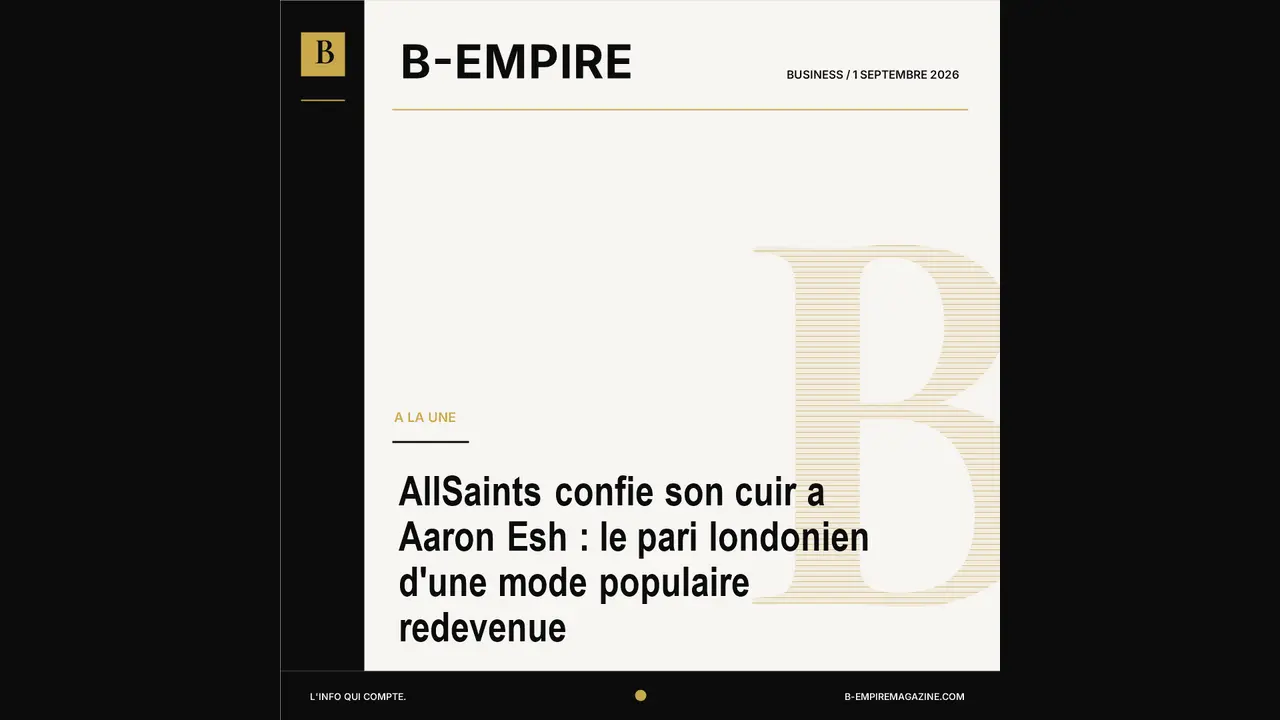
On September 1, 2026, AllSaints did not simply place an autumn-winter collection on the shop floor. The London brand opened a live test: can a popular label become desirable again without betraying its price point, its audience and its mythology? The answer is being carried by Aaron Esh, the Central Saint Martins-trained designer, London native and new creative director of a house that once dressed the indie imagination: black leather, military boots, post-gig silhouettes, a slightly worn urban sensuality, unmistakably Spitalfields.
According to Vogue Business, Esh’s first collection is launching globally today, with a deeper ambition than a wardrobe refresh. AllSaints wants to return as a cultural brand, not merely as an upscale high-street habit. The wager is delicate: too much nostalgia turns the exercise into costume; too much sophistication risks stripping the brand of its accessibility. Esh chooses a third path, one of almost intimate precision: take the white T-shirt, the denim, the leather jacket, the coat, then recalibrate the proportions, materials, linings and the way the garment actually falls on the body.
That formula matters because it says something about fashion’s current mood. Traditional luxury has slowed across several seasons, younger customers are making sharper choices, and mid-market brands are searching for a new legitimacy. The easy answer would be to shout louder: logos, short collaborations, spectacular campaigns. AllSaints, instead, appears to be seeking clarity through cut. In the announcement carried by PR Times, Esh says he is less interested in defining the customer by age or social category than by character. In other words, AllSaints does not want to sell only a product, but an attitude that can be recognised without aggressive branding.
That line could sound like marketing. It becomes more interesting when you look at the architecture of the relaunch. The collection arrives with a campaign shot by Alasdair McLellan, styled by Katy England, and a renewed graphic identity built around the brand’s archives, from the Ramskull to signs that evoke military markings. TheIndustry.fashion notes that the campaign combines models with street-cast Londoners: artists, students, a chef, a dancer, a publisher and a craftsperson. This is not incidental. AllSaints wants community to come before product, and the clothes to look as if they were discovered inside a life already in motion.
The central question is commercial. AllSaints is not a couture house and does not pretend to become one. Its territory remains more accessible than luxury, but more culturally charged than fast fashion. That is precisely the most contested zone in contemporary retail: consumers want to buy better, but not necessarily cheaper at any cost; they want pieces that last, but also a social signal, a belonging, a story. If Aaron Esh succeeds, he can prove that a diffusion brand can recover value without imitating luxury’s closed codes.
British GQ reports that Esh approached the launch with an almost physical logic, down to store work, overnight preparation and an obsession with clothes being worn. That detail matters. Fashion often speaks in terms of worlds, but it still wins in front of a mirror, when a jacket sits correctly or a boot changes someone’s posture. For AllSaints, whose mythology was built on immediate confidence, the battle is not only aesthetic. It is tactile. It happens in the feeling that a customer becomes someone again the moment the piece goes on.
The brand’s return also arrives as London is trying to protect its role as a laboratory. Between heritage houses, experimental young labels and global retail giants, the British capital has always produced fertile friction. AllSaints under Esh could become a bridge: accessible enough to reach the street, considered enough to interest the industry, nostalgic enough to speak to former customers, and new enough to avoid looking like a lazy reissue of the 2000s.
What is happening here therefore extends beyond AllSaints. It is a question of cultural power in upper-middle fashion. For a long time, this segment was condemned to follow: follow runways, follow influencers, follow markdown cycles. With Esh, AllSaints is trying to regain initiative by arguing that desirability can come from a daily wardrobe rebuilt with seriousness. Not every coat has to become a manifesto; sometimes it is enough for a brand to recover its accent, its rhythm and its body.
There is risk, of course. A brand relaunch is rarely judged on day one. The images can be beautiful, the interviews persuasive, the intentions perfectly worded; the real verdict will arrive in fitting rooms, online baskets, customer returns, margins and the ability to maintain consistent quality. But on this September 1, AllSaints gives the market a rare signal: the return of cool may not come through a spectacular rupture, but through the patient reconstruction of what it means to wear London now.
Sources
- Vogue – The First AllSaints Collection by Aaron Esh Drops Today
- TheIndustry.fashion – AllSaints unveils first collection under Creative Director Aaron Esh
- PR Times – AllSaints Autumn Winter 2026 under Aaron Esh
- British GQ – How Aaron Esh is jumpstarting a new AllSaints era
- AllSaints – New In Fall Winter 2026