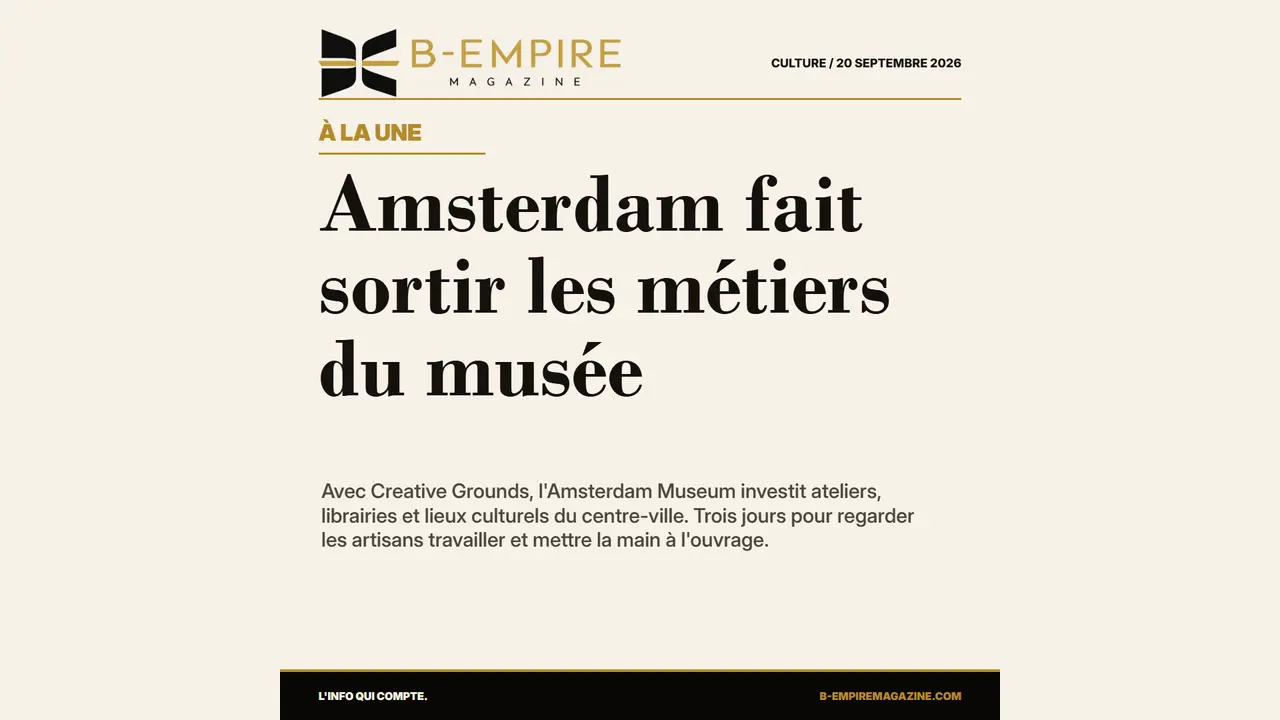
To understand a craft, it can help to leave the museum gallery. From 18 to 20 September 2026, the Amsterdam Museum is organizing the first edition of Creative Grounds across several city-centre venues. Workshops, exhibitions, talks and tours invite visitors to watch makers at work and then try certain techniques themselves. The programme ranges from zine-making to glass, from goldsmithing to baking. This move is more than a change of scenery: it turns the city into a space for collecting, demonstrating and discussing creative work.
An exhibition spread across the city
The event is not concentrated in one building. Vrij Paleis, Athenaeum bookshop, Spui25, Theater de Richel and other partners have opened their doors to a free public programme, with registration depending on the activity. The format matters as much as the content. In a workshop or a shop, visitors can see tools, spatial constraints, materials and the time a piece requires. Where a finished object may appear effortless, work in progress makes the choices and trials behind it visible.
The Amsterdam Museum presents this first gathering under the theme of craftsmanship. It is not solely about older trades. The programme brings together glass, jewellery, embroidery, independent publishing, photography and design, among other practices. That breadth avoids treating handmade work as a single style or a nostalgic commodity. Instead it shows practices that can transmit techniques while inventing new forms. Audiences can enter through different interests: material, the history of a neighbourhood, images, or simply a wish to make something.
Collections as a starting point, not the destination
Four artists, Ella de Haas, Zoë Love Smith, Tijmen IJsendijk and Jero Leeflang, have created new works inspired by the museum’s collection and their own perspectives on central Amsterdam. Their work is displayed at different locations in the city. This approach changes the role of the collection: it is not only a group of objects to preserve and explain, but material from which living artists can respond to the place where they work.
Another example is Mum’s Tins, a series by Georgy Dendoe included in the programme. The artist connects the museum’s Luycken Collection, which the institution says contains more than 15,000 prints, books and drawings, with his mother’s collection of soda tins. The comparison does not claim that these archives are identical. It suggests that urban memory can pass through familiar household objects as well as officially preserved collections. This is the kind of conversation a museum can open when it temporarily moves beyond its own walls.
Making changes the way we look
Weekend workshops include glasswork, embroidery, crochet and zine-making. The WERKER collective invites participants to print on fabric using woodblocks connected to less visible queer histories. On Sunday, Knits and Notes brings knitting, music and storytelling together at nachbar. These sessions do not ask visitors to become professionals in an hour. They offer a glimpse of the difficulty, enjoyment and attention involved in a gesture repeated and refined over time.
A practice becomes easier to appreciate once one has encountered, even briefly, the resistance of a material and the hesitation of a beginner. This participatory element distinguishes Creative Grounds from an exhibition in which everything remains at a distance. It also raises a question about museum education: how can an institution communicate an object’s value without showing the body, time and skill involved in making it? Demonstrations and workshops cannot replace collections, but they can broaden the way collections are read.
Creative lives beyond display cases
The photographic project Creatives In/AMS, shown at Vrij Paleis, follows local makers over the course of a year, week by week, looking at their work and the way they build creative lives. That duration contrasts with the festival’s three days. It is a reminder that an event can make people visible without, by itself, solving questions of workspace, income or access to an audience. The programme also includes guided walks through city-centre crafts, linking places of production with the neighbourhood around them.
As of 20 September, the Amsterdam Museum has not published visitor figures or an impact assessment for this first edition. It would be premature to describe it as a proven model. A future assessment could examine whether visitors returned to participating workshops, whether makers gained lasting contacts, and whether people who rarely enter a museum felt welcome in this city-wide format. These are questions to investigate, not successes already established by the programme. Its proposition is nevertheless compelling: if material culture is made in workshops, shops, shared spaces and kitchens, a museum can meet it there rather than waiting for it to become an archive. For B-EMPIRE, Creative Grounds shows a museum less concerned with owning every object than with making the people and skills that animate a city easier to see. That shift also asks institutions to value ongoing work, not only finished things.