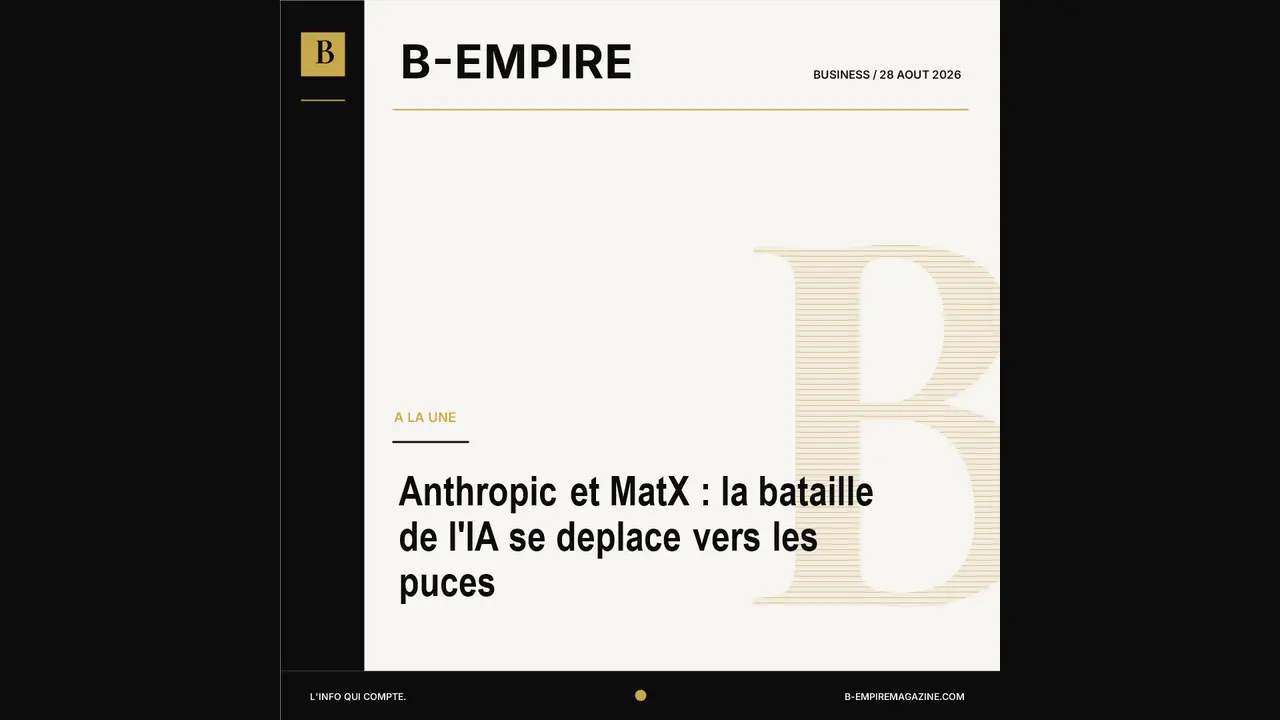
The next great advantage in artificial intelligence will not be fought only inside models, but inside the metal that runs them. Reuters reported that Anthropic discussed buying MatX, an artificial intelligence chip startup, for roughly $7 billion. The acquisition talks are no longer active and, according to one source cited by the agency, have evolved into partnership discussions. Even abandoned, the project says something decisive: AI labs no longer want only to buy computing power. They want to design it.
MatX, founded by former engineers from Google’s TPU unit, is now seeking to raise new capital at a valuation of about $4 billion, according to Reuters. Anthropic declined to comment, and MatX did not respond to the agency. But the mere size of the discussed price is enough to move the conversation. A lab known for Claude considering a check of that magnitude for a semiconductor team is not a venture-capital anecdote. It is an industrial statement.
When Software Wants to Own Its Factory
For two years, AI giants have mostly been described as model companies: parameters, reasoning, agents, multimodality, safety, API pricing. That story was incomplete. Behind every assistant, every automatic summary, every agent that codes or negotiates a task, there is a physical chain: data centers, memory, networking, energy, cooling and specialized processors. Whoever controls that chain controls part of the cost, availability and pace of innovation.
Anthropic, like its rivals, depends on a compute market dominated by Nvidia and by major cloud providers. That dependence is not only financial. It imposes queues, technical trade-offs, supply constraints and strategic vulnerability. Creating an in-house chip, or partnering with a team able to design one, turns a cost line into a competitive advantage. It is the old dream of vertical integration applied to the age of giant models.
MatX, a Small Team at the Center of a Huge Market
MatX’s profile explains the interest. Former Google engineers who worked around TPUs possess a rare skill: designing chips not for every possible use, but for the precise workloads of training and inference. In modern AI, that specialization can be extremely valuable. A marginal improvement in energy efficiency or compute throughput can become, at the scale of a large model, a colossal saving.
That is why the valuations look dizzying. A startup that does not yet have Nvidia’s commercial weight can still be seen as a strategic shortcut. Buying MatX would have meant buying brains, a roadmap, a potential technical lead and a partial escape from market scarcity. If the acquisition did not happen, the interest remains revealing: hardware talent has become as sensitive as model talent.
The End of Cloud Innocence
During the first phase of generative AI, the logic appeared simple: rent GPUs, train bigger, attract users, raise capital, repeat. That mechanism created spectacular growth, but it also exposed a weakness. Infrastructure costs are rising faster than many recurring revenues. Investors are starting to ask how labs will turn adoption into durable margin.
In that context, the chip becomes an answer. It promises a better cost per query, an architecture adapted to the model, fewer bottlenecks and stronger bargaining power with suppliers. It also promises a more credible financial story: the lab is not merely burning capital to rent someone else’s machine, it is building infrastructure that can become an asset.
Nvidia Remains the Center of Gravity
It would be naive, however, to see this as a quick exit from Nvidia’s orbit. Business Insider recently described the scale of Nvidia’s investments in its own AI ecosystem, with stakes, licenses and agreements that reinforce its central role. The company no longer sells only chips. It organizes a market around itself, with software, models, infrastructure, partners and customers bound by technical excellence.
It is precisely because Nvidia remains so powerful that others are looking for alternatives. Anthropic does not need to replace the whole chain to improve its position. A partnership with MatX could already help it develop certain workloads, test architectures, attract engineers and signal to the market that the lab will not remain passive. In such a concentrated industry, even a partial alternative can change a negotiation.
AI Becomes Heavy Industry
The important word here is industry. Artificial intelligence long kept an image of pure software: researchers, servers, code, viral demonstrations. The MatX file shows that this image is now insufficient. AI leaders must think like infrastructure manufacturers, with multi-year horizons, supply chains, hardware design teams and serious execution risks.
Designing a chip is not like launching a feature. Cycles are long, mistakes are expensive, industrial dependencies are numerous, and competition never stands still. The advantage is immense if the chip works. So is the risk if it arrives too late, too expensive or too specific. That is why the move from a potential acquisition to a partnership seems logical: it allows learning without immediately swallowing all the risk.
A Battle for Private Sovereignty
This chip race is not only technical. It touches a form of private sovereignty. Major AI labs want to reduce dependence on a handful of suppliers, but also protect design secrets, optimize their models more intimately and secure their growth. In classic software, infrastructure could be abstracted away. In generative AI, it becomes almost part of identity: the model and the machine learn to define each other.
Governments are watching this dynamic closely, because semiconductors are already geopolitical ground. The labs are watching it with commercial urgency. If AI demand continues rising, every cent saved per query can become a weapon. Every watt saved can make a product more profitable. Every month gained in training a model can move a market.
What B-EMPIRE Takes Away
Reuters’ reporting on Anthropic and MatX shows that the AI war is leaving the whiteboard and entering the foundry. Software is no longer enough. Labs are seeking chips, teams, architectures, economies of scale and maneuvering room against dominant compute platforms.
The acquisition did not happen, but the signal matters more than the deal. Anthropic wants to be less of a tenant of its technical future. MatX becomes, in this story, the symbol of a new scarcity: not only data or model researchers, but engineers capable of turning algorithmic ambition into silicon. Consumer AI feels immaterial. Its power is becoming more material every day.
Sources
- Reuters via Investing.com – Anthropic planned, then abandoned $7 billion purchase of MatX, August 27, 2026
- Reuters via Euronext – Anthropic and MatX deal talks, August 27, 2026
- Boursorama with Reuters – Anthropic reportedly considered buying MatX, August 28, 2026
- Business Insider – Nvidia’s AI investment spree, August 27, 2026