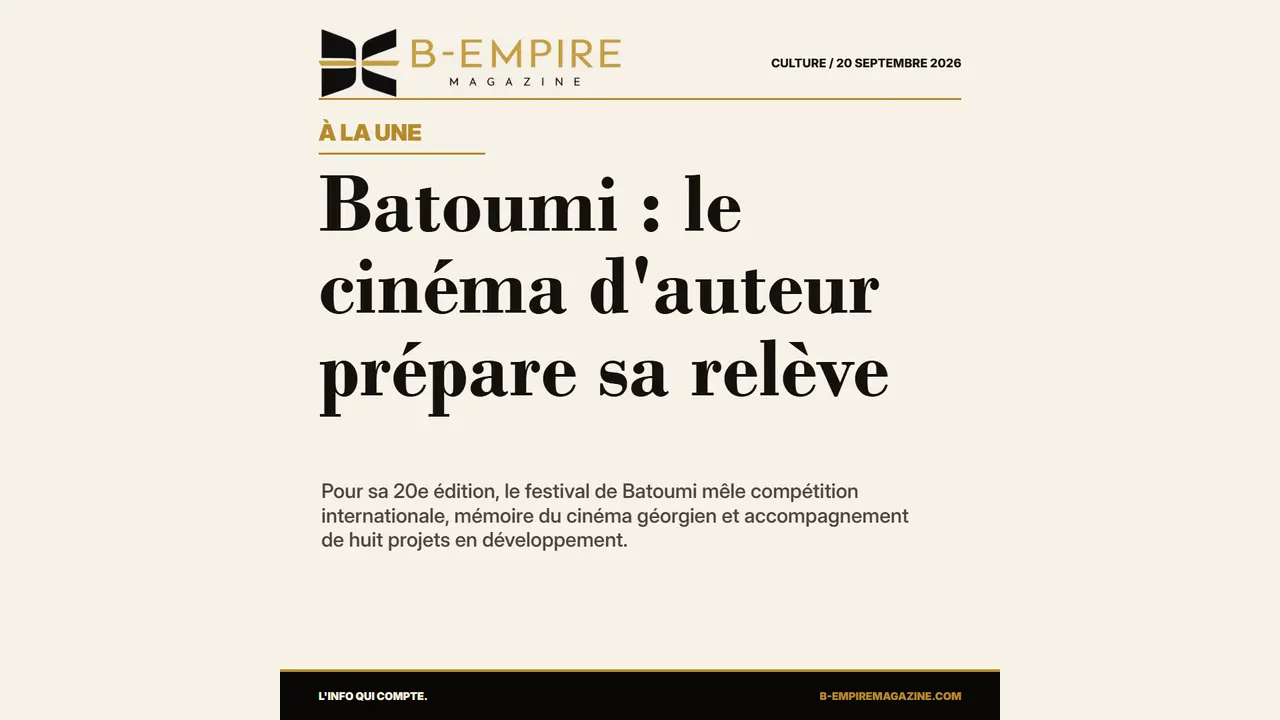
A film festival is not limited to the movies audiences see this week. In Batumi, Georgia, the Batumi International Art-House Film Festival (BIAFF) is holding its twentieth edition from 19 to 26 September 2026. The event lists an international competition of ten feature films, shorts, heritage programmes and industry meetings. Its value lies in that combination: showing completed works while helping other films move from an idea toward production. The anniversary offers a view of auteur cinema in a region seeking to widen its professional networks.
Ten films in competition, many ways to tell a story
BIAFF has announced ten films for its International Feature Film Competition. In its statement, it emphasizes a range of generations, countries and cinematic languages. It describes intimate stories as well as broader social realities, touching on identity, family, belonging and memory. These are the festival’s descriptions, not a critical verdict on every title. What can be verified now is the structure of the programme; awards and audience responses are still to come. That distinction matters during a festival week, when promotional language can easily be mistaken for a review.
The broader selection on the website also includes titles such as Ryusuke Hamaguchi’s All of a Sudden (Soudain), Cristian Mungiu’s Fjord and Rafael Manuel’s Filipiñana. These examples signal the event’s international ambitions, but should not automatically be confused with the ten competition entries: the site distributes its films across several sections. For an audience member, the opportunity is to move between discoveries, established filmmakers and different formats without reducing the whole festival to a single future prize list.
The present meets the memory of images
The 2026 programme includes a Masters’ Collection, a short-film competition, special screenings, a Music in Cinema strand, and sections devoted to Georgian film heritage and classic Georgian animation. The latter deserve attention. An international festival can be a window onto the world while giving local audiences a chance to revisit their own images on a large screen. In either case, context matters: presenting, discussing and placing films in history can do more than simply string screenings together.
BIAFF traces its story back to 2006. Twenty editions later, its place in Batumi’s cultural life cannot be measured only by the number of titles screened. Meetings among directors, critics and audiences create a space where cinema from different places can be compared without forcing it into one commercial formula. It would be excessive to call this a solution to independent film’s distribution problems. The festival does, however, provide a moment of visibility and conversation that many films struggle to secure elsewhere.
Alternative Wave: eight films still to be made
The professional side is less visible than the screenings, but says much about the festival’s strategy. Founded in 2015, Alternative Wave supports film projects in development, particularly from Georgia and the wider Black Sea region. Its 2026 programme lists eight selected teams due to start work on 22 September at Radisson Batumi. Their sessions are intended to address writing, project presentation, international finance and production strategy before the projects are shown to industry professionals.
The problem the platform tackles is practical: an original idea does not become a film simply because someone notices it in a cinema. It needs a developed script, a budget, partners, sometimes a coproduction, and then a plan for circulation. BIAFF describes group workshops, individual consultations and work on presentation materials. No financing secured for the eight 2026 projects has been announced at this stage. Selection means access to support, not a guarantee that a shoot will take place.
A festival as cultural infrastructure
The connection between the public and industry sides makes the festival look like a small cultural infrastructure. Screening venues provide access to finished films; professional meetings create possibilities for those not yet complete. The two sides can reinforce each other. A filmmaker may gauge an audience’s response, meet a potential partner and discover how others approach a story. For a city, this can generate cultural activity beyond a single event, although the lasting effect needs to be evaluated rather than assumed.
What the 2026 edition leaves behind remains unwritten. It will be worth tracking which films find another life after Batumi, which Alternative Wave projects actually advance and whether local archives reach new audiences. The distinction between a public premiere, a development workshop and a distribution deal is important: each marks a different stage in a film’s journey, and none automatically produces the next. For B-EMPIRE, this twentieth edition recalls a simple truth: auteur cinema needs screens, but it also needs time, exchange and the means of production. A useful festival does not only celebrate work that is already ready. It helps make possible the work that does not yet exist. Such a role is harder to count than ticket sales, but it may matter for the next generation of filmmakers.