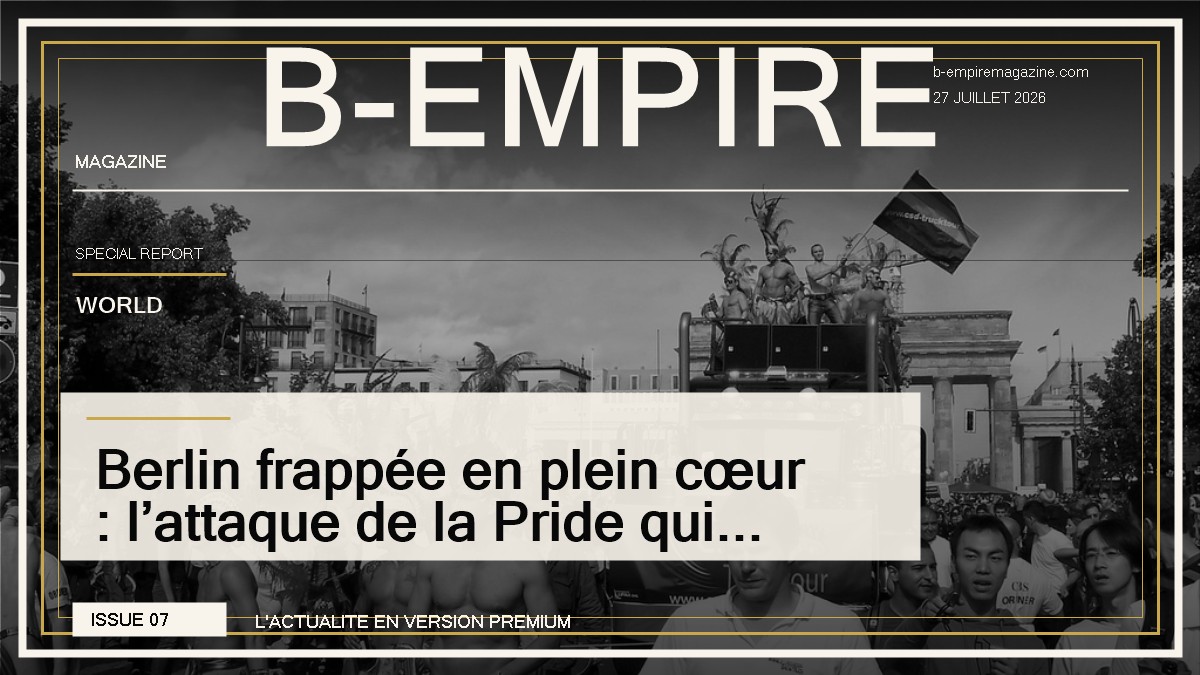
Berlin woke up wounded after a night that was meant to celebrate freedom. A woman was killed and 29 people were injured when a vehicle plowed into individuals in Tiergarten, near the Christopher Street Day, one of the largest pride marches in Europe. The 21-year-old suspect, who was sought for several hours, died Sunday evening during a police intervention in Spandau. German authorities now classify the incident as an Islamist attack, while the federal investigation seeks potential accomplices or supporters.
The violence of the act, its location, and its presumed target give this attack a significance that far exceeds the German capital. It strikes at an emblematic demonstration of LGBTQ+ visibility, at the heart of a metropolis that has built much of its contemporary identity on openness, culture, and the freedom to live. It also comes at a time when organizers of major European events are reevaluating their security measures.
A Celebration Turns Tragic in Minutes
According to Berlin police and German public media, the white vehicle entered Tiergarten on Saturday, July 25, shortly before 10 PM. It took the Ahornsteig, a path in the park, knocking over several people before crashing into a tree. Investigators later suspect the perpetrator attacked other victims with a knife. A woman died that very evening.
The initial toll, set at 16 or 17 injured amidst the confusion of the night, was raised on Sunday to 29 injured by Federal Interior Minister Alexander Dobrindt. According to ZDF, the injured were no longer in life-threatening condition by Sunday afternoon. Approximately 150 emergency responders were mobilized, with a plan in place for a mass casualty event.
Just a few hundred meters away, the closing evening continued near the Brandenburg Gate. The concert was interrupted, and organizers asked the audience to leave. Despite the uncertainty and shock, the evacuation occurred without major panic, according to emergency services. Hundreds of thousands had participated earlier in the parade and associated events.
Suspect Found in Spandau and Killed During Arrest
A massive manhunt mobilized security forces throughout Berlin. The suspect, a 21-year-old German born and raised in the capital, was ultimately located on Sunday in family gardens in Spandau. According to police, he approached special forces with a knife. Officers opened fire. Attempts at resuscitation were unsuccessful.
Authorities indicated that he was already known to security services. Berlin’s judiciary noted that he had been sentenced in May 2026 to one year and ten months for preparing a serious violent act threatening the state and for disseminating banned propaganda related to the Islamic State organization. This conviction was not final, as the prosecution had appealed. He had previously spent several months in pre-trial detention in Germany and Lebanon.
These elements raise a sensitive question about the monitoring of already identified radicalized individuals. However, they are not sufficient on their own to establish the entire scenario of the attack. The investigation must still determine how the vehicle was able to enter the park, whether the suspect acted alone, and if he received any material or operational assistance. Caution remains essential regarding individual responsibilities as investigations continue.
An Attack on a European Symbol of Freedom
The Berlin Christopher Street Day is not just a festival. Established in West Berlin in 1979, this event has become a major political and cultural gathering. It advocates for equality, protection against discrimination, and recognition of LGBTQ+ individuals. Its name refers to the mobilizations that arose after the Stonewall riots in New York in 1969.
The attack thus struck a space laden with meaning. Chancellor Friedrich Merz described it as an attack on German society and called on the country to defend its freedom. Berlin’s mayor, Kai Wegner, condemned it as an assault on a free and open society. On Sunday, residents returned to lay flowers near the site of the tragedy, while a memorial ceremony for the victims gathered political leaders.
For the LGBTQ+ community, the trauma is twofold: there are the direct victims, and then there is the fear that public visibility itself becomes a risk. However, association representatives emphasized the need not to abandon public space. This response is essential, as the goal of an attack is also psychological: to instill fear, isolate targeted groups, and push society to close in on itself.
Amsterdam, Paris, and European Capitals Under Pressure
The consequences are already being felt beyond Germany. Amsterdam is hosting WorldPride and its own annual celebrations. Mayor Femke Halsema assured that the security situation is being closely monitored and that additional measures would be implemented if necessary. Across Europe, the equation is delicate: to strengthen controls and physical barriers without transforming festive events into anxiety-inducing spaces.
For France, which regularly hosts very large cultural, sporting, and activist gatherings, the Berlin incident will be observed closely. Anti-ram vehicle measures have multiplied since the attacks that have struck Europe. However, Tiergarten reminds us of the vulnerability of peripheral areas, secondary paths, and exit flows, even when the main perimeter is protected.
The challenge is not just to install more barriers. It requires better coordination among intelligence, justice, police, organizers, and emergency services. It also necessitates rigorously monitoring individuals already flagged while respecting the rule of law. A democracy cannot respond to an attack on freedom by renouncing its own rules.
The Risk of a More Polarized Society
After an attack, the battle for narrative begins immediately. The facts must remain at the center: German authorities currently classify the incident as an Islamist attack and are seeking potential accomplices. This classification cannot serve to collectively label millions of Muslim citizens, just as the defense of LGBTQ+ individuals should not be reduced to a partisan debate.
Berlin precisely concentrates these multiple identities. The Associated Press spoke with Ali Darwich, a Berlin police officer, gay and Muslim, who fears both an increase in fear within the queer community and a new wave of racism. His testimony summarizes the trap set by terrorism: to pit groups against each other that share the same need for security, dignity, and freedom.
What Europe Cannot Ignore
The signal sent by Berlin is brutal. Open, lengthy, and heavily attended demonstrations remain difficult to secure at every meter. Arrival and departure routes can become weak points. Information held on radicalized profiles must circulate effectively among services. Finally, support for victims and witnesses must continue long after the police tape is removed.
But the response will not only be measured by the number of barriers deployed at the next gathering. It will also be measured by the capacity of Europeans to continue occupying public space, to protect minorities without fueling other hatreds, and to demand precise accountability for any institutional failures.
The Berlin Pride was meant to showcase a city confident in its diversity. The attack sought to transform this visibility into vulnerability. The mourning is now immense, the investigation urgent, and the questions many. Yet, the strongest response will remain that which Berlin and Europe build over time: more security, more clarity, and no capitulation to those who seek to make fear a boundary.
Sources
- Tagesschau â what we know about the attack and the suspect, July 26, 2026.
- ZDF â report and account of the rescue efforts at Tiergarten, July 26, 2026.
- Associated Press â attack near Berlin Pride, July 26, 2026.
- Berlin Public Prosecutor’s Office â official statement on the suspect, July 26, 2026.
- Reuters â initial details on the attack and security measures, updated July 26, 2026.