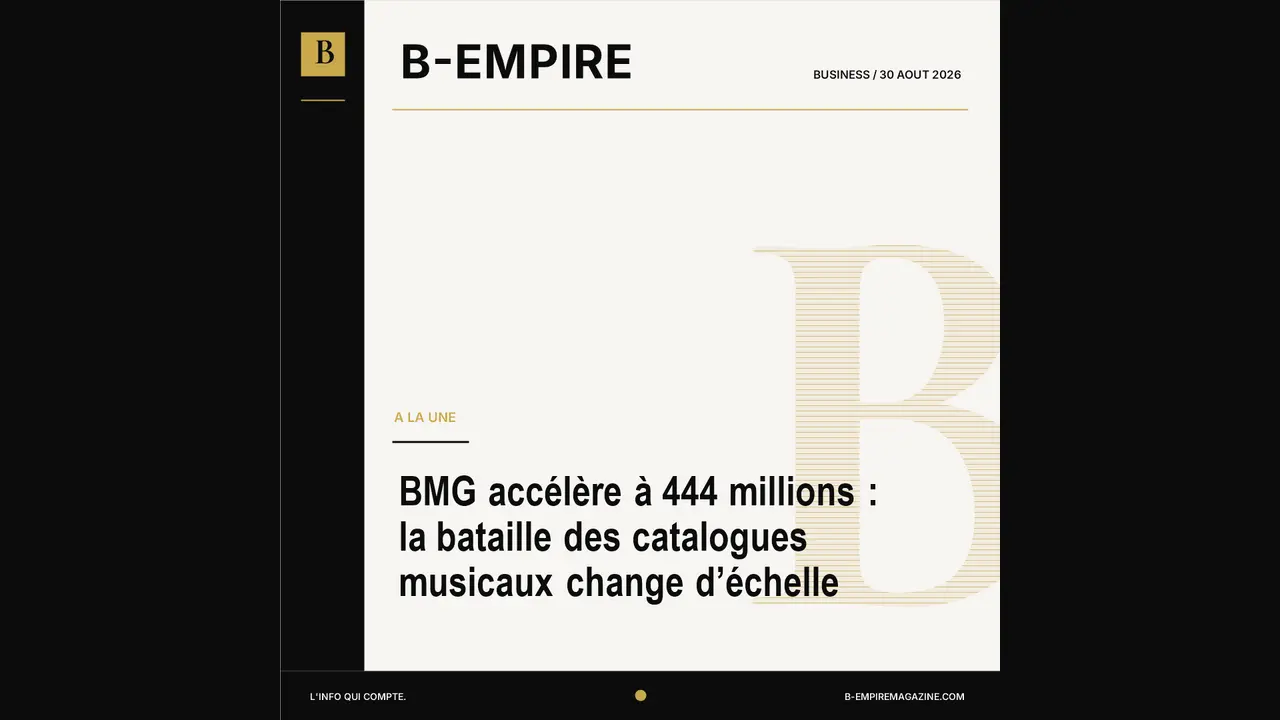
Global music is no longer just played in studios, on TikTok, or at the top of charts: it is played in the ownership of songs. BMG has just provided a spectacular demonstration of this. In the first half of 2026, the company recorded â¬444 million in revenue, representing a published increase of 5% and an organic growth of 8.1%. Behind these figures lies a much broader offensive: to buy, manage, and enhance rights that will continue to generate revenue for decades.
The group also reported â¬127 million in adjusted operational EBITDA, up from â¬122 million a year earlier. Its margin stands at approximately 28.7%, nearly at the record level of the previous year. In an industry where visibility can be immense but margins are fragile, this stability tells us something essential: catalogs and music publishing remain among the most coveted assets in the cultural economy.
â¬444 Million and a Very Clear Signal
The results published on August 28 by BMG and its parent company Bertelsmann show a company that is larger, more profitable, and above all, more aggressive. Half-year revenues increased from â¬424 million to â¬444 million. The organic growth, which neutralizes the effects of currency and scope, reached 8.1%. This provides a clearer view of the group’s actual dynamics.
BMG attributes this performance to the growth of streaming subscriptions, recent releases from its artists, and the advancement of its BMG Next strategy. Music Business Worldwide notes that underlying revenues from subscription streaming in recorded music have grown at a high single-digit rate. Streaming is no longer presented as a mere promise: it fuels a machine capable of financing new acquisitions.
The Hidden Record Behind the Results
The most revealing figure may not be the revenue. BMG claims to have made the largest half-year investment in music rights in its history during the first six months of 2026. Fourteen catalog acquisitions were completed during this period. Since 2021, the group’s investments in these assets have reached $1.8 billion as part of Bertelsmann’s Boost program.
This race for rights is based on a powerful logic. A well-known song can generate royalties through streaming, radio, cinema, television series, advertising, video games, covers, and social media. A strong catalog thus becomes a kind of global cultural infrastructure: invisible to much of the public, but active every time a track is listened to, synchronized, or rediscovered.
The phenomenon extends beyond BMG. Investment funds, major labels, publishers, and specialized companies have been seeking for several years to secure repertoires capable of generating predictable revenue streams. Scarcity is no longer just about the next hit. It also concerns works that have already proven their ability to transcend generations.
BMG and Concord: A Merger That Could Reshape the Landscape
The next step is strategic. Bertelsmann indicates that the merger between BMG and the American company Concord is expected to be finalized in the third quarter of 2026. This operation could create an entity with increased strength in recorded music, publishing, catalogs, and international rights management.
This scaling matters in the face of the three historical majors and technology platforms. The more a holder owns titles, compositions, and relationships with artists, the greater their weight in licensing negotiations. Size also brings additional resources to analyze data, detect unauthorized uses, and exploit a song across multiple markets.
However, increased concentration also raises a question: who decides how musical heritage circulates? For artists and authors, a large player can offer resources, a global presence, and better administration. It can also exacerbate the imbalance between those who control rights and those who create works. Financial growth never absolves the need to examine contracts, transparency, and value sharing.
What Streaming Has Really Changed
Streaming has transformed the catalog into a permanent asset. In the era of physical records, a reissue or media campaign was often necessary to bring an older work back to the forefront of the market. Today, a viral clip, a global series, or a film scene can instantly revive a track in dozens of countries.
This continuous availability favors owners who can quickly identify new uses. A song can be revived through a dance, a nostalgic trend, or synchronization. The challenge is no longer just to maintain a catalog but to activate it: new versions, digital campaigns, audiovisual placements, remixes, merchandise, and partnerships with platforms.
A Direct Issue for France and Europe
For France and Europe, this global consolidation is not abstract. The continent possesses historical repertoires, powerful collective management organizations, and linguistic diversity that attracts investors. French song, electronic music, French rap, and catalog music can be valued in new territories, but they can also fall under the control of players whose decisions are made far from local stages.
Europe will therefore need to reconcile two ambitions: allowing music companies to grow in size while preserving artists’ ability to negotiate fairly. Rules on competition, copyright, and artificial intelligence become central here. When a company invests billions in works, it will logically seek to protect their exploitation against piracy, unauthorized training of models, and synthetic copies.
The Next Battle Will Be Technological
BMG aims to present itself as a digital company before being a traditional record label. The BMG Next strategy emphasizes the concentration of activities, profitability, and the use of technology. This focus becomes crucial as artificial intelligence disrupts creation, title detection, and remuneration.
The future value of a catalog will partly depend on the ability to prove the origin of a work, track each use, and negotiate licenses on a large scale. Companies that control both rights, data, and distribution tools will have a considerable advantage. This is where BMG’s â¬444 million makes perfect sense: it not only describes a good semester but also the means for a battle that is just beginning.
True Power Lies in Longevity
Artists dominate attention, but rights holders often dominate the long term. BMG has understood this and built a business capable of monetizing songs long after their release. The merger with Concord could accelerate this transformation and create a heavier competitor in the global industry.
For the public, music will remain emotion, discovery, and memory. For the companies that finance it, it also becomes a global portfolio where each listen can produce value. The signal sent by BMG is impossible to downplay: in the next musical decade, owning songs will matter almost as much as making them known.
Sources
- BMG, first half 2026 results, August 28, 2026.
- Bertelsmann, half-year results and outlook 2026, August 28, 2026.
- Music Business Worldwide, analysis of BMG’s growth and merger with Concord, August 28, 2026.
- Music Week, data on revenues and investments in catalogs, August 28, 2026.