
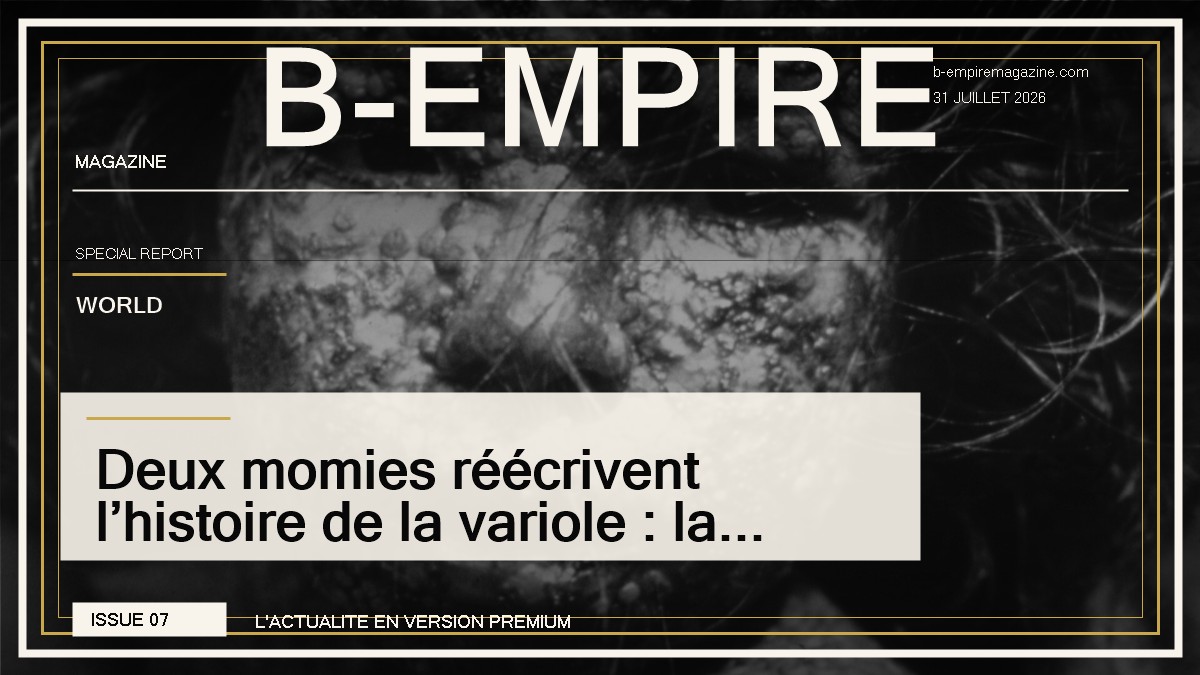
The narrative of one of the greatest health catastrophes in history has just gained proof inscribed in bones. In northern Chile, the DNA of two individuals who died around five centuries ago reveals an ancient lineage of the smallpox virus. The analysis, published on July 30 in the scientific journal Science, establishes the strongest genetic link to date between European strains and those that circulated in the Americas after 1492.
Colonial chronicles had already recounted the epidemics, the decimated cities, and the collapse of indigenous communities that had never been exposed to this disease. This time, the demonstration does not rely solely on written records by conquerors, missionaries, or administrators. It comes from fragments of legs taken from a man and a woman found in Camarones, on the arid coast of Chile.
A Discovery That Transforms a Historical Certainty into Biological Evidence
The international team, led by geneticist Shigeki Nakagome from Trinity College Dublin, studied thirteen bone samples from an archaeological site in Camarones. Two contained traces of the Variola virus, responsible for smallpox. Radiocarbon dating places the deaths of these two adults, aged 18 to 35, between 1492 and 1631.
The decisive result comes from genomic comparison. The lineage discovered in Chile is positioned between medieval European strains and more recent versions of the virus. In other words, its genetic tree points to the Old World and confirms that the virus striking South America descended from a lineage that arrived from Europe during the colonial period.
This conclusion does not mean that we now know the exact ship, person, or route that introduced the virus. Researchers remain cautious: several waves of colonists crossed the Atlantic after Christopher Columbus’s voyages, while the transatlantic slave trade may also have played a role in the circulation of infections between Europe, Africa, and the Americas.
Why Camarones Changes the Scale of the Narrative
The Chilean site is located far from the initial Caribbean points of contact. No episode of smallpox had been precisely documented there before. The presence of the virus in this area thus opens a dizzying question: how did an infection introduced from the other side of the continent reach populations settled on the South American Pacific coast so quickly?
One hypothesis is that the disease may have utilized indigenous trade and human networks that predated colonization. These routes connected vast territories, transporting goods, information, and people. After the arrival of the virus, they may have inadvertently become epidemic highways. The health conquest may thus have preceded direct contact with Europeans in certain regions.
This dynamic helps explain why some communities were sometimes struck before even seeing a soldier or a colonist. It also reminds us that colonization was not merely a succession of battles and political decisions: it abruptly altered the microbial ecology of a continent.
The Disease That Upset the Balance of Power
Before its eradication, smallpox was among the deadliest diseases known. It killed about one in three infected individuals according to historical syntheses cited by the Associated Press, leaving many survivors blind or severely scarred. In the Americas, where populations had no acquired immunity against the virus, its impact was particularly devastating.
Epidemics killed millions, disorganized societies, disrupted the transmission of knowledge, and weakened military resistance. The study does not reduce the conquest to a single pathogen. Weapons, local alliances, forced labor, land dispossession, and colonial political systems remain essential for understanding history. However, ancient DNA shows that the virus was a material actor in this shift.
For Constanza de la Fuente Castro, a biological anthropologist at the University of Chile and co-author of the study, the human cost is no longer just visible in demographic statistics. It is readable in the biological remains of real people. Behind the grand narrative lie two young adults whose deaths were likely caused by smallpox.
What Ancient DNA Can Still Reveal
Archaeogenetics allows for the identification of pathogens in bones, teeth, or preserved tissues, and then reconstructs their familial relationships. In this case, it also sheds light on the evolution of the virus. Scientists observed that certain genetic functions had gradually been deactivated, a process that may have helped smallpox better specialize in its human host.
However, the study has significant limitations. Thirteen samples were tested, and two infections identified: this is sufficient to establish presence and lineage, but not to measure the exact extent of an epidemic across the region. Preservation conditions, the availability of human remains, and ethical requirements also limit research. Scientists will need to work with Chilean institutions and the communities involved to ensure that the study of the past respects the individuals whose remains make these discoveries possible.
A Global Lesson in the Face of New Health Threats
Smallpox was declared eradicated by the World Health Organization in 1980, following an international vaccination and surveillance campaign. It remains the only human infectious disease to have been eliminated on a global scale. This success demonstrates what scientific cooperation can achieve when states share a goal, data, and resources.
The Chilean discovery does not signal a return of the disease: it pertains to ancient DNA, not current circulation of the virus. Its significance lies elsewhere. It shows how human mobility, conquests, and trade exchanges can transport pathogens thousands of kilometers, often faster than societies can comprehend the threat.
It also invites us to view the history of epidemics from multiple continents. Europe appears here as the genetic origin point of the lineage, Africa as a possible route yet to be documented, and South America as the territory where the biological impact can now be read. This global framework avoids a simplistic narrative while maintaining the central conclusion: colonization brought smallpox to the Americas.
The Signal That No One Can Ignore
Two fragments of bone have survived five centuries in the Chilean desert. They now tell a story that archives alone could not prove. The conquest of the Americas was political, military, economic, and cultural; it was also microbial. Science does not only discover where a virus came from: it restores presence to the lives taken by it.
The next step will be to search for other ancient genomes on the continent to map the routes and timeline of smallpox. Each new sequence could clarify the speed of spread, the links between regions, and the evolution of the virus. Five hundred years after the catastrophe, DNA is just beginning to reveal the full geography of the shock.
Sources
- Associated Press â Ancient mummy DNA provides scientific evidence that colonization brought smallpox to the Americas, July 30, 2026.
- El PaÃs â Two mummies from 500 years ago confirm that Europeans brought smallpox to America, July 30, 2026.
- World Health Organization â Smallpox.
- Centers for Disease Control and Prevention â History of Smallpox.