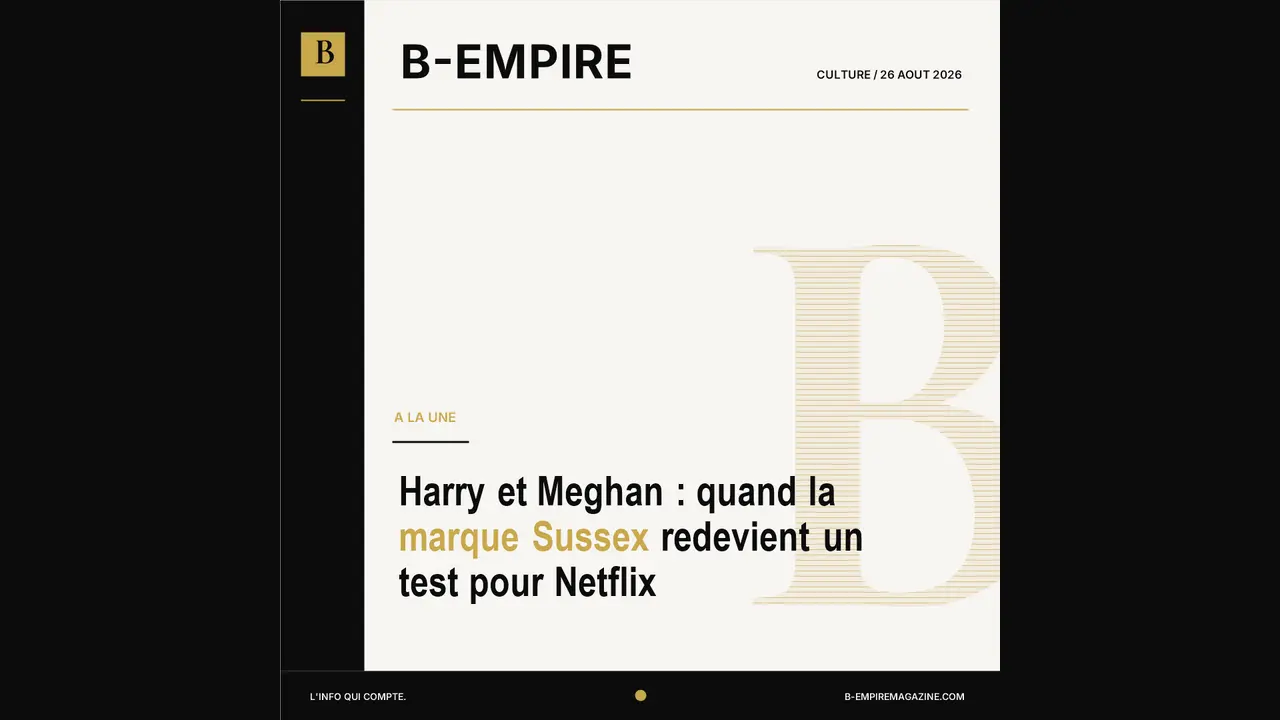
Some brands search for attention. Then there are Harry and Meghan, whose every move turns attention into global weather. Their reported return to the United Kingdom, six years after they left for the United States, has triggered a revealing new sequence: rumors of a role for Meghan in The Gentlemen, the Netflix series tied to Guy Ritchie’s universe, partial denials, accounts of a possible withdrawal after backlash, and immediate analysis of the couple’s commercial value. The affair tells us less about a simple casting episode than about a strategic problem: what is celebrity worth when it attracts and divides in equal measure?
Reuters raised that question on August 26 by speaking with branding and entertainment specialists. Their conclusion is clear: nobody can buy this volume of visibility, but that visibility comes with an emotional, political, and media bill. For Netflix, for Archewell Productions, and for lifestyle brands tied to Meghan, the couple remains a conversation machine. The challenge is to convert that conversation into desire, audience, or trust, rather than permanent noise.
A Casting Rumor Turned Economic Indicator
According to Reuters, reports circulated about possible discussions around Meghan appearing in a Guy Ritchie Netflix crime drama, before another account suggested the offer had been withdrawn because of a negative reaction in the United Kingdom. Neither the parties involved nor Netflix publicly confirmed a definitive version. Euronews, for its part, notes that the rumor concerned the planned third season of The Gentlemen, while underlining the uncertainty around whether the offer itself ever fully existed.
That ambiguity did not stop the story from doing its work. In the attention economy, verification often arrives after circulation. The mere association of Meghan Markle with a British series, a popular director, and a return to the country was enough to generate a complete narrative. For a platform, that energy is tempting. It can make a show exist before its official campaign. But it can also place the show inside a culture war larger than the project itself.
The Sussex Paradox: Guaranteed Audience, Impossible Control
The value of Harry and Meghan is not simply their fame. Many celebrities are famous. Their particularity is that they trigger opposing narratives with equal intensity. To their supporters, they embody a couple that refused a violent family and media system. To their critics, they monetized their break with the monarchy while asking for privacy. Between those two readings, every project becomes a symbolic referendum.
Reuters cites British communications figure Mark Borkowski, who sees in the couple a rare ability to generate audience and visibility. That power is exactly what platforms seek in a saturated market. Streaming no longer needs only content; it needs events. Harry and Meghan function as a permanent event. The risk is that the event absorbs the work. If Meghan takes a role, will the public discuss her character, her accent, her acting, or the monarchy?
Netflix Faces Two-Edged Celebrity
The couple already knows Netflix well. Their documentary Harry & Meghan drew considerable audience, powered by intimate access to their version of the royal story. Other projects, however, received a more uneven response, while their relationship with Spotify ended. Reuters notes that the reported $100 million Netflix deal was downgraded and that the Spotify agreement estimated at $20 million came to an end. The market’s message is clear: initial curiosity is not enough to create a durable franchise.
That is why the possibility of a return to acting is interesting. It would move Meghan from content based on her own life toward fictional work. In theory, that is a way to reduce documentary pressure and show craft. In practice, the transition is difficult. A very famous actress can struggle to disappear behind a role, especially when her public image is already overloaded with political, social, and family meanings.
The United Kingdom as a Relaunch Setting
The return to the United Kingdom adds another business angle. Pauline MacLaran, a marketing professor at Royal Holloway quoted by Reuters, believes an English setting could feed a new story for Meghan’s lifestyle brand, with a British touch attractive to American consumers. The idea is commercially coherent: turn exile, then return, into an aesthetic. The implicit campaign would suggest a more rural, more heritage-driven, slower life, far from the drama of Montecito and Buckingham.
Yet the same setting that can enrich the brand can also weaken it. In the United Kingdom, Harry and Meghan are not only cultural entrepreneurs; they remain dissenting royal figures. Their presence reactivates conflicts around press, family, class, race, and power. Selling jam, a candle, or a series from that territory is therefore not a simple repositioning. It is an operation of reconciliation with a public that has never spoken with one voice.
Privacy as an Impossible Product
The hardest paradox to resolve remains privacy. Harry and Meghan left royal obligations while citing, among other things, the intensity of media scrutiny. Yet their economic independence depends largely on constant visibility. This contradiction is not only moral; it is structural. A personal brand sells proximity. A family seeks protection. The two goals regularly collide.
Platforms and brands working with them must therefore learn a delicate grammar: use public interest without seeming to exploit intimacy, create narrative without reopening wounds, produce prestige without reigniting tabloid war. It is possible, but it requires editorial discipline stronger than the simple promise of exclusivity. In their case, storytelling must become more restrained, otherwise it feeds exactly what it claims to move beyond.
Work as the Only Narrative Exit
One of the most useful observations reported by Reuters comes from entertainment journalist Caroline Frost: the British public may judge quickly, but it respects work. This point may indicate the only way out. For Meghan, a genuine return to acting, especially in a demanding setting, could shift the conversation from controversy to performance. For Harry, continuity around the Invictus Games and charitable commitments can restore a usefulness more stable than royal confession.
The Sussex brand must therefore change its center. Less self-explanation, more production. Less royal counter-narrative, more solid cultural objects. Less promise of rupture, more visible competence. The public may never be unanimous, but it often distinguishes effort from pure exposure. In the celebrity economy, that nuance is vital.
A Lesson for the Whole Entertainment Industry
The episode goes beyond Harry and Meghan. It shows how strongly platforms now seek names capable of creating noise before a script is even confirmed. But it also reminds us that noise is not a complete strategy. A polarizing brand can provide a spectacular opening and then complicate writing, marketing, partnerships, criticism, and reception.
For Netflix, the question is not simply whether Meghan Markle can attract viewers. She can. The real question is whether a project can absorb that attention and transform it into artistic or commercial value. For Harry and Meghan, the stakes are even more personal: proving that their brand can produce something other than commentary about itself. The British return may be their greatest test. Not because it places them close to the palace again, but because it forces their story to enter a new phase at last: the phase of proof.
Sources
- Reuters via Investing.com — Harry and Meghan’s media storm shows the power and peril of their brand, August 26, 2026.
- Reuters via Internazionale — Harry and Meghan’s media storm shows the power and peril of their brand, August 26, 2026.
- Euronews — Has Meghan Markle already been dropped from starring in The Gentlemen?, August 24, 2026.
- People — The Gentlemen renewed for Season 3 as Meghan Markle remains in talks for a role, August 25, 2026.