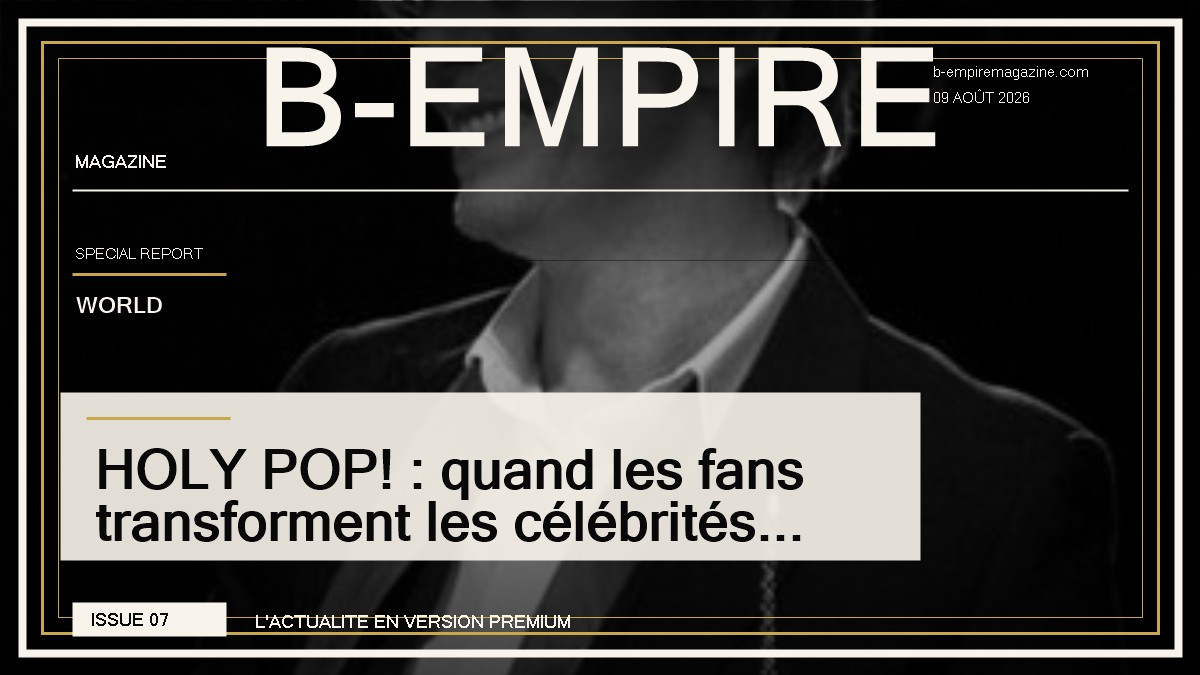
A piece of gum chewed by Nina Simone rests under glass like a relic. Memorabilia from Prince, David Bowie, Britney Spears, George Michael, Dolly Parton, and the Spice Girls takes the form of altars. In London, the exhibition HOLY POP!, which closes on August 9, 2026, at Somerset House, poses a dizzying question: have celebrities replaced saints in part of our modern lives?
The answer does not lie in an easy provocation. For nearly three months, the exhibition has observed the objects, gestures, and gatherings through which fans express their admiration, grief, or sense of belonging. Photographs, videos, private collections, and artistic creations narrate a global phenomenon: a star is no longer just a famous person. They can become an intimate landmark, a shared memory, and the center of a community that transcends borders.
Stars Elevated to the Status of Relics
Presented in three rooms of Somerset House, HOLY POP! begins with personal devotion, traverses the rituals of collective mourning, and then delves into the intimacy of domestic shrines. The exhibition gathers ordinary objects to which fans’ attachment gives extraordinary value: photos, figurines, letters, candles, clothing, concert memorabilia, and meticulously organized accumulations.
The cultural casting is immense. David Bowie, Princess Diana, Andy Warhol, Aaliyah, Prince, George Michael, Britney Spears, Elvis Presley, Dolly Parton, and the Spice Girls coexist with Dobby, the character from Harry Potter. This juxtaposition speaks volumes about contemporary pop culture: fictional characters, artists, and public figures can all occupy a real emotional space in the lives of those who admire them.
The scenography deliberately pushes the religious vocabulary. There are altars, pilgrimages, offerings, and objects elevated to the status of talismans. However, the exhibition does not ask visitors to believe that celebrity is a religion in the strict sense. Rather, it shows that humans repurpose ancient forms of devotion to make sense of very contemporary attachments.
Nina Simone’s Chewed Gum: A Mundane Object Turned Treasure
The highlight of the exhibition is dedicated to a tiny object: a piece of gum chewed by Nina Simone. Musician Warren Ellis retrieved it from the stage of the Royal Festival Hall in 1999, after what would be the singer’s last concert in London. Preserved for years, it inspired his 2021 book, Nina Simoneâs Gum, and is displayed here on a velvet cushion, protected by a glass case.
Out of context, this gum might provoke laughter or discomfort. But its story changes the perspective. It materializes a moment that Warren Ellis did not want to see fade: the presence of an artist, the intensity of a performance, and the memory of an aesthetic shock. The object has almost no intrinsic value. Its power comes from the narrative, the transmission, and the emotion projected onto it.
This is the central mechanism of any relic. A piece of paper, a lock of hair, a concert ticket, or a shoe worn on stage becomes precious because it symbolically reduces the distance between an icon and its audience. In an age saturated with digital images, the physical object still promises a concrete, imperfect, and irreplaceable trace.
Global Fandom Has Become a Social Force
Fan communities no longer merely buy records or tickets. They produce archives, translate content, organize events, fund charitable campaigns, and collectively defend the image of their idols. Social media has accelerated this organization. An attachment once experienced in a bedroom or a local club can now connect, in seconds, with millions of people.
This dimension explains why HOLY POP! transcends mere entertainment. Fandom provides language, codes, and identity to individuals who may feel isolated elsewhere. It creates friendships and spaces of recognition. For some minorities, figures like Prince, George Michael, David Bowie, or Britney Spears have also represented the possibility of escaping norms, inventing their appearance, or claiming another way of existing.
The death of a star makes this community particularly visible. Flowers placed in front of a home, messages written on a wall, spontaneous singing, and silent gatherings transform individual pain into public ceremony. Fans mourn a person they did not know personally but whose voice, films, or gestures accompanied pivotal moments in their own history.
Between Sincere Communion and the Attention Industry
The exhibition largely chooses tenderness and celebration. This approach is refreshing in a digital culture where fan passion is often caricatured. The critique from Time Out, which gives it four out of five stars, praises the profound effect of certain installations while noting that the religious parallel is sometimes overstated and that the pitfalls of obsession could have been explored more deeply.
This reservation opens an essential debate. Devotion can create connection, but it can also be exploited. Platforms transform every emotion into a click, every conflict between fandoms into engagement, and every merchandise into a commercial opportunity. Star teams know how to cultivate a sense of ongoing closeness, while fans invest considerable time, money, and emotional energy.
There is also a boundary between homage and intrusion. Collecting official merchandise is not the same as monitoring a celebrity’s private life. Admiring a work does not obligate one to defend all the choices of its creator. A healthy culture of fandom assumes maintaining this distance: emotion can be authentic without granting a right of possession over the famous person.
A Powerful Mirror for France and the World
The phenomenon exhibited in London exists everywhere. In France, the improvised memorials after the passing of a singer, actor, or sports figure use the same codes: flowers, portraits, song lyrics, and personal messages. Shrines dedicated to Johnny Hallyday, Dalida, or Claude François show that popular memory is also built outside official institutions.
But the scale is now global. A French K-pop fan, a Nigerian admirer of American cinema, or a Brazilian community dedicated to a British singer often share the same videos, symbols, and rituals. Global celebrity creates a common language, sometimes faster and more mobilizing than major political or national narratives.
This circulation also compels museums to rethink what deserves preservation. Fan archives, kitsch objects, and amateur creations have long been placed on the margins of legitimate culture. Somerset House treats them as documents capable of explaining an era. This shift is significant: cultural history is not only made by stars and industries but also by the audiences who interpret, collect, and transmit their works.
After HOLY POP!, the Altars Remain Lit
The closing of HOLY POP! on August 9 does not conclude the phenomenon it exposes. Domestic altars will remain on shelves, memorials will continue to attract visitors, and digital communities will invent new rites. Pop culture changes its stars and platforms, but the human need to preserve a trace, share admiration, and recognize oneself in a figure endures.
The strength of the exhibition lies in having taken these emotions seriously without demanding that they be shared. In front of Nina Simone’s gum or a shrine dedicated to George Michael, everyone can see a curiosity, an excess, or a poignant gesture. This hesitation is precisely the subject: a celebrity becomes an icon when strangers collectively decide that they represent something greater than themselves.