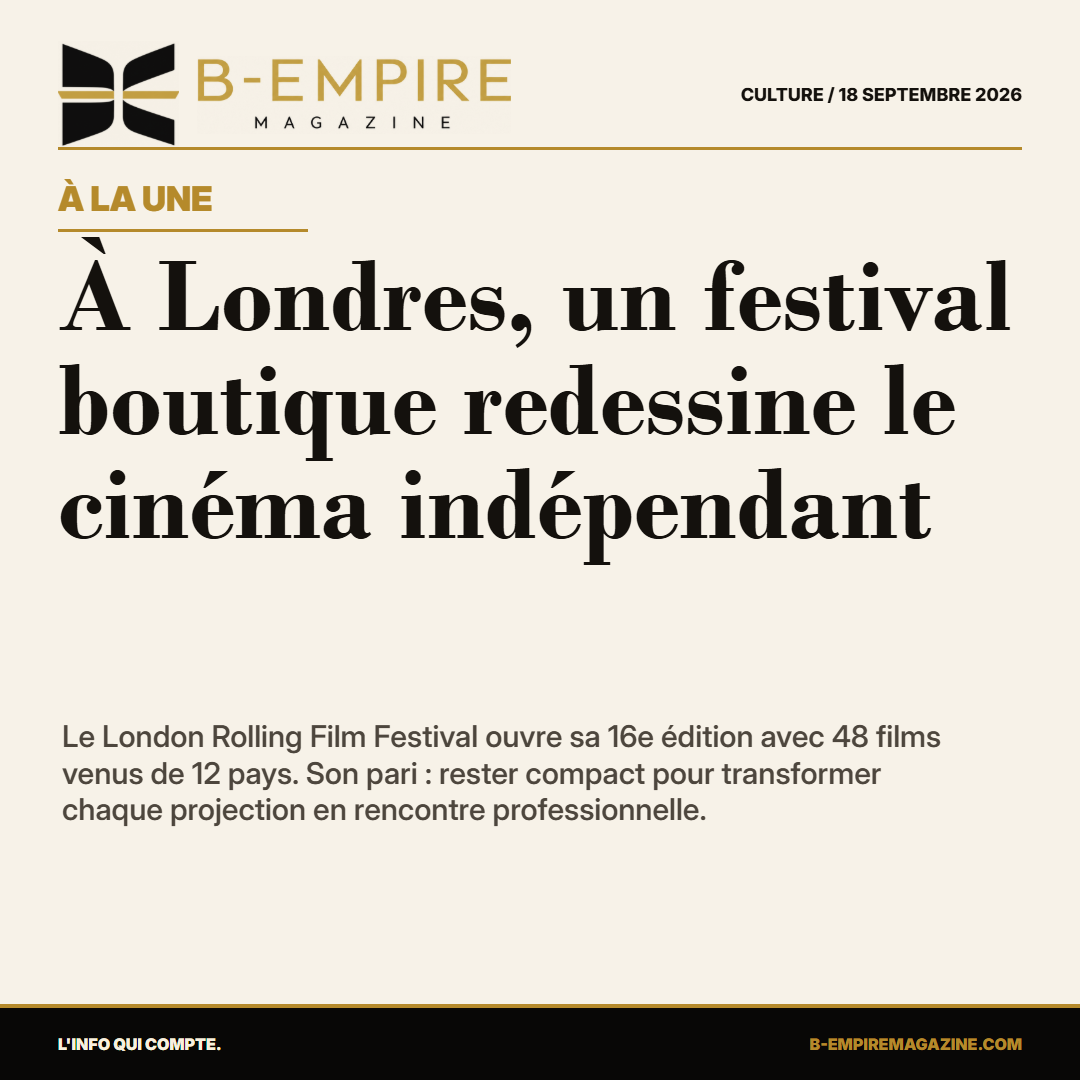
In a season crowded with red carpets, global markets and ever-expanding competitions, the London Rolling Film Festival is defending an almost radical idea: a festival can grow without becoming impersonal. Its sixteenth edition opened on September 17, 2026, at Vue Cinema Piccadilly and several central London venues with 48 films from 12 countries. The program has doubled since 2025, yet the organization still describes itself as a boutique event, built around filmmakers attending in person, conversations after screenings and professional relationships that can last longer than the projection itself.
The figure of 48 films therefore tells only part of the story. The works were selected from submissions representing 28 countries, with four world-premiere features and two UK premieres. The festival includes films connected to recognized performers such as Jodie Whittaker and Vicky McClure while placing significant attention on teams still looking for distribution, partners or their next round of financing. That coexistence of visibility and development is what separates a useful small platform from a showcase that simply accumulates titles.
Scarcity as a Cultural Strategy
Large festivals are built on abundance: hundreds of films, several theaters running at once and a permanent race against the clock. The London Rolling Film Festival chooses a different rhythm. Selected directors are expected to represent their work, and every screening includes a conversation with the audience. Viewers do not receive only a finished film; they encounter a process, an intention and sometimes the practical vulnerabilities behind an independent production.
That proximity also has economic value. For an emerging producer, a focused twenty-minute discussion may open more doors than a screening buried inside an enormous catalog. It makes the team’s abilities visible, tests how the project is presented and creates a first circle of advocates. In a sector where marketing budgets remain beyond the reach of many independent companies, the quality of the context becomes an asset. The festival is selling less volume and more attention.
Films That Examine Their Own Industry
The opening film captures that ambition. Mark Forbes’s Quiet on Set: The Class Division in the Film Industry? examines the social barriers that shape access to screen careers. Its title immediately confronts the festival with an uncomfortable question: what is the point of celebrating new voices if material conditions prevent some talent from entering the profession or remaining in it? The September 18 screening at Vue Piccadilly is followed by a filmmaker Q&A, turning the documentary into a starting point for a discussion about labor, networks and social mobility.
The selection widens that perspective through documentaries about identity, memory, archives and history, alongside fiction and short films emerging from different production cultures. Feature titles include Connected, DAAL, Innovation Secrets – Will Innovation Save Us or Kill Us? and ROOTED OUT – Chapter 2, all announced as world premieres. The festival also highlights a strong presence of women filmmakers and stories that locate strength or hope within difficult circumstances. Diversity is not presented as a separate category; it shapes the way the program interprets the world.
A Festival Designed to Produce What Comes Next
The most interesting stakes may appear after the credits. The program combines screenings, conferences, industry conversations and project-development opportunities. Pitch Corner offers filmmakers a brief format in which to present work to professionals. The Help to Roll Fund provides a £1,000 award to support one filmmaker. That amount cannot finance a feature, of course, but it can pay for a decisive step: a proof-of-concept edit, submission fees, translation, travel or several days of postproduction.
On September 18, a panel organized with Yes She Cannes at the Royal Society of Arts adds another layer to the structure. Partnerships of this kind connect a local event to an international network and underline how an independent film’s career often advances through stages: lab, boutique festival, market, territorial premiere, sales agent, platform or theater. Festivals become less like final destinations and more like temporary infrastructure where projects can change status.
London’s Two-Speed Festival Capital
London’s calendar makes this edition especially revealing. A few weeks later, the BFI London Film Festival will present 251 titles from 88 countries for its 70th edition. The two events differ radically in scale and function, but together they form an ecosystem. The major festival brings media power, prestige and international circulation; the boutique gathering offers relational density, accessibility and time to speak. One does not cancel the other. Independent cinema needs these different scales if discovery is not to be reserved for work already supported by large networks.
For B-EMPIRE, the signal extends beyond British cinema. Creative industries frequently talk about the democratization of tools, even though the true scarcity is access: access to a screen, an attentive conversation, a decision-maker and a community willing to recommend a film. By requiring its expansion to remain compatible with human connection, the London Rolling Film Festival offers a practical response. Its success will not be measured only in tickets sold between September 17 and 21, but in the collaborations, distribution agreements and future films that begin after the doors close.