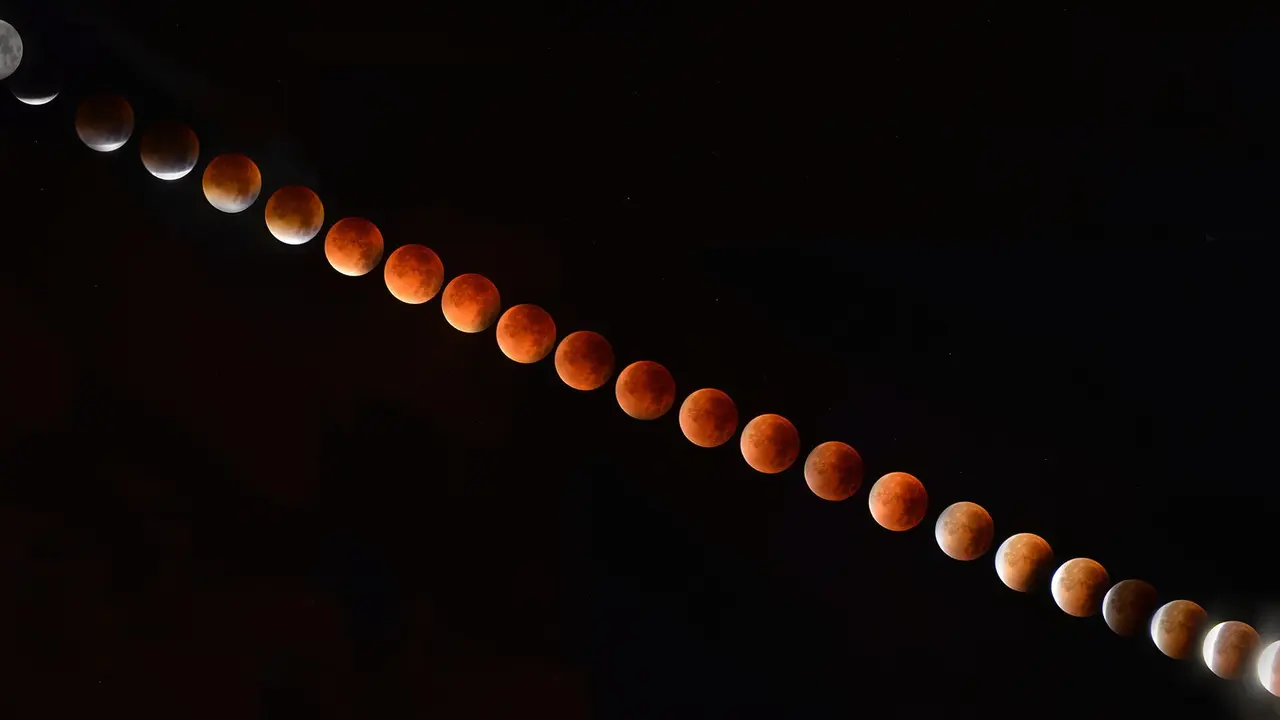
The sky is set to offer an image that billions of people will be able to share almost simultaneously. On the night of Thursday, August 27 to Friday, August 28, 2026, the shadow of the Earth will glide over the Moon, covering nearly its entire surface. While it will not officially be a total eclipse, the result promises to have all the visual power of one: at its peak, only a thin lunar border will remain directly illuminated, while the rest of the disk may take on coppery or dark red hues.
This event comes just sixteen days after the total solar eclipse on August 12. The roles are reversed this time: the Earth is positioned between the Sun and the full Moon, casting its shadow into space. NASA classifies the phenomenon as a partial lunar eclipse, visible from the Eastern Pacific, the Americas, Europe, and Africa. According to the Associated Press, over three billion people, or about 44% of the worldâs population, will be in a zone where they can see at least part of it, provided the weather cooperates.
A Partial Eclipse That Will Almost Be Total
The term âpartialâ may seem modest. It is not in this case. Recent estimates indicate that the deep shadow of the Earth will cover about 96% of the visible face of the Moon at the peak of the phenomenon. NASA gives an umbral magnitude of 0.930 in its catalog, while consumer tools may display a slightly different proportion depending on how the surface or the obscured diameter is measured. The essential message remains the same: the Moon will come very close to a complete disappearance in the Earthâs shadow.
The eclipse will begin discreetly when the Moon enters the penumbra at 1:23 UTC. The much more distinguishable partial phase will start around 2:33 UTC. The maximum will occur around 4:12 to 4:14 UTC, before exiting the deep shadow around 5:52 UTC and the complete end of the phenomenon at 7:01 UTC. In total, the ballet will last more than five and a half hours, with about three hours and eighteen minutes in the darkest shadow.
Why the Moon Can Turn Red
The Moon does not produce its own light. It reflects that of the Sun. During a lunar eclipse, the Earth blocks direct sunlight, but some solar rays still pass through our atmosphere before reaching the satellite. Blue colors are more scattered, while red and orange tones continue their path and bend towards the Earthâs shadow. This is the same principle that colors sunrises and sunsets.
The exact hue remains impossible to guarantee. It depends notably on the state of the Earthâs atmosphere: dust, smoke, clouds, and particles can make the Moon appear lighter, browner, or redder. This uncertainty is part of the spectacle. Two eclipses with comparable geometry do not necessarily produce the same color. The entire planet acts as a living light filter.
What France Will See in the Early Morning
In metropolitan France, early risers will need to wake up on Friday, August 28. The penumbral beginning will occur around 3:23 AM Paris time, followed by the true dark bite becoming visible around 4:33 AM. The global maximum will arrive around 6:12â6:14 AM, while the Moon will already be low on the western horizon. This position will provide a rare photographic opportunity, with the eclipsed disk close to landscapes, monuments, or urban silhouettes.
Geography will play a significant role. Western France should benefit from a more favorable window before the Moon sets, while the east will see it disappear earlier below the horizon. The site Timeanddate indicates variable durations depending on regions and cities. To maximize chances, it is better to choose an open point towards the west or southwest, away from buildings, hills, and trees that could obscure a low Moon.
A Global Spectacle, But Not Identical Everywhere
The Americas will be particularly well-positioned. Nearly one billion people in the United States, Canada, Central America, and South America will be able to follow the entire or most of the phenomenon during the night. In Europe, Africa, and the Middle East, dawn and the Moonâs setting will gradually interrupt the spectacle. In some areas of the Pacific, conversely, the Moon will rise while the eclipse has already begun.
This difference in perspective transforms the event into a planetary conversation. The same shadow will be observed above New York, Mexico City, Rio, Dakar, Paris, or Madrid, but at different heights and local times. Live video feeds and shared images will allow following the passage of the eclipse from one continent to another. This is precisely the type of phenomenon that reminds us that the sky knows no borders or time zones.
How to Observe It Without Expensive Equipment
Unlike a solar eclipse, a lunar eclipse can be viewed directly without protective glasses. No special filter is necessary. To the naked eye, the change in brightness and the progression of the shadow will already be visible. Binoculars will enhance the contrasts on the craters, while a small telescope will reveal the moving boundary between the illuminated area and the Earthâs shadow.
For photographers, the main difficulty will be less about safety than exposure. As the Moon darkens, it will be necessary to increase the exposure time or sensitivity, at the risk of losing sharpness. A tripod, delayed shutter, and a long focal length will help. On a smartphone, the night mode may work, but it is better to stabilize the device and avoid excessive digital zoom. Including a foreground can produce a stronger image than a simple close-up of the disk.
The Weather Will Be the True Arbiter
The astronomical phenomenon is predictable to the second; clouds, however, are not predictable several days in advance. In France as elsewhere, it will be necessary to check local forecasts the day before and a few hours before the maximum. A dense cloud cover can completely erase the Moon, while simple breaks can sometimes provide a few memorable minutes.
Light pollution is less problematic than for a meteor shower, as the full Moon remains a very bright object. However, moving away from urban centers improves contrast and observation comfort. The main challenge will be the horizon: a terrace, beach, plain, or elevated point oriented towards the west will provide more time before the Moon sets.
The Cosmic Signal That No One Can Ignore
After the solar eclipse on August 12, this second celestial scene closes an exceptional sequence. It will also be the last major lunar eclipse before the end of 2028, according to Timeanddate. Its nearly total nature will make the nuance between scientific classification and popular perception particularly fascinating: technically partial, visually spectacular, globally shared.
In a fragmented news flow, the lunar eclipse of August 28, 2026, possesses a simple strength. No ticket is required, no screen is mandatory, and no capital can claim exclusivity. Just look towards the west at the right time. For a few hours, the shadow of our own planet will become visible on another world.
Sources
- NASA Science â Eclipses, updated August 25, 2026.
- NASA GSFC â Lunar Eclipse Catalog, data for August 28, 2026.
- Associated Press â Near-total lunar eclipse is coming up with the Americas in prime position, August 23, 2026.
- Timeanddate â 10 Things About the August 2026 Lunar Eclipse, August 21, 2026.
- Timeanddate â Partial Eclipse of August 28, 2026 in France.