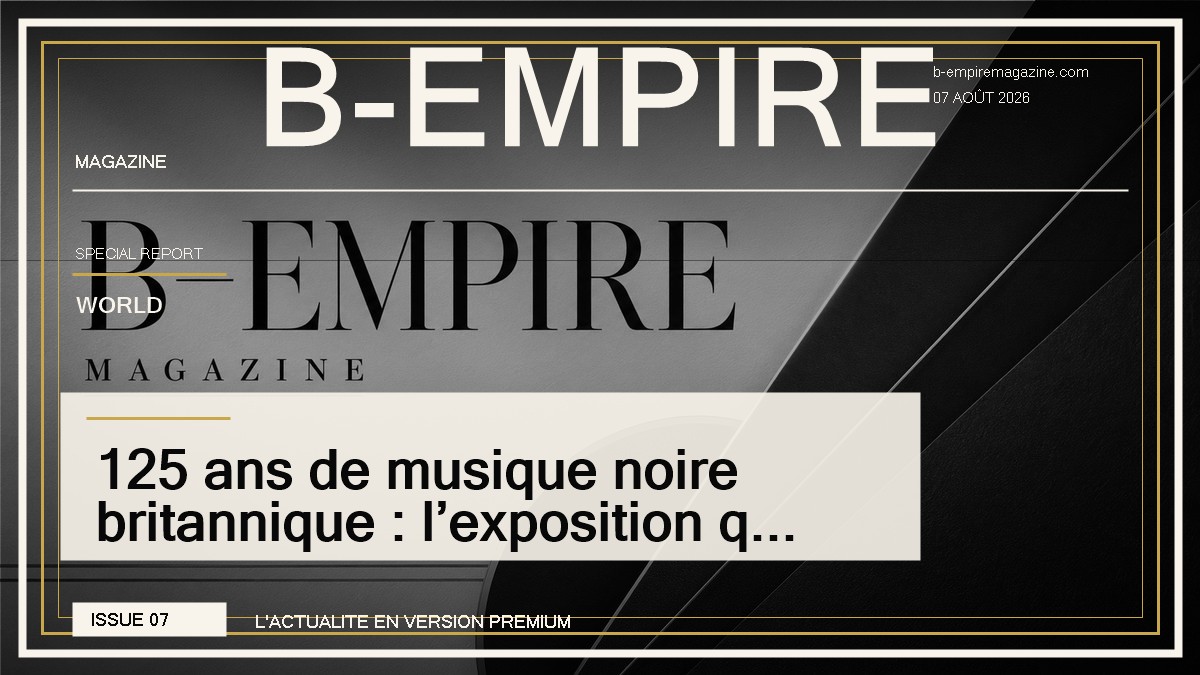
London has not just listened to the world: it has remixed it. At the V&A East Museum, the exhibition The Music Is Black: A British Story unfolds 125 years of black British music and re-centers an often diluted truth in official narratives: a decisive part of the global soundtrack was born from migrations, resistances, underground nights, pirate radios, and communities capable of transforming exclusion into invention.
Open in the new museum in Stratford and running until January 3, 2027, the exhibition returns to the cultural news in August with a series of events, including a day dedicated to black joy and sonic memories on August 13. The timing is strategic. While platforms give the impression that all music appears instantly and without borders, the V&A reminds us that each genre has a history, places, struggles, and creators too often left out of the frame.
A British History Become a Global Language
The exhibition covers the period from 1900 to the present day. It traverses jazz, calypso, reggae, lovers rock, punk, soul, sound system, jungle, drum and bass, UK garage, grime, and contemporary forms of electronic music or rap. This timeline is not a mere succession of styles. It shows how generations of black Britons have responded to their social environment by inventing new sounds.
Influences from Africa, the Caribbean, and the United States met the urban realities of the UK. Accessible production techniques, powerful basslines, community parties, and the circulation of records did the rest. In Birmingham, Bristol, Manchester, or London, innovation did not arise in a vacuum: it was built in neighborhoods where music allowed for gathering, storytelling of identity, and the creation of an economy.
The result far exceeds British borders. The rhythms, aesthetics, and dissemination methods associated with these scenes have influenced pop, hip-hop, fashion, advertising, and club cultures across several continents. Grime has provided a grammar for a new generation of rappers. Jungle and drum and bass have redefined the speed and texture of electronic music. The sound system has established a way to occupy public space and build community around sound.
Over 200 Objects to Make Hidden Voices Visible
The journey gathers around 200 objects, including archives, clothing, photographs, artworks, documents, and filmed images. This material choice matters. In the age of digital flow, a stage outfit, a poster, an album cover, or broadcasting equipment tells what listening statistics cannot show: who had access to studios, who controlled the venues, how an audience recognized itself, and why certain innovations were celebrated without their creators always receiving the same recognition.
The sound device also gives essential space to listening. An exhibition about music could easily become a silent museum filled with relics. The V&A East, on the contrary, opts for a multisensory experience. Visitors move through a story where objects converse with tracks, testimonies, and social transformations. Music is not decorative: it is the living proof of the narrative.
This method also allows for shifting the spotlight without erasing it. The major figures remain present, but the exhibition draws attention to the backing vocalists, producers, promoters, stylists, photographers, radio hosts, and communities that made the successes possible. It tells an industry through its human infrastructure, not just through its headliners.
Clubs, Pirate Radios, and Fashion: The True Engines
Black British music has often developed outside dominant circuits. When major radios, venues, or record labels opened their doors with difficulty, other networks emerged. Sound systems, clubs, independent record stores, and pirate radios became complete media. They tested tracks, created audiences, and accelerated the birth of new genres.
This model remains highly relevant. TikTok, YouTube, and streaming platforms seem to have replaced the old infrastructures, but the principle remains: a community can impose a culture before the industry knows how to name it. The difference is that the speed is now global. A sound produced in a room in London can reach Paris, Lagos, Johannesburg, New York, or Tokyo in a matter of hours.
Fashion plays the same role of transmission. Hairstyles, jewelry, club silhouettes, stage outfits, and street codes extend music into imagery. They sometimes become international trends detached from their original context. By placing them back into a social history, the museum does not close culture: it makes its filiations visible.
What France Can Hear in This London Mirror
France has a different history, but it shares a fundamental question with the UK: how to honestly recount the influence of African and Caribbean diasporas on national culture? From jazz to Caribbean music, from raï to rap, from afrobeat to electronic, French scenes have also been shaped by migratory circulations, working-class neighborhoods, and independent networks.
The parallel is not to copy the British narrative. It rather invites French institutions to document the scenes while they are alive, to preserve their archives, and to listen to those who built them. Too often, museum recognition comes after the disappearance of venues, the dispersal of private collections, or the loss of testimonies.
Paris, Marseille, Lyon, Lille, or Toulouse have musical histories that connect France to Africa, the Caribbean, the Middle East, the United States, and the rest of Europe. Making them visible does not reduce French culture to its multiple origins: it precisely explains how it became global. The international success of francophone rap already shows that creations born at the margins can become central powers.
An Exhibition That Also Speaks of Economy and Power
Behind the celebration lies an economic question. Who owns the catalogs? Who collects the rights? Who transforms a community aesthetic into a global product? And who can sustainably live off the value created? The history of popular music is full of innovators recognized late, unbalanced contracts, and genres that became profitable after being ignored.
Presenting this history in a major museum does not alone correct these imbalances. But it changes the framework of the debate. Black British music no longer appears as a series of peripheral subcultures: it becomes a national heritage and a major contribution of the UK to the world. This recognition can influence education, research, conservation, and how the industry attributes credit.
The V&A East itself carries this ambition. Located in East London, at the heart of a territory marked by migrations and urban transformations, the museum asserts its desire to connect creation to daily life. Its inaugural exhibition thus sends a powerful institutional message: stories long considered alternative belong to the main narrative.
The Signal That the Cultural Industry Can No Longer Ignore
The Music Is Black arrives at a moment when artificial intelligence, platform concentration, and the race for content threaten to render the origin of works even more invisible. In the face of millions of available tracks, recounting the filiations is not a nostalgic exercise. It is a way to preserve meaning, credit, and value.
The exhibition especially reminds us that a global culture rarely begins at the top. It starts in communities that craft their own spaces, find their own frequencies, and create an audience before receiving official validation. London has exported sounds that have become universal because its black British population transformed their experiences into new forms.
One hundred and twenty-five years later, the world still dances to this story, sometimes without knowing its name. The V&A East gives back its faces, objects, and memory. It is more than a musical exhibition: it is an invitation to re-listen to global popular culture while finally asking who built the rhythm.
Sources
- Victoria and Albert Museum â official presentation of the exhibition and programming.
- V&A Blog â design, schedule, and main outlines of the journey.
- V&A Academy â program for the Black Joy Day on August 13, 2026.
- WritersMosaic â analysis of the journey, the approximately 200 objects, and the sound experience.
- Museums Association â recent study on programming and missing narratives.
- Wallpaper* â cultural selection for August 2026.