
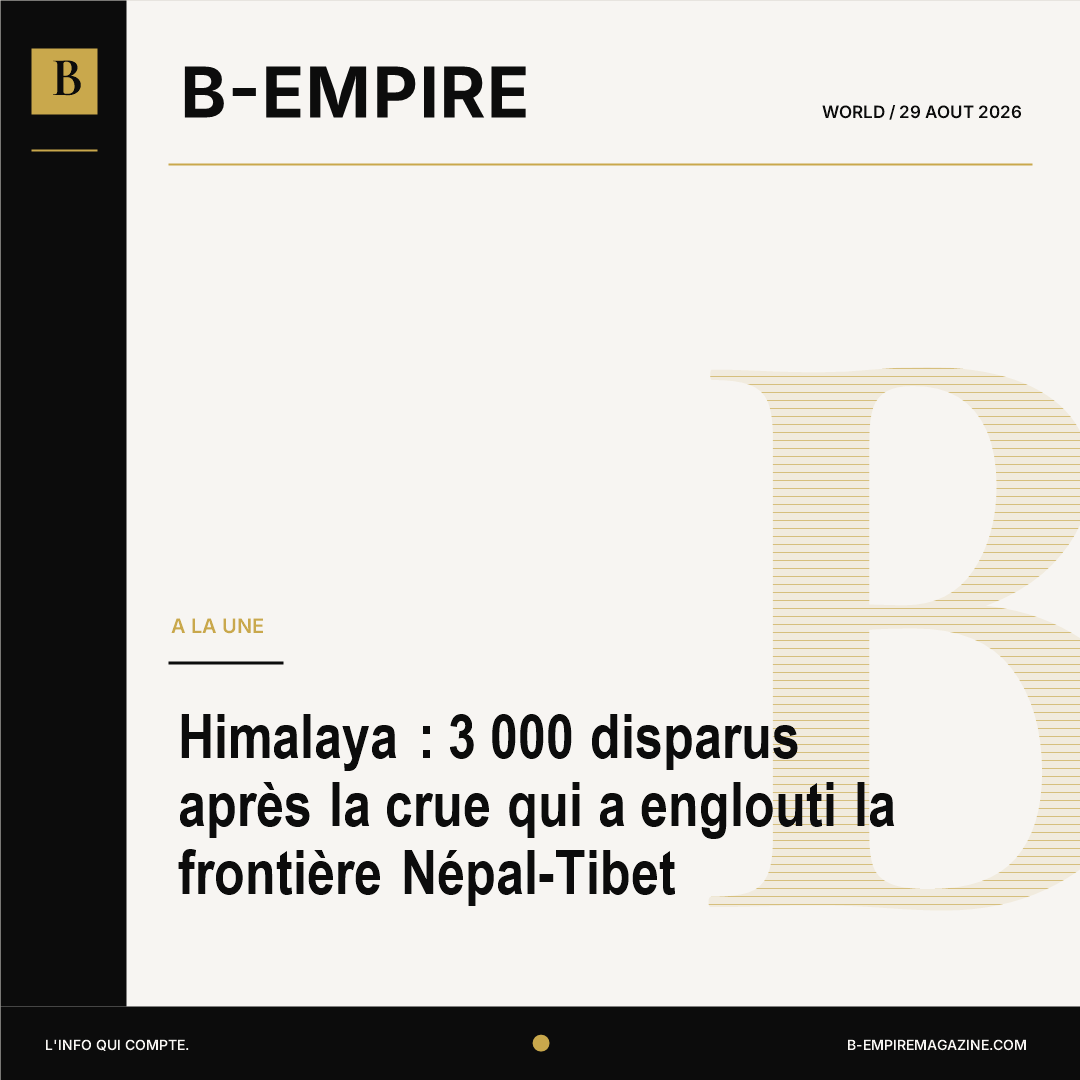
In the Himalayas, an entire border has been struck as if by a mountain wave. Four days after the flash flood that devastated valleys in Nepal and Tibet, the human toll has taken on a staggering dimension: 676 dead and nearly 3,000 people reported missing, according to figures released on Saturday, August 29, by authorities and reported by the Associated Press. More than 3,700 people have been rescued in Nepal, but families are still waiting, sometimes without any news.
This disaster is not merely a local tragedy. It reveals the vulnerability of a strategic corridor between China and Nepal, frequented by locals, workers, traders, tourists, and pilgrims from dozens of countries. It also raises a global question: how to protect high-altitude populations when ice, rock, water, and infrastructure meet in an increasingly unstable environment?
A Toll That Measures the Catastrophe
In Nepal, the national disaster management agency has raised the toll to 669 dead and 2,426 missing. On the Tibetan side, Chinese authorities have reported seven dead and over 550 missing in Gyirong County. These figures remain provisional: some communities are isolated, communications are disrupted, and search teams are progressing through a landscape reshaped by mud and debris.
The weather complicates operations further. Reuters reports that Nepal had to suspend part of the search efforts on Saturday due to bad weather and has requested foreign technical assistance. Among the missing are at least 540 foreign nationals, including many Indian pilgrims. The catastrophe thus immediately transcends national borders and mobilizes embassies, consular services, and humanitarian organizations.
The Signal from a Glacier
Initial analyses of satellite images provide an essential element. Scientists cited by the Associated Press have identified the collapse of rock and ice at high altitude, near the border. This mass is believed to have triggered a brutal chain reaction: displacement of materials, release of water, formation of a torrent laden with mud and boulders, and then rapid propagation into inhabited valleys.
Before-and-after images show rivers suddenly widened, banks torn away, and entire areas covered in sediment. A scientist interviewed by AP described the event as the largest glacial flood he has ever observed. The phenomenon was all the more deadly as its speed left very little time for residents and travelers to understand the danger and reach higher ground.
Gyirong, A Gateway Between Two Worlds, Swept Away
The border post of Gyirong is one of the most striking symbols of the catastrophe. This crossing connects the Tibetan plateau to Nepalese roads and plays an important role in trade between the two countries. The waters swept away roads, bridges, buildings, and vehicles, cutting off a vital logistical axis just when rescue efforts are most needed.
In the affected Nepalese districts, particularly Nuwakot and Rasuwa, helicopters are transporting clothing, rice, biscuits, and essential goods. Survivors arrive at reception centers covered in mud, sometimes after several days of isolation. The priorities are clear: to find the missing, treat the injured, provide drinking water, prevent diseases, and restore safe access.
Why the Alert Was Not Enough
A disaster as rapid as this tests the entire alert chain. In the Himalayas, sensors are rare, valleys are deep, and telephone networks can disappear with a road or a tower. Even when an anomaly is detected, transmitting a comprehensible warning to thousands of dispersed people and then organizing their evacuation requires minutes that the flood does not always allow.
The issue is therefore not only to predict the rain. It is necessary to monitor glaciers, high-altitude lakes, rocky slopes, and natural dams formed by landslides. It is also essential to connect scientific data to sirens, mobile messages, evacuation routes, and regular drills in every exposed community.
Climate Change in the Background
It would be premature to attribute this specific event solely to climate change without dedicated study. However, the general context is well established: the Himalayas are warming, glaciers are retreating, and glacial lakes are evolving. These transformations can alter slope stability and increase certain risks in high mountains. The catastrophe serves as a reminder that climate adaptation is not a diplomatic abstraction, but a matter of roads, sensors, rescue, and human lives.
For South Asia, glacial melting presents a dual challenge. In the short term, it can contribute to sudden floods. In the long term, it threatens the regularity of water on which hundreds of millions depend. The tragedy in Nepal and Tibet thus becomes a warning for all mountainous regions, from the Alps to the Andes.
A Human, Economic, and Diplomatic Crisis
The consequences will extend far beyond rescue operations. The destruction of bridges and roads will disrupt cross-border trade, tourism, and the supply of isolated villages. Reconstruction in such difficult terrain will cost billions and require choices: rebuild in the same place, relocate certain infrastructures, or redesign transport corridors.
Coordination between Beijing and Kathmandu will also be closely observed. Water knows no borders, and alert systems must quickly share measures taken upstream and downstream. Satellite data from several countries already shows the importance of open scientific cooperation when a disaster strikes a politically sensitive area.
What the World Must Remember
- The combined toll reaches 676 dead and nearly 3,000 missing in Nepal and Tibet.
- More than 3,700 people have been rescued in Nepal.
- A collapse of rock and ice at high altitude is at the heart of initial scientific analyses.
- The border post of Gyirong and several essential routes have been ravaged.
- Nepal is requesting foreign technical assistance as weather hampers search efforts.
The coming days will be crucial for those still being searched for. But the real test will last for years: to rebuild without reproducing the same vulnerabilities. The Himalayas have just sent a signal that cannot be ignored. In a world where extreme events intersect with fragile infrastructures, preparedness must advance as quickly as the risk.
Sources
- Associated Press â survivors rescued and nearly 3,000 missing, August 29, 2026
- Reuters â request for technical help and search efforts hampered by weather, August 29, 2026
- Associated Press â satellite analysis of glacial collapse, August 27, 2026
- Le Monde â testimonies of survivors in Nepal and Tibet, August 29, 2026
- El PaÃs â toll progression and rescue efforts in Tibet, August 29, 2026