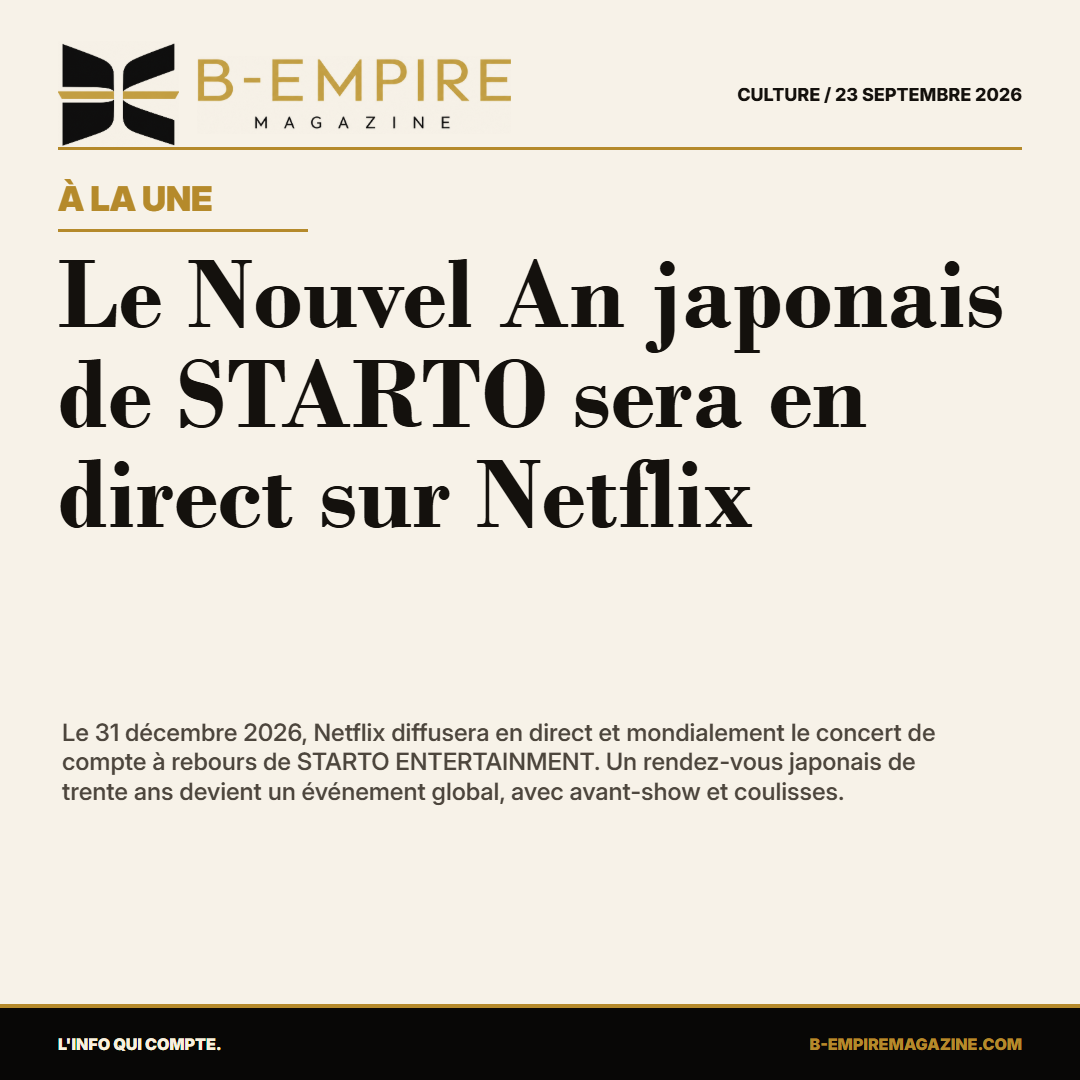
A Japanese year-end ritual will, for the first time, be experienced live far beyond the country. Netflix announced on September 22, 2026, that it would exclusively stream COUNTDOWN CONCERT 2026-2027 STARTO to WORLD simultaneously worldwide on December 31, Japan time. The show will feature STARTO ENTERTAINMENT artists. The service calls it its first Japan-originated major music live event and its first simultaneous worldwide stream of a New Year’s countdown concert. The significance goes beyond adding another title to the catalog: a local gathering is being turned into an event shared across time zones.
A tradition older than streaming
According to Netflix, the concert began in 1996 as a charity event supporting recovery after the Great Hanshin-Awaji Earthquake. Three decades later, it has become part of the year-end routine for Japanese artists and fans. That history gives the title STARTO to WORLD particular weight. Its international reach is new, but the event was not invented to meet a platform’s strategic need. It already has a calendar, a memory and an audience of its own.
A worldwide stream can expand that audience without erasing the concert’s Japanese setting. The countdown will follow Japan’s clock, meaning that international viewers will not all experience it at midnight where they live. This slight mismatch is part of what makes the announcement interesting. Rather than manufacture an abstract universal party, Netflix is exporting a specific cultural moment at its own pace. The announced archive will let people watch later, although a replay cannot entirely recreate the simultaneity of crossing into the new year together.
Before, during and after the show
Netflix and STARTO are planning more than a single broadcast. A preparatory program expected in December will introduce the artists and their journey to the concert. The December 31 live show will remain available as an archive. A third installment, provisionally titled BEHIND the STARTO to WORLD, is expected in late January 2027 and will show rehearsals, preparations and backstage life. This three-part structure turns one night into a story spread over several weeks, offering different entry points to viewers who may not already know the groups.
That structure addresses a straightforward challenge for live entertainment on a global platform. A concert can be deeply moving for longtime fans while leaving newcomers at a distance if they do not know the artists’ journeys or the significance of onstage collaborations. The pre-show supplies context; the backstage program extends interest beyond the performance. Netflix is trying to move viewers between discovery, a real-time appointment and later viewing. The quality of that introduction will matter as much as the camera work.
The next step in an existing relationship
The two partners are not starting from scratch. Netflix points to its work with STARTO on WE ARE! Let’s get the party STARTO!! in 2024. The platform says COUNTDOWN CONCERT 2025-2026 STARTO to MOVE brought together 12 acts and 73 artists and came with a backstage companion program. The 2026 novelty is therefore not STARTO’s presence on Netflix. It is the decision to carry the New Year’s countdown live and simultaneously to a worldwide audience.
Moving from a recorded program to a real-time event changes the relationship with risk and anticipation. With a series, the viewer chooses the hour. For a New Year’s concert, the value of going live lies precisely in the stage and audience advancing together toward a particular instant. The platform will need to preserve that sense of presence while making the performances legible to subscribers discovering STARTO for the first time. Netflix says it is drawing on Japanese and international video production teams, without yet detailing the technical setup.
Japanese music on a wider stage
A simultaneous stream does not erase every obstacle to a global audience. Language, cultural references, timing and familiarity with the performers vary greatly between markets. It does, however, lower a decisive barrier: access. A fan outside Japan will not have to wait for a later edited version or rely on clips shared through social platforms. They can follow the same event at the same moment and revisit it through the archive. For STARTO, that visibility may also make its artists more recognizable beyond their established fan base.
The strategy still has to prove itself. The performing artist lineup and the concert’s exact time were not specified in the September 22 announcement. Netflix also cautions that the programming and dates of related content may change. It would be premature to name a particular group, promise a surprise appearance or forecast an audience figure. What is verifiable for now is the commitment to an exclusive worldwide stream on December 31, supported by a pre-show and a behind-the-scenes program.
Live streaming as a cultural stage
This project also shows how platforms are trying to become more than libraries of on-demand programs. A concert broadcast as it happens creates a collective conversation, a gentle urgency and a reason to log in at a particular time. Its value lies not only in exclusivity but in the chance to bring longtime fans and curious newcomers together around the same instant. The opposite risk is reducing a tradition to a subscriber-acquisition exercise. The editorial treatment of the show will reveal how much room Netflix leaves for its history.
On December 31, the test will be twofold. STARTO will have to keep the warmth of a familiar occasion in front of a new worldwide audience. Netflix will have to show that a live stream can carry that warmth through a screen. If the three planned programs genuinely open up the artists, the concert and the unseen work behind it, the project may offer a model for taking other local music scenes around the world. For now, it chiefly opens a door: a Japanese New Year that people can share live from almost anywhere.
Sources
- Netflix, international announcement, September 22, 2026: stream, event history and companion programs.
- Netflix Japan, announcement, September 22, 2026: local communication about the worldwide live event.