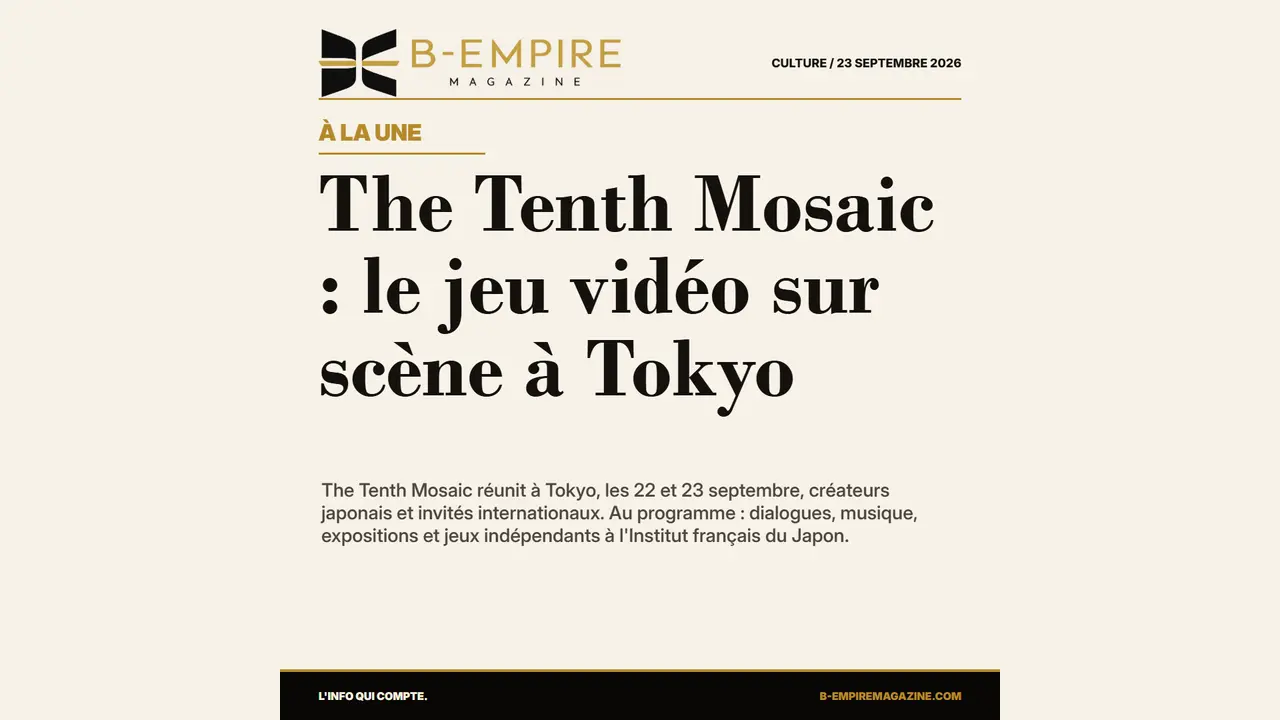
Video games are leaving the living-room screen to fill the halls, stages and exhibition spaces of the Institut français du Japon in Tokyo. On September 22 and 23, 2026, The Tenth Mosaic brings together Japanese creators and guests from abroad for talks, live music, drawing, workshops and a selection of independent games. The festival describes itself as a celebration of the ‘Tenth Art.’ Its program raises a more interesting question than how to number art forms: how do we look at a game when its images, sounds and creative decisions become a shared experience?
Creators face their work
Among the announced conversations is a dialogue between Eric Chahi, associated with Another World, and Fumito Ueda, known for ICO and Shadow of the Colossus. Their names connect different periods and traditions, while inviting the same question: what does a player understand through movement, silence, scenery or the resistance of a virtual world? The value of such a meeting does not depend on a new project announcement. It may lie in hearing creators explain the unseen decisions behind works that have become touchstones.
The program also brings together Katsura Hashino, Shigenori Soejima and Shoji Meguro, the trio associated with the Persona series. Placing creative direction, visual identity and music in the same conversation reminds us that a game rarely has a single author in any simple sense. The experience emerges from coordinated work across writing, drawing, game systems and composition. Showing these disciplines together helps an audience understand why a franchise’s style depends on collaboration as much as an individual signature.
Music and drawing take their place
The Tenth Mosaic announces concerts, exhibitions and live drawing alongside its talks. That changes the way visitors encounter games. A soundtrack can be heard without a controller; an illustration can be studied before it is placed back in its interactive world; a physical object can reveal the limits of its construction. The festival invites visitors to slow down an experience usually defined by action and pay attention to the people who build its details.
There is a limit to that approach. Taking music or an image out of a game may reveal its quality, but does not always restore the relationship between a player’s decision and the work’s response. An exhibition therefore benefits from places where visitors can try, compare and discuss. The indie game showcase announced by the festival has an essential role here: it reminds audiences that the medium is still being invented beyond titles whose reputations are already secure.
A practical French-Japanese conversation
Holding the event at the Institut français du Japon gives it a cross-cultural dimension. The organizer says talks will be available in Japanese, French and English. Translation is more than a convenience for visitors: it opens conversations to people who share neither a language nor necessarily the same history with games. A creator can explain a method to players, students and professionals from several backgrounds.
The announced exchange between Eric Chahi and Fumito Ueda embodies that movement between creative scenes. It should not be reduced to an easy opposition between a ‘French school’ and a ‘Japanese school.’ Games travel, borrow forms, inspire other studios and find audiences far beyond their countries of origin. A conversation across borders is chiefly an opportunity to understand how artistic choices answer one another without becoming identical.
The festival also makes room for creators of horror games, including Frederick Raynal, Keiichiro Toyama, Makoto Shibata and Hifumi Kono. This genre shows particularly well that a player’s emotion is not produced by images alone. The pace of a sequence, the sound, the camera and what remains outside the frame all contribute to tension. Hearing several makers describe their methods can move the discussion beyond monsters and spectacle.
What the festival may leave behind
The official site describes a two-day program, not attendance results or industry announcements. It would therefore be premature to claim that The Tenth Mosaic has already changed the position of games in cultural institutions. Its potential contribution is more precise: creating a place to meet the people behind the works, see their tools and compare different ways of making interactive worlds.
Video games have long had communities, trade shows and competitions. A festival of this kind adds a different pace, attentive to discussion and observation. Its success will be measured by what visitors discover beyond famous names: new games, less visible professions and ideas that keep circulating after the halls close. In Tokyo, the point is to give the medium fresh conditions in which to be seen and understood.
The event also makes the work of preservation visible. Hardware and artwork exhibitions can show how the physical conditions of a period shaped what designers could make. An early game’s distinctive look may reflect memory limits, display technology or a small team’s inventive response to both. Visitors who encounter those materials alongside new indie projects can see continuity without assuming that one generation simply replaced another. That conversation matters for museums and archives as well as for fans: a game is a playable system, but it is also a record of the people, tools and circumstances that made it possible.