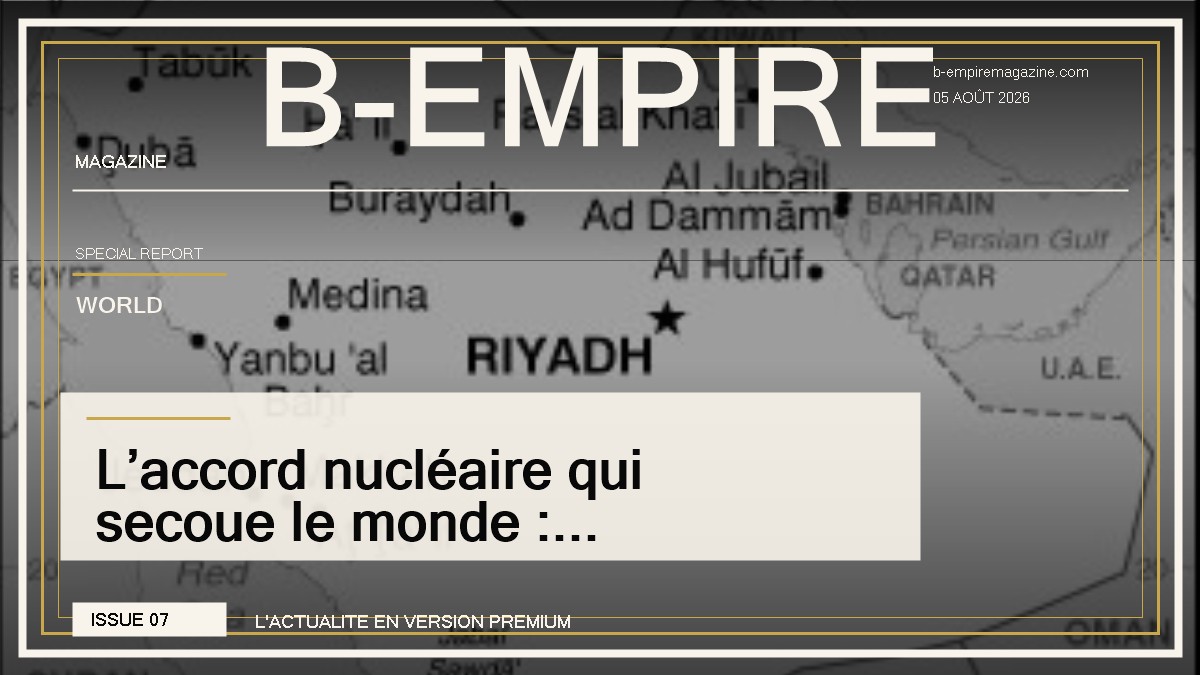
A nuclear agreement between the United States and Saudi Arabia has just shifted one of the most sensitive lines of global power. Signed in Washington by U.S. Secretary of Energy Chris Wright and his Saudi counterpart, Prince Abdulaziz bin Salman, the text paves the way for extensive civil cooperation: reactors, American technologies, and potentially, uranium enrichment on Saudi soil. Presented as historic by both governments, it is already provoking a battle over security, billions in investments, and the future of the Middle East.
Caution remains essential. The so-called â123 agreement,â named after the section of U.S. law that governs nuclear transfers abroad, is not yet an immediate green light for the construction of an enrichment facility. It must be reviewed by the U.S. Congress. Moreover, President Donald Trump later stated that its implementation would depend on the normalization of relations between Riyadh and Israel as part of the Abraham Accords. In just a few hours, an energy signature has thus become a major diplomatic lever.
Why This Nuclear Agreement Could Change Everything
Saudi Arabia aims to transform an economy still heavily dependent on oil. Its Vision 2030 program seeks to develop new industries, attract capital, and produce more electricity without burning as many hydrocarbons. Civil nuclear power can provide stable, large-scale energy, support urban growth, power water desalination, and free up more oil or gas for export.
For Washington, the stakes are both commercial and strategic. American companies, including Westinghouse, are looking to position themselves in a decades-long market against Russian, Chinese, South Korean, and French competitors. The first to build reactors does not just sell equipment: it establishes a lasting relationship involving fuel, maintenance, training, standards, and technological oversight.
Thus, the agreement could redirect the energy architecture of the Gulf. It would offer the United States a central role in Saudi Arabia’s future program while providing Riyadh with sought-after technology and new negotiating power. It is precisely this combination that makes the file explosive.
Uranium Enrichment: The Word That Worries
Enrichment increases the proportion of uranium-235 in the fuel. At low levels, this process serves to power civil plants. At much higher levels, the same technological chain can contribute to producing the material for a nuclear weapon. The issue is not to automatically confuse civil programs with bombs, but to recognize that certain infrastructures are termed âdual-use.â
According to the Associated Press and Reuters, the signed framework could allow for enrichment capacity in Saudi Arabia after a joint study. Not all details have been made public. The U.S. administration claims that a separate bilateral agreement contains security and non-proliferation guarantees. However, specialists and arms control organizations believe that the arrangement would not incorporate all the strictest requirements advocated by Washington in other negotiations.
The comparison with the United Arab Emirates is inevitable. In their nuclear agreement with the United States, the UAE renounced enriching uranium and reprocessing spent fuel, a model often referred to as the âgold standard.â Granting more latitude to Riyadh would create a precedent observed by all countries negotiating with Washington in the future.
Trump Places Israel at the Heart of the Market
Donald Trump’s statement added a political condition that was not clearly evident in the initial presentation. The U.S. president linked the future of the agreement to Saudi Arabia’s entry into the Abraham Accords, meaning the establishment of diplomatic relations with Israel. This requirement transforms civil nuclear power into a bargaining chip in one of the region’s most challenging issues.
Riyadh has so far conditioned normalization with Israel on credible advances toward a Palestinian state. The regional war, tensions surrounding Gaza, and the confrontation with Iran further complicate this calculation. It is therefore too early to assert that the agreement will come into effect in the announced form. The signature exists, but its implementation depends on still-open political, legal, and diplomatic decisions.
The U.S. Congress Now Holds a Key
A 123 agreement must be submitted to Congress, which has a monitoring role mandated by U.S. law. Lawmakers will be able to examine the guarantees, the conditions for technology transfer, and the risks of proliferation. The debate promises to transcend usual divides: some lawmakers will advocate for American jobs and the necessity of not ceding the market to China or Russia; others will call for more intrusive inspections and explicit limits on enrichment.
This step is crucial, as official statements remain general. The U.S. Department of Energy assures that the partnership adheres to high standards of safety and non-proliferation. Critics want to verify what these guarantees actually permit, who will oversee the facilities, and how nuclear materials will be accounted for. Until the complete text and its annexes are reviewed, any definitive conclusion would be premature.
A Global Competition Behind the Reactors
The race for civil nuclear power has once again become a central aspect of great power rivalry. Russia maintains a global presence through Rosatom. China is rapidly developing its own models and often offers integrated financing. South Korea has made its mark with the Barakah plant in the UAE. The United States seeks to rebuild an industrial influence that has long been weakened.
France is necessarily watching this file. EDF and Framatome possess recognized expertise in large reactors, fuel, components, and services. Even if the agreement favors American cooperation, the scale of a Saudi program could generate partnerships or increased competition for the entire European sector. Paris must also reconcile its economic interests, its strategic dialogue with Riyadh, and its commitment to non-proliferation.
A Signal the Middle East Cannot Ignore
The agreement comes in a regional environment marked by the Iranian nuclear program and deep mistrust among powers. Saudi leaders have previously indicated that they would not remain passive if Iran obtained a nuclear weapon. This position does not prove a decision to militarize the Saudi program, but it explains why every clause on enrichment and inspections is scrutinized.
Proponents of the partnership argue that American technology, framed by a thirty-year agreement and close cooperation, offers more visibility than a program developed with a less demanding supplier. Opponents respond that lowering conditions may encourage other states to demand the same rights. Both arguments show that the choice extends far beyond mere electricity production.
What Is Confirmed, and What Remains Uncertain
What is confirmed is significant: the American and Saudi ministers have signed a peaceful nuclear cooperation agreement and a bilateral guarantee framework; Washington wants to submit the text to Congress; the two countries are considering sustainable industrial collaboration. What is not yet confirmed is equally important: no American plant is automatically authorized by this single signature, no enrichment facility is announced as immediately operational, and the condition set by Donald Trump regarding Israel could block or renegotiate the entire deal.
The next sequence will therefore be decisive. It will determine whether this announcement becomes a true energy pivot or remains an agreement suspended by diplomacy. It will also reveal how far Washington is willing to go to keep Riyadh within its technological orbit, and how far Saudi Arabia wants to use its nuclear program to accelerate its transformation and strengthen its autonomy.
A Decision That Will Weigh for Decades
Nuclear power imposes a long timeline. A reactor, a fuel chain, and the associated skills engage multiple generations. Behind the headlines about Trump, Israel, or uranium, a strategic relationship spanning several decades is thus taking shape. The choices made today will determine suppliers, control standards, alliances, and the energy balance of the Gulf.
The world is watching this agreement because it encapsulates the great tensions of the time: energy transition, Sino-American competition, nuclear security, Israeli-Arab diplomacy, and the ambitions of a transforming Saudi power. Its future is not yet written. But the door opened to Washington can no longer be ignored.
Sources
- U.S. Department of Energy â official statement on the signing, July 22, 2026.
- Saudi Press Agency â official Saudi announcement of the agreement, July 23, 2026.
- Associated Press â content of the agreement, enrichment, and expert reactions, July 22, 2026.
- Reuters â industrial scope and contested guarantees, July 22, 2026.
- Reuters â condition set by Donald Trump regarding the Abraham Accords, July 24, 2026.